



























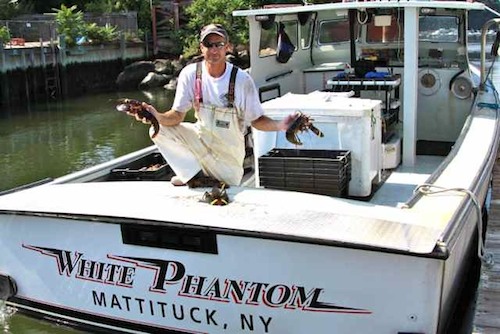
The lone lobsterman still working out of Mattituck Inlet says the lobster population in the Long Island Sound is so depleted, he may quit lobstering this year like everyone else.
Matt DeMaula of Flanders, a third-generation lobsterman, told RiverheadLOCAL this week he’s seriously considering pulling up his gear for good. What he’s landing each day isn’t worth the time, effort and expense, he said.
“Something happened last year,” DeMaula said. “We had a good spring, but then all of a sudden, in late August, things collapsed,” DeMaula said. “It was like someone flipped a switch.”
“I can’t say for certain there was another die-off,” DeMaula said, referring to the devastating massive die-off in September 1999, but it sure seems like there was,” DeMaula said.
Late last summer, lobsters of legal harvesting size started coming up dead or extremely weak in the fishermen’s traps, just like in ’99, according to Roger Frate, president of West End Long Island Sound Lobsters Association.
This year, lobster traps that used to bring in hundreds of lobsters are now bringing in 30 — on a good day, DeMaula said.
“I’m fishing hard but we’re still not putting the numbers on board,” DeMaula said. Most of what he’s hauling is “small stuff, about the size of the palm of your hand,” he said. “The same thing happened in the ’99 die-off.”
DeMaula — and other lobstermen who spoke at the March meeting of the American Lobster Management Board — suspect continued pesticide use by New York governments in the effort to control mosquitoes and fight West Nile Virus.
“The pesticides stressed the larger animals,” DeMaula said. “It seemed like the small ones were not affected.”
More than 100 lobstermen brought a federal class action lawsuit against pesticide manufacturers after the 1999 die-off. The suit was settled in 2004 with a multi-million dollar payment and no admission of culpability by the pesticide manufacturers.
Since the die-off, scientists researching its cause have blamed sustained elevated water temperatures and low dissolved-oxygen levels, but refused to rule out pesticides as a cause or contributing factor.
 Regulators believe the path to restoring the lobster population in the Southern New England Lobster Fishery is “reducing exploitation” — limiting what lobstermen can take from the waters — either by restricting the season or increasing the minimum legal harvesting size. Or, as proposed by the American Lobster Management Board’s Technical Committee last year, by imposing an all-out ban on lobster fishing for a period of five years.
“We fought the proposed moratorium tooth and nail,” DeMaula said.
Lobstermen rallied to oppose the moratorium, which, they said, would put the remaining lobstermen working the Long Island Sound out of business for good.
More than a year has passed since the technical committee’s proposal was first aired. The American Lobster Management Board at a meeting in Alexandria, Va. last Monday, voted to publish for public comment a draft addendum to the fishery management plan that contains three options: maintain the regulatory status quo, adopt the Technical Committee’s five-year moratorium, or reduce exploitation by 10 percent.
If the management board chooses the third option, each of the three “lobster conservation management areas” in the fishery would be free to determine how to achieve the 10 percent reduction, Atlantic Marine Fisheries Commission senior policy coordinator Toni Kerns told RiverheadLOCAL last week.
The public comment period on the draft addendum will close Oct. 14, Kerns said.
DeMaula shrugged off the regulators’ efforts as wrong-headed and irrelevant — or worse. “The technical committee is an absolute joke,” he said. He and other lobstermen blasted the committee’s April 2010 report as based on bad data, primarily because the scientists who conducted the data-gathering survey didn’t know what they were doing, they said.
“When you drop a pot in 30 feet of water on a hard bottom, it will be filled with spider crabs in two hours. You’ll never get any lobsters,” Riverhead commercial fisherman Phil Karlin told RiverheadLOCAL last July.
Karlin, who was having a good season at the time of RiverheadLOCAL’s story and video report in July 2010, said this week he’s pulled in his lobster pots for the foreseeable future, maybe forever.
“Right now there’s a problem here in the Sound. I don’t know what it is, but it’s real,” said Karlin, 70, who has earned a living as a commercial fisherman most of his adult life.
The problem is not overfishing, said DeMaula. Regulators are quick to impose fishing restrictions, he said, but don’t address the real causes. If reducing exploitation were the key to replenishing the fishery, it would be replenished already.
“Considering there’s maybe a couple thousand traps out there now,” DeMaula said. “There were maybe half a million in ’99,” he said. “I would say exploitation has been reduced already, probably something like 98 percent.”
DeMaula blames pesticides for the “recruitment failure” cited by the technical committee. “They spray when the waters are warmest, when the animals are already stressed. It’s the straw that breaks the animal’s back.”
Also to blame, he says, are regulations that have limited fishing for — and therefore increased the population of — the lobster’s natural predators, such as flounder and cod.
“This will be a telling year for me,” DeMaula, 44, said Monday. While most fishermen, like Karlin, are targeting other fisheries, like conch, to stay afloat, DeMaula says if he can’t lobster, he doesn’t think he’ll stay in the industry.
“Every time you turn around, it gets harder and harder to make a living as a fisherman. Ten years from now there will be no commercial dockage,” DeMaula said. “Everyone’s going to be eating tilapia and Chilean sea bass,” he said, referring to the farm-raised fish competing with the catch from local waters.
“The long and short of it…it’s a dying industry,” DeMaula said. The men involved in it are collateral damage. But they’re not just shutting down a resource,” he says of regulators, “they’re destroying a way of life and a community.”

The survival of local journalism depends on your support.
We are a small family-owned operation. You rely on us to stay informed, and we depend on you to make our work possible. Just a few dollars can help us continue to bring this important service to our community.
Support RiverheadLOCAL today.
