




























This spring, Riverhead Middle School eighth-graders will learn about the Holocaust in their social studies classes.
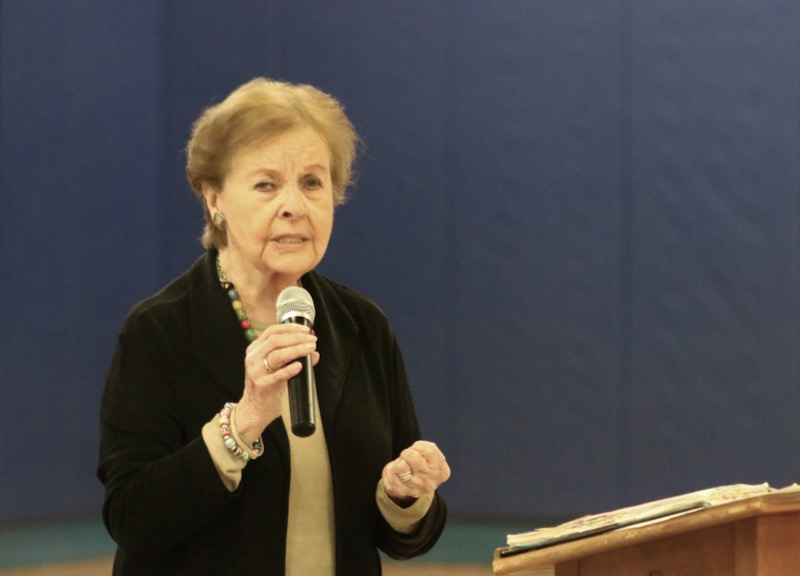
But on Thursday, those students got a first-hand account of that history from the lips of one who lived it: Holocaust survivor Marion Blumenthal Lazan, who visited the middle school to give her personal account of her life as a child in 1930s Germany, the events that led to her imprisonment with her family in the Nazi concentration camp Bergen-Belsen, her life at Bergen-Belsen, where “death was an everyday occurrence,” and the future she built after being liberated by Allied troops at the end of World War II.
“Mine is a story that Anne Frank might have told if she had survived,” Blumenthal Lazan said, referring to the German-born Jewish girl whose famous diary documented her life in hiding under Nazi persecution — and who, unlike Blumenthal Lazan, died at Bergen-Belsen.
“This is also a story that conveys a message of perseverance, determination, faith and above all, hope,” the 89-year-old survivor told the roughly 400 Riverhead Middle School students assembled in the school gym.
Life in 1930s Germany for her was just like the present day, she said. Her father owned a successful shoe business in her small town and the family lived comfortably — until 1935, when the Nazi regime, led by Adolf Hitler, segregated Jews from public spaces and businesses, and imposed curfews on them.
“Jews were only allowed to shop during specific hours of the day and non-Jews were not allowed to shop in Jewish-owned stores,” Blumenthal Lazan said. “And non-Jews were just not allowed to associate with Jewish people. And then, the big letter J for Jew was stamped on ID cards and on passports.”
Nazi repression of Jews led her parents to pursue emigration to the United States.
But then came Nov. 9, 1938. Kristallnacht, or the Night of Broken Glass, brought a wave of violence to Jewish owned businesses and synagogues in Germany, committed by both Nazi paramilitary groups and ordinary citizens alike. Blumenthal Lazan was just four years old at the time.
“Worst of all was that they forcibly sent my father to concentration camps in Germany,” she recalled. “All sorts of terrible stories were relayed to my mother, and we did not know if we would ever see my father again. He was released after three weeks only because our papers were in order for our immigration to America. And to think that just a few years prior, he had been awarded the Iron Cross for his military service in the German army…”
Her family sold their home and business “for a fraction of its worth” and moved to Holland in January 1939 to escape persecution and wait for their chance to move to the U.S.. During this time, her parents took care of some 125 children who were sent by their parents from Germany to escape from the Nazis, and they were housed in a detention camp retrofitted to hold refugees.
But the Blumenthal family’s chance to escape to the U.S. was lost. “In May of 1940, just before our plane departed, the Germans invaded Holland, and we were trapped,” Blumenthal Lazan said. Her family was kept in the Westerbork transit camp, when she was introduced to the “ever present, terrifying 12-foot high barbed wire.”
Transportation of prisoners from their camp to concentration camps in Eastern Europe began in 1942 and gave her “incredible anxiety,” she said. The area became known as Boulevard des Misères (“boulevard of miseries”).
In January 1944, it was the Blumenthals’ turn to be shipped from Westerbork to concentration camps. “We children were actually glad for a change in environment. We were very naive,” she said.
“I remember that it was a bitter-cold, pitch black, rainy night when we arrived at our destination: concentration camp Bergen-Belsen in Germany,” Blumenthal Lazan said. “We were pulled and dragged out of the cattle cars, and greeted by the German guards who were shouting at us and threatening us with their weapons, and with the most vicious attack dogs by their sides.” She was nine years old.
The men and women were divided, separating Marion and her mother Ruth from her father Walter and brother, Albert. Blumenthal Lazan said she had the hope that she and her mother could be exchanged with Germans in British-controlled Palestine, freeing them from the camp. “Unfortunately, that hope never materialized for our family.”
Blumenthal Lazan told the students about the living conditions in the camp. Six-hundred women and girls were cramped in the heatless barracks. In the barracks were triple-decker bunk beds, with two people to one single bed.
She described some of the horrors she saw at Bergen-Belsen, including initially mistaking a bag of naked bodies with what she initially thought was firewood.
There was no privacy to go to the bathroom and no toilet paper, she said. There was hardly any water to drink and she was never able to brush her teeth. There were no trees or flowers or grass. Whenever it rained, they needed to work through the mud, she said.
There was no protective clothing and frostbite was common, Blumenthal Lazan said, and people in the camp treated their frostbite “with the warmth of their own urine.” Little food was given to them to eat.
“Once a month, we were marched in an area to shower and there, under the watchful eyes of the guards, we were ordered to undress,” Blumenthal Lazan said.
“We had heard about exterminations and gas chambers in other areas of Europe, and we therefore were never sure when the faucets would come on as to what would come out: water or gas,” she recalled.
“The Nazis did their utmost to break us physically, spiritually and emotionally. Unfortunately, they did succeed with many of our people,” she said.
“It was not uncommon for people who were no longer responsible for their actions to attempt to escape, even though they knew that the chance to succeed was next to impossible,” she said. “But they also felt that they had nothing more to lose.”
Malnutrition and infections like dysentery ravaged the camp, and prisoners’ bodies and clothes were infested with lice, she said. Crushing lice between her fingers became Blumenthal Lazan’s “primary pastime.”
She invented games to keep herself occupied, she said. One such game would become the title of her 1996 memoir, “Four Perfect Pebbles.”
“I decided that if I were to find four pebbles of about the same size and shape, that would mean that the four members of my family would all survive,” she said.
“It was a torturous, painful, very difficult game to play,” she said. “What if I couldn’t find a third or fourth pebble? Would that mean that one or two of my family members would not get through? Nevertheless, this game gave me something to hold on to, some distant hope,” she said.
“Did I ever find my fourth pebble? That is a frequently asked question,” Blumenthal Lazan said. “I always find my fourth pebble. I made it my business to find them. I cheated all the time. When I found them, I put them in the same place. So the next time I would search for them and I couldn’t find that third or that fourth one, I knew exactly where to go.”
In the spring of 1945, as the Allied forces closed in on Germany to bring an end to the war, the Nazis began ramping up the murders of prisoners in the concentration camps. They starters shipping prisoners from Bergen-Belsen to Auschwitz-Birkenau, the largest of the Nazi “extermination centers,” where more than 1.1 million people were killed.
The Blumenthal family was on the last of the trains to Auschwitz-Birkenau. The family had no water, no toilets, no medical supplies and no food on their journey to the place where certain death awaited.
But signs of hope for the prisoners came when Blumenthal Lazan noticed German soldiers on the train trying to get civilian clothing in an attempt to blend in and avoid becoming prisoners themselves. “And we knew then that the war was coming to an end,” she said.
The Russian army liberated the Blumenthals’ train, she said, and took her family to eastern Germany.
At that time, she was 10-and-a-half years old and weighed only 35 pounds. Her leg had been badly infected during her imprisonment, but it gradually healed with medicine. Her head was shaved to eliminate the lice infestation she suffered with.
Although the Blumenthals were free, an outbreak of typhus would take their patriarch’s life. Her brother Albert, then 12, buried their father.
“When I talk about those years, it is as though I’m relaying a nightmare, a very bad dream,” Blumenthal Lazan told the middle school students. “I separate myself from ever having happened to me and that is how I deal with it.”
But, she said, how her family recuperated after the Holocaust is a “wonderful story.” The Blumenthals were sent to Holland. She and her brother were placed in a children’s home and she was sent to school — the first formal education of her life. She said she felt like a “misfit.”
“It was like learning to live all over again.”
Marion and Albert were being prepared to be sent to part of the British territory in the region of Palestine — territory that would in 1948 become the Jewish state of Israel. But the children and their mother were able to instead emigrate to Hoboken, New Jersey, because their father had secured tickets to the U.S. before the family was seized in Holland and sent to the transit camp. They arrived in the U.S. on April 23, 1948, exactly three years after their train to Auschwitz-Birkenau was liberated, she said.
With the help of the Hebrew Immigrant Aid Society, the Blumentals were relocated to Peoria, Illinois. There, Blumenthal Lazan began to learn English: her third new language since her liberation. Although she was 13, she was placed in courses with nine-year-old students, she said. She worked to help support her family and made time to take extra classes, graduating at age 18 from high school.
She was married shortly after graduation to Nathaniel Lazan, a U.S. Air Force pilot and Long Island native. They have been married for more than 70 years, have three children, nine grandchildren and 12 great-grandchildren, she said. They live in Hewlett in Nassau County. Nathaniel, who accompanies his wife to her talks, was in the audience at the middle school Thursday and received a warm round of applause from the students.
Blumenthal Lazan said she would eventually return to Germany on several occasions. She would speak of her experience during the Holocaust at German schools, universities and churches — a very difficult topic for Germans to hear, she said. She also returned in 2010 to celebrate the naming of a public high school in her honor in the town of Hoya.
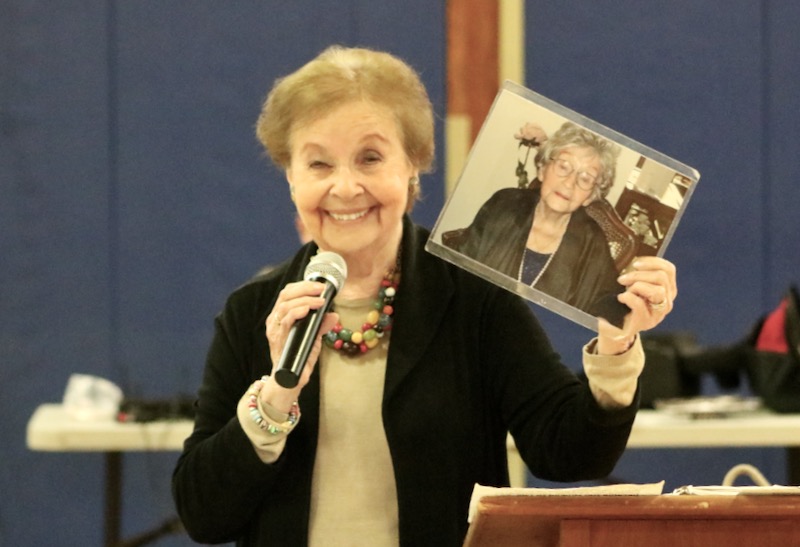
She showed students the yellow star imprinted in the center with the word “Jude” — the German word for Jew — that she was forced to wear while in the concentration camp.
“This represents the Star of David — a beautiful, meaningful Jewish symbol. But the Nazis made it so very ugly,” she said. The patch, known as the Jewish Badge, was sewn onto inmates’ clothing and used by the Nazis to identify Jews. Jews were also required to wear the patch in Nazi-occupied Europe outside of the camps. Inmates as a part of other groups in Nazi concentration camps were identified with similar cloth patches.
The Holocaust ultimately led to the death of approximately 6 million Jewish people — roughly twice the population of Long Island, Blumenthal Lazan noted. The Nazis also murdered more than 5.5 million non-Jews — including Russian prisoners of war, non-Jewish Poles and members of other persecuted groups and minorities across Europe. Documentation of the deaths has been compiled by the U.S. Holocaust Memorial Museum.
“Each of us — each and every one of us — must do everything in our power to prevent such hatred, such destruction and such terror from reoccurring,” Blumenthal Lazan told the students.
“And we can begin by having love, respect, tolerance and compassion towards one another regardless of religious belief, regardless of the color of our skin, regardless of the national origin.”
“This respect towards one another must begin in our homes. At our kitchen table, at our dining room table — wherever we gather with our families,” she said. “You the students must pass it on in your classrooms, in the halls of your schools, communities, towns [and] cities. And only if there is respect and compassion towards one another in the world can we have peace. Period.”
Blumenthal Lazan’s talk at the middle school was prompted by events locally and internationally. Swastikas — the Nazi symbol that has become synonymous with the Holocaust and antisemitism, and is used to harass Jewish people and other minority groups — were found drawn in Riverhead schools in several reported incidents last year, including one at the high school in September and two at the middle school in November.
The appearance of swastikas is a painful reminder of antisemitism in the U.S., including in the local community.
MORE COVERAGE: Recent appearances of swastikas evoke painful memory for Riverhead man
Riverhead’s interim superintendent announced Blumenthal Lazan would speak shortly after the second incident at the middle school.
At the conclusion of Blumenthal Lazan’s talk, several students asked questions and even more lingered to meet her and take pictures.
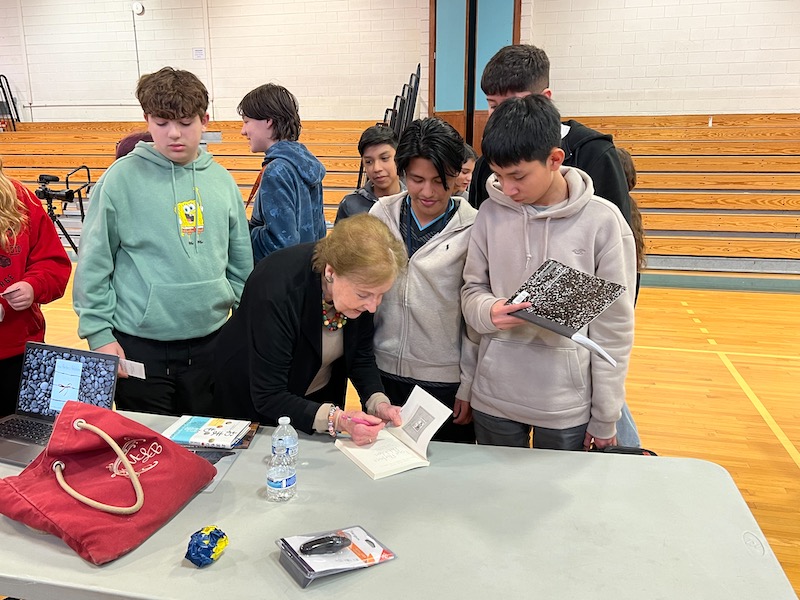
“Having a basis to actually hear from someone who experienced it before learning all the specific details is going to help them so much,” said Riverhead Board of Education President Colin Palmer, who attended the presentation. “I think they’re going to absorb so much more from their classrooms because they’ve actually heard a survivor speak.”
Interim School Superintendent Cheryl Pedisich said she thinks Blumenthal Lazan’s messages of hope and respect resonated with the students in attendance.
“These messages are the lessons learned from that dark period of our history and certainly apply to today’s world situations and definitely to our own individual lives,” Blumenthal Lazan said. “By listening, I hope that you prevent our past from becoming your future.”
The survival of local journalism depends on your support.
We are a small family-owned operation. You rely on us to stay informed, and we depend on you to make our work possible. Just a few dollars can help us continue to bring this important service to our community.
Support RiverheadLOCAL today.
