




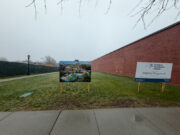
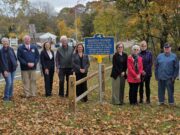
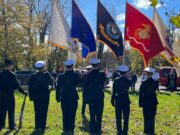



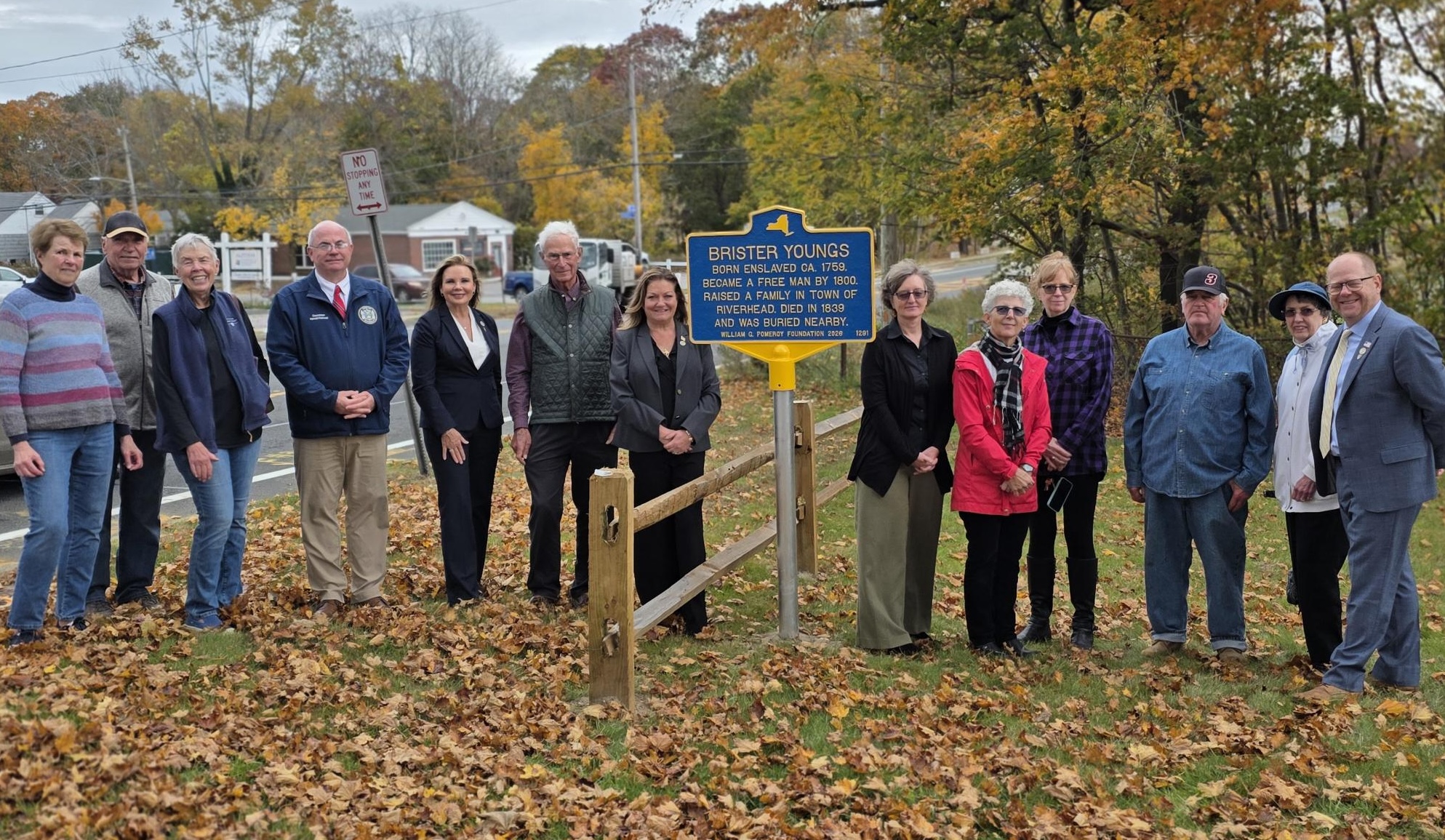
A historic marker honoring Brister Youngs, a man born into slavery in the 18th century who later lived as a free man in Aquebogue, was dedicated Thursday at Aquebogue Cemetery.
The Riverhead Town Board, the Riverhead Landmarks Preservation Commission, Town Historian Georgette Case, and representatives of Old Steeple Church dedicated the marker at a noon ceremony at the Main Road cemetery, where Youngs was buried after his death in 1839.
Youngs, who was born around 1759, was among an estimated 900 people enslaved on the North Fork between 1640 and 1827, when slavery was abolished in New York.
Research by local historians has helped piece together details of Youngs’ life from census records, store ledgers and other surviving documents.
Youngs appeared in the 1790 census as one of two people enslaved by Daniel Youngs, a farmer and longtime minister of the Aquebogue church that once stood on the property where Old Steeple Community Church stands today.
By 1800, census records show Brister Youngs had gained his freedom and established his own household in Aquebogue.
He was married to a woman named Zipporah, who died in 1805. Records from local stores show Youngs buying tobacco, cider, molasses and other goods and selling flax. Other records indicate he worked mowing hay and purchased building materials, possibly for a home.
Youngs also participated in a local fishing company at a time when such companies were otherwise composed of white farmers. Farmers caught menhaden, which were used as fertilizer on their fields.
A surviving diary entry also records Youngs’ reputation for cooking fish chowder. When members of the fishing company caught sheepshead, they contributed ingredients and Youngs prepared the chowder, which was remembered as a special treat.
Youngs died in 1839 at about age 80.

His gravestone survives in the eastern section of Aquebogue Cemetery. His wife is believed to be buried in an unmarked grave nearby. Youngs is also buried beside Thomas Austin, a man who escaped slavery in North Carolina.
Youngs’ grave is one of only a few known graves of formerly enslaved people in Riverhead Town.
The marker is one of two proposed last year by local historians seeking to bring greater attention to the largely overlooked history of slavery in Riverhead and across the North Fork.
The other proposed marker would recognize Sarah Robins, a Native American woman born into slavery around 1689 or 1690 who was enslaved by early Riverhead settler James Parshall. She was sold several times and eventually transported to Madeira, where she challenged her enslavement and later returned to New York to petition for her freedom.
Jamesport historian Richard Wines, a researcher with the North Fork Project, told RiverheadLOCAL last year that the markers were intended to provide visible reminders of a part of local history that has largely disappeared from public view.
The Aquebogue Cemetery, on Main Road opposite West Lane, opened in the 1750s and is the second-oldest cemetery in Riverhead Town.
The Brister Youngs marker was funded by a grant from the William G. Pomeroy Foundation, a Syracuse-based private foundation that supports historical markers across the United States. The foundation says it has funded more than 3,300 markers and bronze plaques in 49 states and Washington, D.C.
The survival of local journalism depends on your support.
We are a small family-owned operation. You rely on us to stay informed, and we depend on you to make our work possible. Just a few dollars can help us continue to bring this important service to our community.
Support RiverheadLOCAL today.
