

























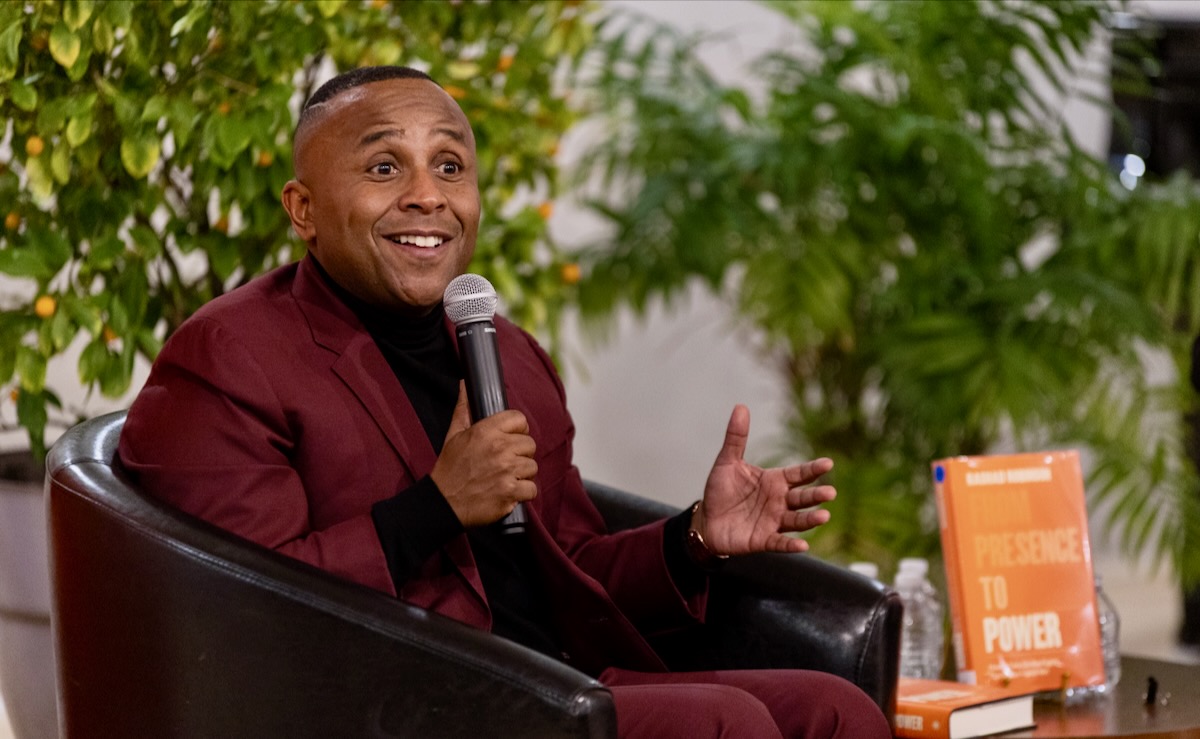
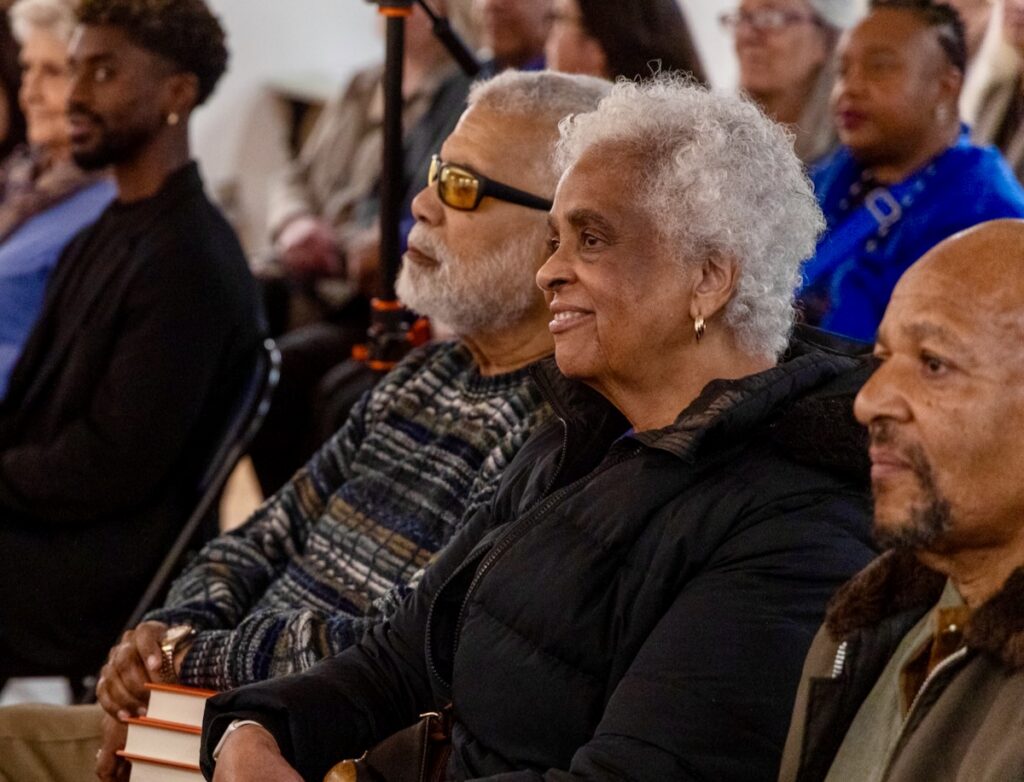
As a child, Rashad Robinson’s parents dropped him off at the Yellow Barn for summer programs at the Riverhead Free Library. On Thursday evening, he returned to the library as an author and nationally known racial justice organizer, looking out at a room that included his parents, his 94-year-old grandmother, former teachers and people who had helped him find his voice.
The homecoming was “surreal and emotional,” he said.
Robinson had come home to discuss what he had learned about turning public participation into lasting change. By the evening’s end, he was asking the people who had supported him to help another generation find its way into public life.
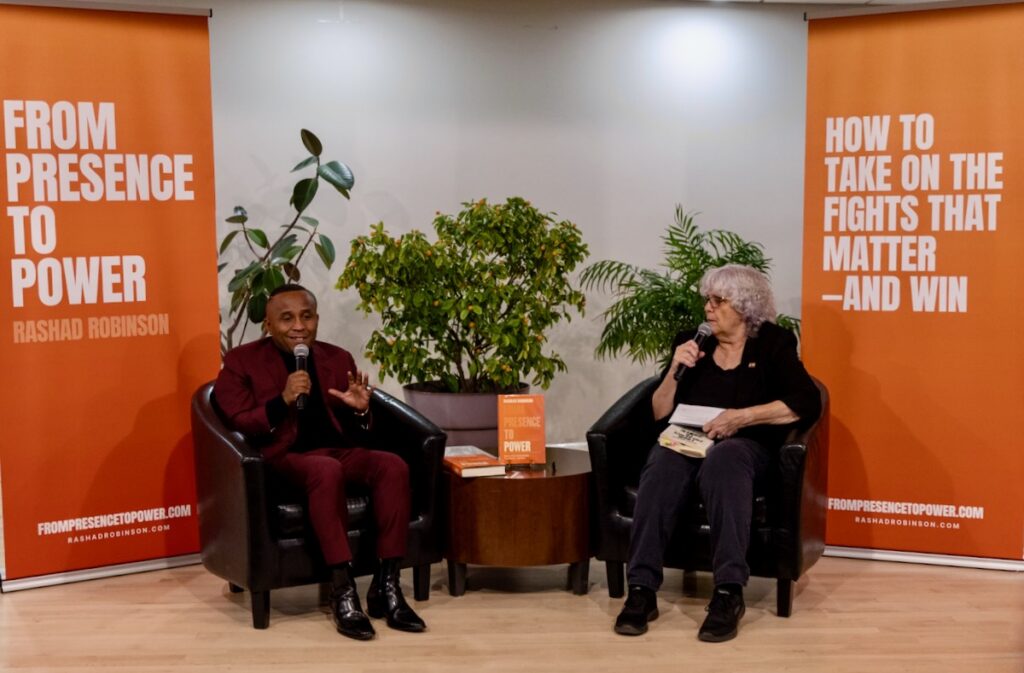
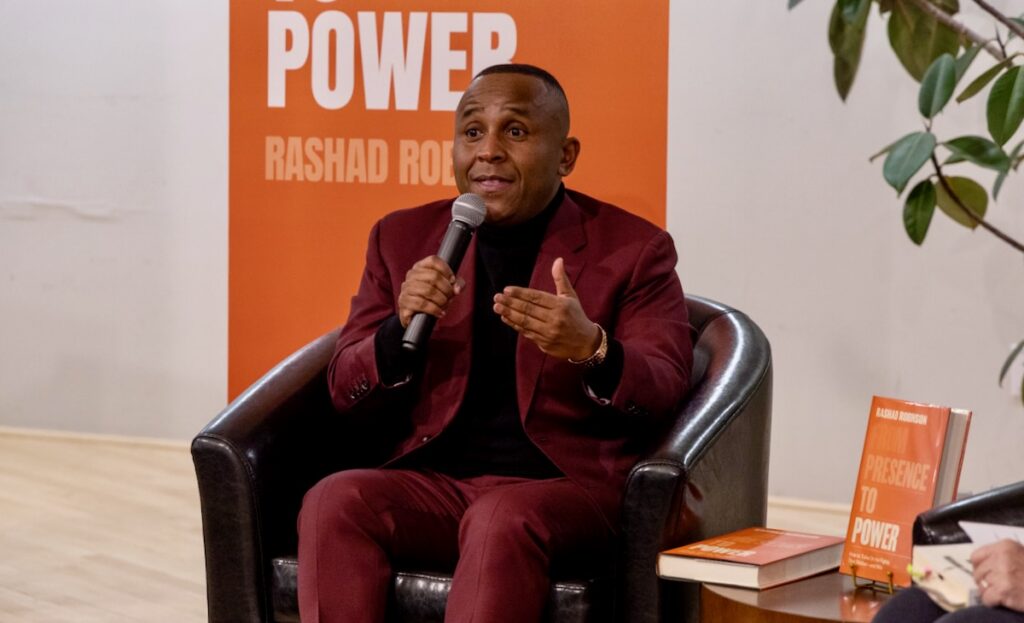
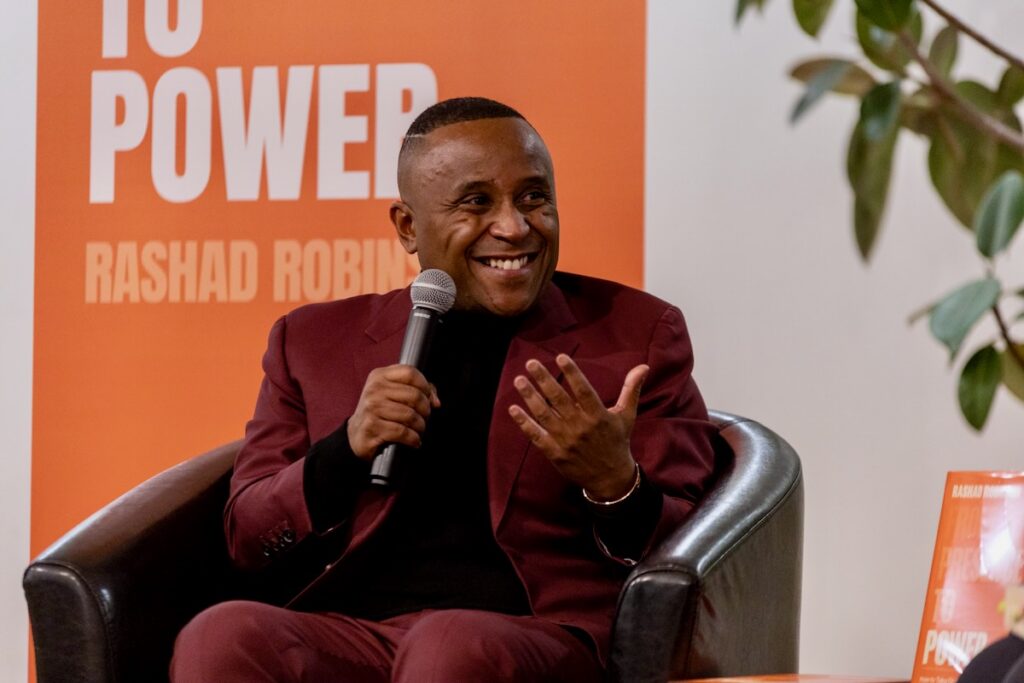
The Riverhead native and former president of Color of Change discussed his book, “From Presence to Power: How to Take On the Fights That Matter and Win,” during a public conversation at the library Nov. 19. I conducted the interview, which was followed by questions from the audience.
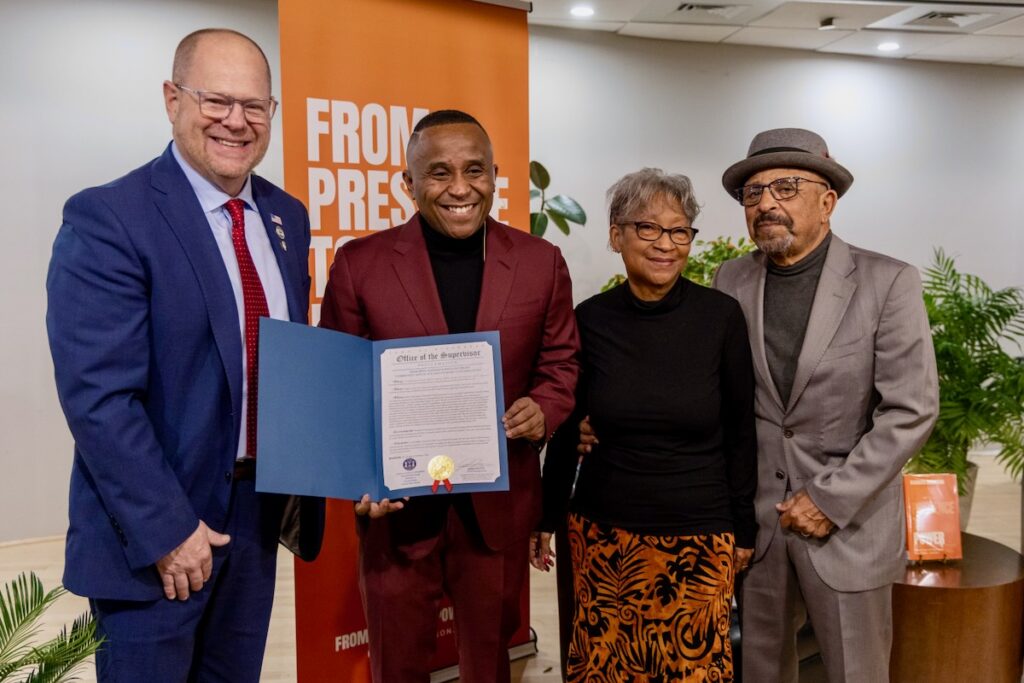
Library Board of Trustees President Mary McDonnell welcomed the crowd, noting that additional chairs had been needed to accommodate the overflow crowd. Town Supervisor Jerry Halpin presented Robinson, a 1997 Riverhead High School graduate, with a proclamation.
Changing the headlines versus changing the rules
Robinson’s discussion returned repeatedly to the distinction at the center of his book: attracting attention and gaining access can help a movement, but neither necessarily gives people the ability to change the decisions that affect their lives.
“Presence is changing headlines. Power is changing rules,” he said.
Confusing the two, he argued, can leave people believing they have won something substantial while the conditions they set out to change remain intact.
The difference between ‘unfortunate’ and ‘unjust’
He illustrated another distinction by reading from the book’s chapter on perception: whether people understand a harmful condition as unfortunate or unjust shapes what they are willing to do about it.
Supplying bottled water to a community with contaminated drinking water provides immediate help. Replacing lead pipes and compensating people for the injuries they suffered addresses the injustice, he explained.
Charity has value, he said. But treating it as the only answer can leave the people and institutions responsible for the harm free to perpetuate it.
Elections, too, create opportunities that require people to keep organizing, he said. Winning office does not itself deliver the changes voters sought.
Robinson recalled a campaign during the Obama administration to remove questions about felony convictions from job applications. He had joined formerly incarcerated organizers to deliver petitions to the White House, he said, when an invitation arrived for a meeting.
Then, according to Robinson, he learned that the invitation was for him alone. The organizers whose experiences were at the center of the campaign would not be admitted because of their felony convictions.
He refused to attend without them.
Officials initially said the rules prevented their participation, he recalled. After he held firm, they found a way to admit the organizers, who met with presidential adviser Valerie Jarrett. Robinson said he returned to New York while they attended the meeting.
Within 10 days, he said, the campaign had secured a presidential directive. The directive ended the practice of federal agencies asking about an applicant’s criminal history at the initial application stage.
Make injustice unprofitable
His point was that advocates need to keep challenging institutions, including those led by political allies, rather than accept their explanations of what is possible.
The same thinking informs his approach to corporations. Agreement with a cause does not necessarily overcome the interests benefiting from the existing arrangement, he said. Those benefits can include money, status and hierarchy.
“You have to make injustice unprofitable,” he said.
Robinson described his confrontations with Facebook and his concerns about artificial intelligence, arguing that technology companies need government oversight and consequences for the harm their products can cause.
For audience member Cindy Clifford, a local civic and political activist, the discussion raised a practical question: Does signing a petition accomplish anything?
She described responding to petitions about issues she cares about, then wondering whether the act serves a purpose without someone able to carry those demands to a decision-maker.
Robinson said a petition’s value depends on the strategy behind it. Some, he cautioned, serve primarily to build mailing lists and solicit donations.
An effective campaign needs to identify who can deliver the desired change and what would give that person or institution a reason to act.
“The people who it’s focused on have no reason to listen. We have no leverage over them, and so we do have to think strategically about how we use our time and energy,” he said of campaigns lacking that foundation.
Resources, money and incentive structures
He offered similar advice when Ian Wilder of Riverhead asked how to advance a local proposal, put forth by OLA of Eastern Long Island, concerning police responses to immigration enforcement. “Some of the other towns have entered discussions. Our town, including our town supervisor, and we have a mixed board, has refused to hold a hearing or have any type of real discussion about this,” Wilder said. “What would you suggest as concrete steps in order to move that forward?”
Robinson emphasized that he did not know enough about the particular dispute to recommend a campaign. His starting point would be research.
“When someone is blocking something, I always look for where the money is, how it’s being funded, who is supporting it,” he saids. “After the resources and the money, I would look for the other incentive structures at play, and by tracking that, you can oftentimes determine who your target is,” he said. “Sometimes the target of your campaign is not the person you may think is your decision maker. It might be someone that your decision maker needs. It might be someone that is funding your decision maker.”
Robinson pointed to the work he did around the American Legislative Exchange Council, known as ALEC. That work wasn’t about going after ALEC, he said. “It was about going after ALEC’s funders.”
Color of Change, under Robinson’s leadership, ran a high-profile campaign pressuring major corporations to cut ties with and stop funding ALEC, a conservative group that drafts model state legislation. The model legislation reflected positions that Color of Change opposed in areas such as voting rights, gun regulation, criminal justice and corporate accountability. More than 100 companies, including Amazon, McDonald’s, Coca-Cola, Walmart, PepsiCo, and Best Buy, stopped funding ALEC as a result of that campaign, according to Color of Change.
Audience member John McAuliff of Riverhead brought the discussion home again, asking how Riverhead’s changing community could come together.
Robinson recalled organizing his first protest here, against Rite Aid’s restrictions on young people entering the store, while he was in high school.
He also remembered being the only Black student in his honors history class and debating politics with a teacher who encouraged him but, Robinson felt, held limited expectations about his future.
According to Robinson, the teacher suggested he become a doctor rather than a lawyer because Riverhead had no Black doctors and he would have a ready market. Robinson understood the remark as both a compliment and an assumption that he would remain in Riverhead and serve only Black patients.
Challenge assumptions about what’s possible
For Riverhead today, Robinson urged residents to challenge assumptions about what is possible and learn from communities that have approached similar problems differently.
“We disrupt the rules around how things have always worked,” he said.
Making schools and other institutions work better can benefit the whole community, he argued. Weakening one part of a community diminishes its overall ability to succeed.
“This is not a zero-sum game,” he said.
Reaching people where they are
Audience member André Daniels then asked how young people could be inspired to get involved and find purpose in their community.
Robinson said organizing means finding the places and circumstances in which people will participate.
“My goal is to go to as many different places in many different forms as people get information and wrestle with these ideas. And so I had spent a lot of time across the podcast universe, going on podcasts and engaging in those spaces because people show up to different things in different ways,” Robinson said.
“And so my invitation is, if there is some other way that you think I could be here, with a real audience and young people who are going to be there, this is my community and I’m and I’m down for that .” Robinson said.
“Let’s think of every single person as a potential protagonist in the story, and let’s find ways to make them the hero,” he said. “Let’s go to the places where they are and engage with them. Like if this library discussion on a Thursday night is not the space for the young folks of the community, I get that. And so let’s find the right space at the right time to actually make that possible.”
‘I am your son.’
He credited his parents with helping him attend protests and meetings, and recalled being a young person who went to school board meetings and hosted a public-access television show.
Looking out at the audience in the packed meeting room, Robinson said he recognized people who had helped make those experiences possible.
“There are so many people in this room who are part of my story,” he said.
There are young people in their lives now who want to get involved and make themselves heard, he said, and the people who had helped him could become part of those young people’s stories, too.
“Thank you, Riverhead. I am your son, and I am so honored that you all came out tonight to be part of this discussion and are supporting this effort,” Robinson said.
The survival of local journalism depends on your support.
We are a small family-owned operation. You rely on us to stay informed, and we depend on you to make our work possible. Just a few dollars can help us continue to bring this important service to our community.
Support RiverheadLOCAL today.
