






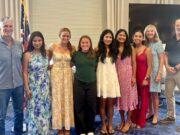






You may have heard from your teenagers about a seminar that my family and I presented at Riverhead High School this past spring. It was called Rx for Disaster – Get Smart About Prescription Painkillers and Over-the-Counter Drugs. (Video.)
It was by far one of the most difficult things I’ve done, not only in my career, but in my entire life. It was even more difficult for my sister-in-law Cathy and my husband Michael.
There was no texting. There was no chit-chat. There wasn’t a dry eye in the house. As we spoke to hundreds of 10th, 11th and 12th grade students, we saw them connect with our words. We watched them understand our message. We saw them look at our photos and understand our analogies. At least half a dozen students asked us for help that day.
We heard for weeks afterwards what a strong impact we had on those young lives. The conversation rocked the classrooms. No work was accomplished for weeks. Just talk. Just shared stories of common friends who chose the wrong path; stories of times they were offered pills, the times they tried it, the times they realized their parents or siblings were addicted.
My husband, sister-in-law and I wondered then and still do now, just how many of those teenagers opt not to use drugs because of what was discussed in that auditorium. We hope it was hundreds, but we are content in the fact that we gave them the information and will do so again every year that we are alive so that maybe a few more will choose not to try prescription narcotics.
So, exactly what did we say to them? We told them a story about my nephew Philip; a beautiful, tall, blonde surfer who died of a heroin overdose just four days before his 21st birthday; a baby whose addiction story began at age 12 with marijuana and quickly escalated to involve alcohol, cocaine and painkillers. Five stints in detox and rehab, countless counseling opportunities, family interventions; a doctor, an educator and three nurses in the family; none of which were even remotely helpful in preventing his death.
On his 21st birthday, Philip’s younger brother and my husband Michael spread his ashes in the ocean at Davis Park, the place he found refuge from his chaotic existence. I know it sounds ridiculous and you probably cannot fathom this but as the remains of his body slipped into the sea, his family felt a sense of relief. It’s hard to believe but Philip has finally escaped the grips of addiction – he has come to a peace he couldn’t find here on Earth.
Sometimes it seems like pills are everywhere and I don’t know whether it’s because I’m more aware of it or because it’s really that much of an epidemic. You’ve read many stories like this in the pages of Newsday. You’ve seen the photos of beautiful teenagers all across our area and the nation who are dying of heroin overdoses and probably think, “how do things seemingly normal kids end up on heroin?”
I’m going to give you the same analogy I gave those kids. Prescription narcotics, also called opiates – Vicodin, Percocet, Oxycontin, Roxicet, Dilaudid, Fentanyl – change your brain chemistry the very first time you take them. The human body contains endorphins, which are natural opiate painkillers. You also have millions of receptors (I called them cups) for those opiates. These chemicals are the body’s way of protecting itself against pain. When you ingest a painkiller, it fills those receptors or cups.
For example, let’s say you have a certain number of opiate receptors in your body. If it currently takes one Percocet to fill all those receptors; to feel pain relief and sedation, after time your brain will begin to make more receptors. So, you will continually need to increase the amount of medication you take in order to get the same pain relief, or the same high.
Not only do you become habituated, or used to the habit of taking the medication, but you also become physically dependent upon it. Those cups are used to being filled, and so when they are not, a vicious withdrawal syndrome ensues. Sweats and shaking chills, nausea, vomiting, abdominal pain, dizziness, lightheadedness, body aches and headaches are all part of the detox / withdrawal process. Many addicts have told me that they don’t want to continue to use, but they are so afraid of withdrawing that the fear alone drives their drug use.
For these kids, pills are expensive – sometimes $5-20 a pill. So when their body chemistry is demanding the use of hundreds of dollars worth of medication to fill their receptors, how do they afford it? They need to find something cheaper. What’s cheaper but causes the same effect? Yep, you guessed it…heroin.
It’s an inescapable and inevitable downward spiral – from the very first pill to the final overdose. And, get this… the kids aren’t the only ones affected. Guess where they get the pills? Yep, you guessed it…most of the time they find leftover pills in their parents medicine chests.
Pain is the most common presenting symptom in doctor’s offices. And many times, patients will leave the doctor’s or dentist’s office, or local emergency room with a prescription for narcotics. Yes, narcotics are great painkillers. But in my work, in my daily decisions, I weigh the risks of narcotic addiction agains the benefits of pain relief and the equation almost never adds up in favor of prescribing them. I almost always opt for something else, something non-addictive, and reserve narcotics for severe and refractory pain like that associated with cancer.
By now, you’re probably thinking that I’m being dramatic, that it can’t be that bad. But as a mother, as a physician, as the loving aunt of a nephew who battled addiction and lost, I’m telling you that it’s THAT bad. I see it in the office, in the hospital, in the schools, in my own family.
I encourage you to speak with your teenagers and watch the link to the video from the parent forum (which unfortunately was not well-attended). Ask them about my presentation. I’m sure they’ll be able to explain the pharmacology. Ask them about Mr. Hugelmeyer, one of their Assistant Principals; how he lost his surfing buddy, the nephew who made him an uncle; how desperately we tried to get him help; how hard it was calling the police on his own family; how devastated he was to get that call on Tuesday morning, June 8th, 2010.
Ask them about Philip; about how he looked like just another handsome and fun-loving teenager; about how he was raised in a middle-class neighborhood by two working professionals; how he was an unbelievable athlete with superhuman skill and the potential to go to college on scholarship; how he suffered with mental illness and probably self-medicated to feel normal; how he tried anything and everything that came before him; how he physically fought his dealers and his best friends; how he stole everything his family owned to support his addiction; how he died before he had the chance at college, a career or a family.
Ask them about the story his mother told – how she was the one who found him limp and blue, how she unsuccessfully gave him mouth-to-mouth, how she watched the coroner drive away with her oldest son in the back of his van. That’s a story they won’t soon forget. We could see them commiserating with her, with him, with us. We could see in their eyes that they don’t want to cause you that kind of pain.
One in six teens has abused prescription painkillers. Get educated. () Have the discussion, let them know that you are aware that this problem is out there and that you will help them make good decisions or that you will help them recover. Ask them if they have used or are using or know someone who is. Then go and empty your medicine chests so you can turn your prescription drugs in. The DEA hosts several drug take backs, as do local police departments and our own hospital Peconic Bay Medical Center. If your doctor offers a narcotic, ask if there’s something less addictive you can use instead. Be cautious with what you put in your body and what you leave in your home. If the medications need to be there, make sure they are secure and keep a running count of how many you have so you can monitor for stolen pills.
Finally, take a look at yourself and your family members, especially the elderly who may have been prescribed these medications and don’t even realize they’re addicted. If you or someone you know is dependent on narcotics, ask your doctor for help. It isn’t easy, but as long as you are alive, there is hope that you can recover. I beg of you, please don’t be the parent or the aunt who gives the presentation or writes the article warning about the dangers of narcotics long after it’s too late. Thank you.
Links:
http://www.drugfree.org/drug-guide/prescription-pain-relievers
http://www.theantidrug.com/pdfs/TEENS_AND_PRESCRIPTION_DRUGS.pdf

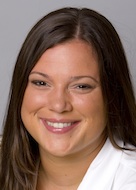
Alexis Hugelmeyer, D.O. is the wife of Michael, mother of Isabella, 5, and Lance, 2, and a family physician whose passion is hands-on manipulation for treatment and healing of any and every type of medical problem. She is administrative director of medical education and internship director at Peconic Bay Medical Center and also a private practitioner in Riverhead. A graduate of Villanova University and New York College of Osteopathic Medicine, she lives in Baiting Hollow.
Look for Dr. Mom every Saturday on Riverheadlocal.com
{loadposition tab20}
{loadposition tab1}
The survival of local journalism depends on your support.
We are a small family-owned operation. You rely on us to stay informed, and we depend on you to make our work possible. Just a few dollars can help us continue to bring this important service to our community.
Support RiverheadLOCAL today.
