























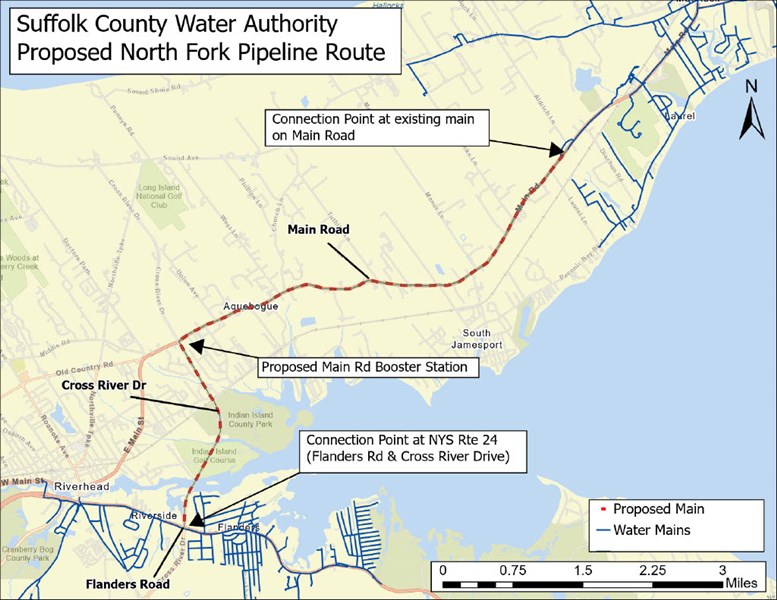
The Suffolk County Water Authority has accepted a final environmental impact statement for its proposed North Fork water main, moving the controversial project through Riverhead closer to completing environmental review while a legal dispute over local zoning authority remains unresolved in court.
The SCWA board accepted the document Oct. 29. The board could adopt a formal findings statement as early as its November meeting, completing the review required under the State Environmental Quality Review Act, according to an Oct. 30 announcement.
The project would carry water from SCWA’s existing supply system in Southampton through Riverhead to serve customers in Southold. No customer connections would be made within the Riverhead Water District service area.
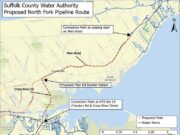
SCWA’s preferred route follows Cross River Drive from the Flanders Road area, passes beneath the Peconic River and turns east along Main Road toward Laurel. The approximately 7.2-mile, 24-inch transmission main would connect to existing SCWA infrastructure near Franklinville Road. A booster station would be built on authority-owned property near the southeast corner of Main Road and Cross River Drive.
The authority announced the shift from Sound Avenue to Main Road in July, following objections from Riverhead officials and residents about traffic, construction disruption and effects on farms and tourism. The revised route is about a mile shorter. SCWA projects completion in 2028, compared with 2030 under its earlier plan.
“This project is a requirement for the long-term sustainability of the North Fork,” SCWA Chairman Charlie Lefkowitz said in the Oct. 30 release.
SCWA operates 60 wells across 18 well fields on the North Fork, serving approximately 9,500 customers. The authority says rising demand and the vulnerability of the area’s shallow aquifer to contamination and saltwater intrusion require a supplemental supply.
Water delivered through the new main would come from existing permitted capacity in Southampton, according to SCWA. The authority says importing that water would reduce pressure on North Fork wells and help protect the local aquifer.
SCWA’s announcement says the Main Road route would lower costs. However, the FEIS says that route is expected to cost more because of nighttime construction and roadway-restoration requirements, while offering hydraulic, operational, safety and water-quality advantages.
Public comments and SCWA’s responses
The final statement responds to comments submitted during three August hearings and a written comment period that ended Sept. 25. Those comments included requests for stronger conservation measures, independent construction oversight, more detailed traffic and wetland analyses, and greater local government involvement.
Group for the East End favored the Main Road route over Sound Avenue but expressly withheld endorsement of the overall project. The environmental organization cited the shorter route and reduced disruption to Sound Avenue’s agricultural and historic corridor while identifying outstanding questions about oversight, conservation and future expansion.
Riverhead environmental consultant Jeffrey Seeman and Jamesport resident Barbara Blass challenged whether the environmental review adequately addressed the shift to Main Road, where construction would affect a different concentration of businesses, residences and community facilities.
SCWA defended its alternatives analysis, saying both routes had been evaluated sufficiently to compare their impacts. It said Main Road offered a shorter alignment, wider shoulders and hydraulic advantages, including avoiding the need for a second booster station.
Both Seeman and Blass also questioned the lack of detailed traffic data and the analysis of construction effects near Aquebogue Elementary School. SCWA said it would coordinate with state and county road authorities before construction to determine whether additional traffic counts or observations were necessary.
The authority committed to a school-specific traffic-management plan addressing bus routes and stops, arrival and dismissal, parent pickup and drop-off, pedestrian safety and access. It also described advance coordination with businesses over deliveries, events and access needs. Detailed schedules and traffic controls would be developed through final construction planning and roadway permits.
“Construction is scheduled to take twelve months once all the final permits are in place,” SCWA Director of Construction Maintenance Brendan Warner said in the Oct. 30 release. Warner said work would be staged to avoid traffic disruptions during peak summer and fall months.
The FEIS says the state Department of Transportation has not yet determined where open trenching would be permitted along the state-road route. The department generally requires trenchless installation within state rights-of-way unless it accepts a project-specific justification for open-cut construction.
In response to concerns about wetlands and existing utilities, SCWA described protective construction practices and said some field verification, utility locations and alignment adjustments would be addressed during final design and permitting. The authority also amended its soil tables in response to Seeman’s request to identify prime agricultural soils.
Group for the East End recommended an independent construction monitor, potentially funded jointly by SCWA and local governments, reporting to the authority, towns and permitting agencies. SCWA declined a separate third-party monitor and instead committed to appointing a construction manager and environmental compliance liaison to oversee mitigation measures, document deficiencies and track corrective action.
The authority substantially accepted the group’s recommendation for a construction-information website. It committed to providing updates on work locations, schedules, detours, access restrictions and progress, along with a way for the public to submit questions, complaints and reports of possible violations.
The group also urged a formal conservation effort involving SCWA, municipalities and community organizations. Riverhead and Southold officials had previously questioned whether stronger conservation measures could reduce the need for the pipeline.
SCWA pointed to existing tiered rates, education, rebates and conservation planning. It said conservation could reduce outdoor use and peak demand but would not, by itself, meet the project’s water-quality, pressure, firefighting and emergency-supply objectives.
For a possible future East Marion-to-Orient extension, the group sought further environmental review accounting for changed conditions, storm vulnerability and potential development beyond the proposed service area. SCWA said it would evaluate whether supplemental review was necessary if that phase advances under materially changed circumstances. It did not commit to an automatic supplemental environmental impact statement.
The authority also rejected including possible extensions to Browns Hills or Orient Point in the current growth analysis, saying it had no current plans or funding for those extensions.
Questions about local oversight remain unresolved. SCWA sued Riverhead earlier this year, seeking a ruling that the project is immune from the town’s zoning and land-use requirements. Riverhead determined that its requirements apply; SCWA reached the opposite conclusion after conducting its own hearings. The pre-trial disclosure phase of the litigation is scheduled to be completed by Dec. 15, according to court records.
Responding to objections from several commenters, the FEIS repeatedly cited SCWA’s immunity determination and acknowledged that litigation remained pending. Its response to Seeman’s challenge concerning the absence of a board quorum at the immunity hearings repeated that position without directly explaining the quorum issue.
The FEIS says final route selection will be made through the findings process. A public and agency consideration period of at least 10 calendar days must follow filing of the FEIS completion notice before SCWA issues its findings and makes its decision.
The final environmental statement and supporting documents are available on SCWA’s project website.
The survival of local journalism depends on your support.
We are a small family-owned operation. You rely on us to stay informed, and we depend on you to make our work possible. Just a few dollars can help us continue to bring this important service to our community.
Support RiverheadLOCAL today.
