













The coronavirus pandemic brought production at Long Island’s only remaining duck farm to a screeching halt this spring.
Crescent Duck Farm in Aquebogue, operated by the Corwin family since 1908, was essentially shut down for three months. With the closure of restaurants across the region, the farm saw its core market dry up, said H.F Corwin & Son president Doug Corwin.
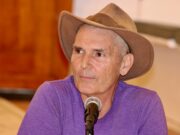
“I had to lay off about 70 people in April,” Corwin said, the shock still evident four months later. “I never laid off anyone in my life and now suddenly I had to lay off 70 people — all at once.” That’s most of the 84 people on his company’s $4.5 million payroll.
Corwin, 61, said 2020 has been a year unlike any other in his lifetime. “I’ve never seen a year where you had to make so many radical changes at once. We had to do what we had to do to survive,” he said.
Corwin said he knew if they didn’t shut down the processing plant, “people would get sick.”
He’s brought back about 50 to 55 employees so far and believes he should be able to bring back the rest in the next month.
Like everyone, he said, his family has been trying to understand what the future will bring. “But who knows, really?” he asks. “Where’s Manhattan right now?” The city’s high-end restaurants make up a large share of the customer base of the white Pekin ducks Crescent breeds, raises and processes. Those restaurants are still not up and running, he said.
The farm’s production has returned to about 25% of its usual output — up from 5% in April. It typically produces a million ducks a year. The farm accounts for 4% of the industry total.

Corwin, a fourth-generation duck farmer who operates the business with his sons, Blake and Pierce, and his brother Jeff, said the family tries to see the COVID situation as an opportunity. They’ve taken the opportunity to undertake some projects at the sprawling 145-acre farm that they wouldn’t ordinarily have time to tackle.
“We’ll survive this,” Corwin said, with the confidence of a business owner who has navigated and survived the myriad difficult challenges of duck farming on Long Island — a place once synonymous with ducks, where 100 duck farms once thrived. Crescent is the lone survivor.
The challenges brought about by the pandemic have been many — and not all obvious to the casual observer. For example, Crescent operates a state-of-the art waste treatment plant, to process the waste generated by the 140,000 ducks typically on the farm at any given time. The facility can handle up to 100,000 gallons of wastewater per day.
It uses complex biological processes to treat the wastes. Bacteria digest the organic matter, removing nitrogen from the liquid waste to levels that meet N.Y. State drinking water standards. The treated wastewater is then discharged to a six-acre man-made wetlands system, which further cleans it as it is recharged to groundwater.
You can’t just flip a switch and turn a facility like that off and then back on again, Corwin noted.
“With COVID, all of a sudden, we had to starve this thing,” he said of the plant. “We had to cut it down to 5% or so. We’re now gradually building back up” as the farm is breeding and raising more ducks as it ramps up production.
The plant is evidence of how farming practices have to change for farms to remain viable.
“If you think where you are today is where you’re going to be five years from now, you’re not going to survive,” Corwin said. “You have to adapt and evolve.”
Duck farms, including Crescent, used to raise their birds outdoors, in open pits. But the duck wastes generated too much nitrogen under standards put into place after the adoption of the federal Clean Water Act, which was the beginning of the end for Long Island duck farms that failed to evolve, Corwin said.
The switch to housing the ducks indoors and the construction of the wastewater treatment plant, which went online in 2007, were two major adaptations that allowed the 112-year-old Crescent Duck Farm to survive where others failed.
“We’ll survive COVID,” Corwin said. “Our society will survive COVID.”
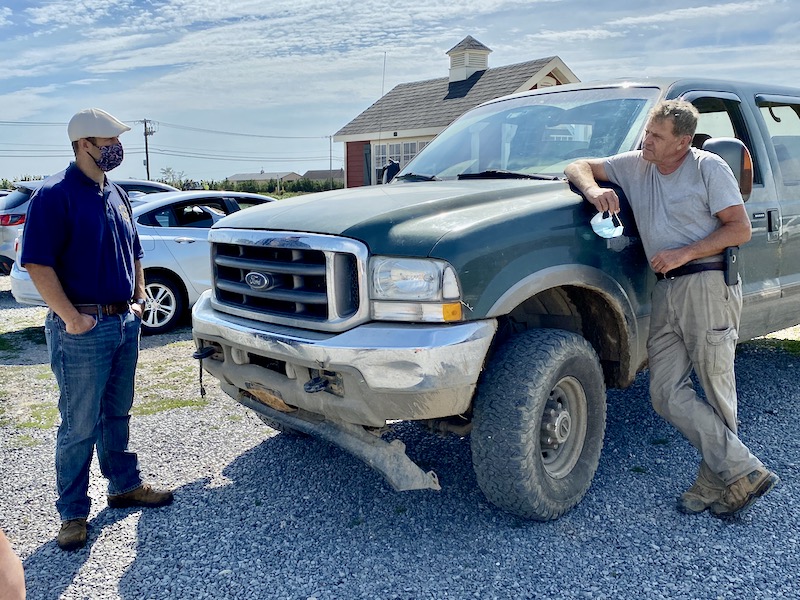
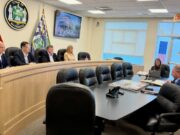
Crescent was one stop on a farm tour by the Suffolk County Legislature’s presiding officer Rob Calarco today.
The tour was arranged by Long Island Farm Bureau. “You’ll see how agriculture has changed and evolved to do better to protect the land and water resources,” L.I. Farm Bureau administrative director Rob Carpenter told the Patchogue legislator at the start of his tour. It kicked off at the Long Island Horticultural Research & Extension Center in Riverhead, where Calarco met with the center’s director, Marc Bridgen and members of the center’s staff, who discussed the wide-ranging and crucial research they conduct to help keep Long Island’s diverse agricultural industry sustainable.
Calarco also visited Schmitt’s Farms in Riverhead, where farmer Phil Schmitt said his wholesale trade took a hit in the pandemic but retail sales at his roadside stand on Sound Avenue spiked.
“People have a renewed sense of the value of locally grown food,” Calarco said.
The presiding officer also visited CJ Van Bourgondien Greenhouses in Peconic, Krupski Farms in Peconic and Aeros Oyster Farm in Southold.
“This was a good opportunity to learn more about agriculture and the impacts farmers have been feeling in the pandemic,” Calarco said.
The survival of local journalism depends on your support.
We are a small family-owned operation. You rely on us to stay informed, and we depend on you to make our work possible. Just a few dollars can help us continue to bring this important service to our community.
Support RiverheadLOCAL today.
