




















Frustration with the slow pace of progress in the cleanup of the former Grumman superfund site in Calverton has residents and government officials fed up.
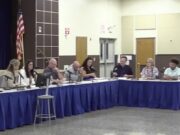
In a grassroots effort, members of the Calverton Restoration Advisory Board, community members and county and town officials have scheduled their own meeting outside of the Navy’s twice-annual cleanup updates in order to receive data obtained through an investigation by county health department officials. The meeting will take place on Tuesday, April 28 at the Manorville Fire Department headquarters.
At the last Calverton Restoration Advisory Board (RAB) meeting on Feb. 10, the Navy would not allow Suffolk health department staff to present well-testing data they’d collected over the prior year.
Calverton RAB member and clean water advocate Adrienne Esposito, executive director of Citizens Campaign for the Environment, said the county sampling was requested through the RAB, the data collection was completed, and members expected it would be shared as part of the Navy’s public process.
Addison Phoenix, the Navy’s current project manager for the Calverton site, said that Navy representatives and contractors are authorized to discuss “Navy-generated data associated with the environmental restoration program.”
Esposito called that decision “very unhelpful,” because it undermined the idea of agencies working together in partnership. Further, she said, the information would “educate members of the public” and “add to the understanding of what is a concern and what is not a concern” as a result of groundwater contamination at the site and a plume of contamination that has been migrating off-site.
Members of the RAB are appointed by the Navy to provide citizen input on the environmental cleanup and restoration of the former military manufacturing and testing facility. Its meetings are intended to provide the community with periodic updates from the Navy on the status of its investigation and cleanup/restoration efforts — as well as an opportunity to give the Navy feedback and ask questions.
The first Calverton RAB meeting was convened on April 28, 1998. The most recent meeting held in February was the Calverton RAB’s 62nd meeting.
Frustrations with the pace of progress in the cleanup and the Navy’s stance on the scope of its investigation have been present since the beginning. The RAB’s first community co-chair, Sherry Johnson of Manorville, served from its first meeting in 1998 until 2002 — when she quit after becoming disgusted with the Navy’s lack of responsiveness, she said in a RiverheadLOCAL interview in June 2021.
Johnson recalled in that interview how reluctant the Navy was to do groundwater testing, and how it refused to test off-site. “I can’t tell you how many times I argued with them about testing,” Johnson said. “I’m sure towards the end I was screaming at them.”
Johnson said the Navy could trace the movement of contaminated groundwater plumes but wouldn’t because “their plan was natural attenuation.”
“I always compare them to the Department of Energy at the lab,” she said, referring to Brookhaven National Laboratory in Upton. “They bent over backwards to do whatever the people wanted. And we couldn’t get the Navy to do a damned thing.”
The Navy’s refusal to test groundwater in areas outside the former Grumma site lasted decades.
The Navy continues to deny responsibility for off-site groundwater pollution, though it documented high levels of PFAS contamination of soil and groundwater have been documented at a large number of locations throughout the former Grumman site itself.
PFAS — shorthand for per- and polyfluoroalkyl substances — are synthetic chemicals used for a variety or purposes in many different industrial processes and consumer products.
Revelations about groundwater contamination polluting nearby residential wells south of the facility led community members and elected officials to demand the Navy take responsibility for the contamination and fund the extension of public water mains to the community south of the site, where public water hookups are not available. It never did, though federal elected officials pressed for and got some federal aid to help cover the costs.
The Navy eventually documented chemical plumes containing four types of PFAS — shorthand for per- and polyfluoroalkyl substances, synthetic chemicals used for a variety or purposes in many different industrial processes —that migrated off-site in a southeasterly direction and tracked to the shores of the Peconic River, which led to fish consumption health advisories in 2023. Earlier this year, the county banned fishing in Swan Pond, a county pond in Calverton, after the Navy notified the county that it had documented PFAS contamination there.
Riverhead Council Member Bob Kern, a member of the RAB for several years, grew animated at the February RAB meeting over the lack of progress with cleanup.
Take “McKay Lake as an example,” he told Navy representatives at that meeting. “You know, there’s 1,000 parts per trillion going down the Swan Pond to Donahue Pond to the Peconic River, and you’re doing no remediation,” he said. “We could talk about what you find here in this building and that building,” he said, referring to the data presentation Navy reps wer giving that night, “but when is the cleanup going to start?”
In another exchange, Kern characterized the Navy’s presentations as a stall tactic and questioned whether the effort is being driven by available funding rather than urgency. “This is very nice, but this is stall,” Kern said after a lengthy presentation on historic records and potential source areas, adding, “You have no money.”
Riverhead Water District Superintendent Frank Mancini told attendees at the February meeting that a private well at the Peconic River Sportsmen’s Club was impacted by volatile organic compounds about two decades ago. The Navy team assigned to remediation of Calverton site at the time denied responsibility —until the Suffolk County health department drilled and presented vertical profile well data that, he said, forced the Navy to “take ownership” of the plume. Mancini said that history, and the decision not to allow the county to present now, “makes the [Navy’s] decision even stinkier.”
In an interview Tuesday afternoon, Kern said the separate community meeting became necessary because the Navy won’t allow county health officials to present their testing data in the formal RAB setting, but the April 28 community meeting is also intended to do a better job of getting the message out to the wider public about the urgency of the situation and the Navy’s failure to take meaningful action to address the serious groundwater pollution at the former Grumman site that is now impacting areas outside of the facility.
Kern said the tone surrounding the issue has shifted since the Feb. 10 meeting, which he said made clear to the Navy that local officials and RAB members “aren’t playing around anymore.” Kern said that meeting helped prompt what he characterized as new “traction” — though he emphasized he does not believe the Navy is moving quickly enough.
Kern said that, behind the scenes, Riverhead officials and RAB members are also participating in ongoing technical discussions with state regulators and Rep. Nick LaLota’s office.
But, he said, residents need a clear, public forum where county health experts can present what they are seeing in the field and answer questions directly.
A Navy spokesperson said the upcoming meeting is “Calverton Navy Plume Community Meeting scheduled for April 28 is “not sponsored or endorsed by the U.S. Navy or the official NWIRP Calverton Restoration Advisory Board (RAB)” and as such, “Navy representatives will not have an active presence.”
The flyer being circulated by organizers of the April 28 community meeting bluntly states that the Navy has been dragging its feet for decades and “it’s time for accountability and action NOW!”
Kern urged residents to attend the meeting and register in advance online.
Tuesday’s meeting is scheduled to begin at 6 p.m. at Manorville Fire Department headquarters, 16 Silas Carter Road, Manorville.
The survival of local journalism depends on your support.
We are a small family-owned operation. You rely on us to stay informed, and we depend on you to make our work possible. Just a few dollars can help us continue to bring this important service to our community.
Support RiverheadLOCAL today.
