






















Tuesday is National Coming Out Day, and the Riverhead Anti-Bias Task Force teamed up with Riverhead Free Library this week to to host the LGBT Network for a talk about the annual awareness-raising event.
National Coming Out Day is celebrated each year on Oct. 11 to commemorate the first march on Washington for lesbian and gay rights, which took place on Oct. 11, 1987. The day was first celebrated the following year and by 1990, it was observed in all 50 states.
The goal of the Long Island-based LGBT Network’s National Coming Out Day Campaign is to create safe spaces for LGBT people where they live, work, play and pray, LGBT Network program coordinator Camille Limongelli told a gathering at the library this week.
A guiding principle is to avoid making assumptions about people based on outward appearances, Limongelli said. That includes assumption about someone’s gender, sexual orientation, age, race or intellect.
“There’s so much more to who we are…so much more to us on the inside that people don’t get to see just by looking at us,” Limongelli said.
She focused on what life is like LGBT youth, typically in schools, which she said highlights why National Coming Out Day Campaign is important.
Nearly 60% of LGBTQ students feel unsafe at school because of their sexual orientation, according to the most recent National School Climate Survey, conducted every three years by GLSEN, a nonprofit organization founded by educators in 1990. The survey probes the experiences of LGBTQ youth in schools.
The 2019 survey found “77% avoided school functions, and 35% skipped school because they felt unsafe,” Limongelli said. “And almost all of these statistics are even higher if you are transgender, gender nonconforming or nonbinary,” she said.
Ninety-five percent heard anti-LGBT remarks at school. “And at very high levels…they either don’t report their concerns because they feel like they won’t be heard or they report their concerns, nothing is happening or they’re told to ignore it,” Limongelli said. Fifty-seven percent of students victimized don’t report it and 61% of those who did report it said staff did nothing or they told the student to ignore it, she said, quoting the survey’s findings.
“This victimization has long-term effects for students,” Limongelli said. “Students who experienced harassment and bullying in school have lower GPAs, lower self esteem and higher rates of depression. They’re more likely to drop out of school and they are nearly twice as likely to not pursue secondary education,” she said.
And that leads to higher rates of mental health issues, depression, suicide and homelessness among LGBT young adults, Limongelli said.
Over 40% of homeless young people identify as LGBT, she said. Many of these individuals are leaving their homes because they cannot be there — they can’t come out at their homes, it’s not safe, they come out and they’ve been kicked out as a result, or had to leave for their safety.
Limongelli spoke about how to be an ally. Avoid using slurs, such as “that’s so gay” when describing something that’s dumb or annoying. And when you hear that, stop it.
“That’s the difference between a bystander and an upstander,” she said. “It’s an uncomfortable situation for everybody.” But for an LGBT person hearing a slur in the presence of an ally who says nothing to stop it, it’s even more uncomfortable because it’s like a violation of the trust the person had in their ally, Limongelli said. She recalled being in that situation many times herself.
Limongelli also spoke about language termed “micro-aggressions” — saying things like, “I never would have guessed” when someone comes out to you, or “I support you despite who you love” or “I support you despite who you choose to be.”
“It’s not a choice,” Limongelli said. “Being LGBT is who we are.”
It’s important not to make assumptions about gender, she cautioned. “We really don’t know how people identify,” she said. “And sometimes folks’ gender isn’t always immediately obvious.”
Use gender-neutral language, she urged. By saying “boys and girls” or “ladies and gentlemen,” she said, “we’re forgetting our transgender folks, our nonbinary folks, and our intersex folks.” Use all-inclusive language instead, she said.
“Be a pronoun pro,” Limongelli said. “When you introduce yourself, say what pronouns you use,” she said. “This is important for cis-gender folks to do because this takes that burden off folks who are transgender, or nonbinary or gender nonconforming,” Limongelli said.
“So what do you do when you mess up? Mistakes happen. That is perfectly okay. We’re human. Don’t over-apologize and bring even more attention to the situation. Because then it’s kind of making this kind of embarrassing moment, more public for you. And for them,” she said.
Businesses and other organizations can make sure that patrons know that it’s a safe space. This can be magazines in a waiting room that represent the LGBT community, or all-gender restrooms.
In the classroom, if you are a teacher, use the correct name and pronoun of students, regardless of what’s on the roster, Limongelli said. “Ask students what name do you use, what pronouns do you use?” She suggested sending out a form asking this ahead of time, to avoid asking students out loud on the first day of class.
Incorporate LGBT existence into your curriculum, she said. “This is especially important to me because history has erased us,” Limongelli said. “LGBT people have been around since the beginning of time, but they are invisible in history books,” she said. “Bring in LGBT speakers. We do speaking events at schools and different organizations.”
It’s important to continue learning, Limongelli said.
“You’re all here tonight to learn — learn about LGBT history, learn about culture, learn about current events,” she said.
“You know, unfortunately, there’s a lot of anti-LGBTQ legislation being passed all around this country. And it’s important to know that because it is impacting the local community,” Limongelli said. As an LGBT person, it feels like the country is turning against you, she said. As an example, Limongelli cited the “don’t say gay” bills being passed in other states.
And, she noted, it’s happening on Long Island too. There are districts around the island that are trying to do similar things, including libraries, Limongelli said.
National Coming Out Day is a day of LGBT visibility, so the LGBT Network NCOD Campaign is known as “wear the ribbon” — pinning a rainbow or blue-pink-and-white ribbon to indicate support. The LGBT Network also asks people to sign its safe space pledge, which can be found on its weartheribbon.org website
https://weartheribbon.org/sign-the-pledge-national-coming-out-day-campaign-lgbt-network-2/
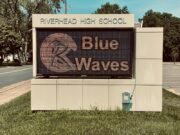
Tina Cinimo and Karenann Volinski, co-advisors of the Gay-Straight Alliance club at Riverhead High School attended the LGBT Network presentation Tuesday evening and were busy making ribbon pins as Limongelli spoke.
Cimino and Volinski both teach in the high school. The GSA has 10 to 15 student members and it meets every other Wednesday. It’s a social setting but has the structure of a club, with a student president and officers. They discuss safety spaces and other topics important to the students.
It’s a place where students can talk about their experiences in the school, both good and bad. It’s helpful, Cimino and Volinski said. They can also discuss healthy ways to respond to aggression and bullying — and what it means to be an ally, regardless of one’s sexual orientation or gender identity.
The LGBT Network was founded in 1993 and is headquartered in Hauppauge, with centers in Sag Harbor, Bay Shore and Astoria, Queens. More information can be found on their website.
https://lgbtnetwork.org/about/
The survival of local journalism depends on your support.
We are a small family-owned operation. You rely on us to stay informed, and we depend on you to make our work possible. Just a few dollars can help us continue to bring this important service to our community.
Support RiverheadLOCAL today.
