






















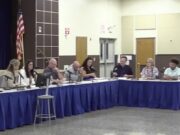






The candidates for Riverhead Town Board in this year’s election came together Thursday night to answer questions and trade occasional barbs in this year’s only face-to-face candidate forum.
The candidates night forum was jointly hosted by the Greater Calverton and Wading River civic associations at Riley Avenue Elementary School in Calverton. About 100 people attended the event, moderated by the presidents of the two civic groups, Calverton Civic’s Toqui Terchun and Wading River’s Sid Bail. The joint forum is a 20-plus-year tradition for the two civics, Bail said.
The event was split into two sessions: the four council candidates were up first, followed by a face-off between the two supervisor candidates.

Part One: Council candidates face-off
Incumbent council members Ken Rothwell of Wading River and Bob Kern of Aquebogue, both Republicans, are facing challenges from Mark Woolley of Riverhead and Kevin Shea of Baiting Hollow, running on the Democratic ticket.
Each council candidate got two minutes for an opening statement and two minutes apiece to answer the same six questions, which were submitted by community residents and read by Bail. Council candidates took turns answering. There was no rebuttal time and no closing statements.
Full audio recording:
Below are the questions and excerpts of each candidate’s answer to each question.
Questions and responders’ names are in bold type.
What have you done or will you do to increase the viability of agriculture in Riverhead?
Shea: Advocated continuing the preservation of farmland, using available dedicated funds such as the Community Preservation Fund and Suffolk County preservation funds to protect remaining farmland. Also supports “establishing open spaces where we can have parks, or maybe do some eco-restoration and create some other forest areas where there are none.”
Kern: Said he has worked to pass codes that protect farmers. Advocates for code changes to enable farmers to process their produce, creating products to sell, the way grapes grown on farmland are processed into wine. “It’s really difficult to farm” in a suburban environment, he said. “’ve been a huge advocate for farming. I’ve been involved in the business. I know what the business is.”
Woolley: Said the L.I. Farm Bureau tells him “the transfer of development rights program is basically broken and needs to be fixed.” Said the farmers say “no one’s really listening to them.” Advocated for listening to farmers “and implement what they need to have done, so they could just do what they want to do, which is just farm.” If the town doesn’t work with the farmers, it will lose its heritage, he said.
Rothwell: Said the town works with the county, pointing to examples of farmland and open space preservation during his tenure on the board. “So we have been actively preserving land. It’s important that every acre that we preserve is something which comes off the tax roll. We do have to focus simultaneously on high tech, high paying jobs, and that belongs up at the Grumman EPCAL site, where we like to see the future development. The town needs to expand the receiving areas for TDRs, he said. EPCAL is a good location as a TDR receiving area. “We’ve been communicating with the Farm Bureau [about] the potential of having cottages on farms, to give an opportunity for farmers to have additional revenue and to have people come and stay and understand the farming experience.”

Should increasing the tax base be the top priority for the town?
Kern: “I totally agree with this position.” Tax revenue from industrial land in town, $2.5 million annually, lags far behind what it should be, he said, considering the town has 400 acres of industrially zoned land outside of EPCAL. He said one of the reasons he started the Emerging Technologies Committee, which is working with Brookhaven National Lab and Stony Brook and others, is to attract industry. We need industrial taxes, he said. “It’s a huge issue for us.”
Shea: “I’m a more of a community based guy. I believe some of the solutions can definitely come from the grassroots up. I would love to see more business coming in, but I also like to see that we have a community that was affordable for us. I’ve been knocking on doors of people saying they just weren’t paycheck away from not being able to afford their home.” He said while the town needs more tax revenue from businesses, that kind of development should be located where “at the same time, the area where our communities are, keeping them safe and healthy and not worry about them intruding in.”
Woolley: “I know you don’t go ahead and put in 412,679 square feet of commercial — HK Ventures down here and knock down more open space that we’re trying to keep here in Riverhead. What you do is you look at EPCAL, first of all, right. Now, as many of you are aware, it’s tied up in litigation, which this town board has just mishandled miserably.” He said he would look into the possibility of moving the Westbury FAA air traffic control facility to the EPCAL site, something he said he explored when he worked for former Rep. Lee Zeldin. But, he said, the EPCAL site is tied up in litigation and costing us hundreds of thousands of dollars in legal fees. He criticized the town for losing lawsuits against Southampton Town and Suffolk County. “We’re losing all these and we’re not just losing tax base, we’re losing tax dollars, and that’s our money. It’s not Monopoly money. It’s real dollars.”
Rothwell: ”To increase a better tax base, yes, you need to bring in high tech, high paying jobs. And yes, we all agree that EPCAL is for that. But I think what the other candidates don’t seem to realize is that Councilman Kern and myself inherited a contract that was signed by Laura Jens-Smith, at the time the former supervisor, and what we did was move things along. And so we made agreements with Triple Five to put them before the IDA, which they agreed to do on their own, and they went before a financial and eligible hearing for them. They were found that they were not competent and they were not approved by the IDA.” That led to the current litigation, he said. “I think that we as residents need to have business people at the helm here to decide when that land does come available, what projects in they’re going there.” He said the town needs to work with the Suffolk County Water authority so it can subdivide that land. That will allow high-tech jobs to locate there. The town has been increasing its tax base downtown, he said. And the new town square will continue that. The Riverhead IDA doesn’t give away things, he said. The IDA has brought in over $2.2 million in additional taxes just in the past 2023 year, and they’ve brought in over 1,400 jobs. And so the incentives are there for them to come in and settle in Riverhead and bring those high tech, high paying jobs and create a better tax base.

Explain your views about the recent efforts to revitalize downtown Riverhead.
Woolley: “Goodbye Craft’d. There goes that building. Up goes another five story building of condos and apartments that nobody’s going to be able to afford. They’re putting in more apartments, 3,000 $3500 numbers, it’s not for the residents, it’s for the tourists. So that leaves us out,” he said. “But what they forgot to do is they’re building all this stuff down there, which we just saw. How about some flooding that just occurred? The river rose one more time,” he said. “When I was…working for Congressman Zeldin at that time, just before COVID hit, I was the one who brought in the Army Corps and said, let’s take a hard look at Peconic River, because if we’re going to be doing anything down there, we got to control the flooding. Army Corps comes in, does a bunch of virtuals, runs a number of options that these guys can do.” He said the town didn’t follow up and instead proceed with development plans downtown. He criticized the town for partnering with developer Joe Petrocell. “We’re going to go ahead and hand everything over to the guy with the golden hand,” he said. “Handle the flooding down there. Look at the Peconic River before you do anything more. If this past Nor’easter didn’t tell you something, open your eyes,” he said.
Kern: “Just to clarify, you know, it’s really interesting. I’m not upset with anybody. I go door to door. I don’t bash anybody. I don’t bash anybody online. I don’t need to. I never did when I first ran, I never did. We’re all Americans. I’m happy to serve you,” he said before turning to the question. “I would suggest that, rather than criticize that you look at the plan. “It’s predicated on flood mitigation. That was the first thing that was taken into consideration: flood mitigation.” He said residents may not want a hotel on the town square but they don’t need a hotel because they live here. “The only time you want a hotel is when you travel somewhere. We are a tourism destination. And if you talk to the hotels, they’re packed.” Nobody builds a hotel because it’s not needed, he said. “And in terms of Joe Petrocelli, I’ll say this. Here’s somebody who’s dedicated so much money to this town, and he, if you go into his buildings and see how they’re constructed, should he be the master developer? Absolutely. Should we be taking a risk on somebody that we don’t know, that doesn’t have a track record. The answer is no, that would be reckless. We’re very fortunate that Joe is willing to do this.”
Shea: Said he likes the downtown revitalization efforts so far, “except for a few things.” The flood mitigation plans are “quite reasonable,” he said. During the planning process, residents expressed opposition to the idea of more apartments being developed downtown. He said large development doesn’t have “that heritage look to it.” He said the town needs to make sure it doesn’t forget its rural character. It can be incorporated into the buildings, too, he said. “I had actually done some some designs of what a hotel could look like, making it look like, maybe more like a ship or a whale, something that says to everyone who comes in your downtown, when they come here, I like coming Even if I’m a resident.”
Rothwell: Said that when he first took office 4 ½ years ago, one of the first projects he was assigned to was meeting with the Army Corps of Engineers about flood mitigation. “And it wasn’t just simply about building a wall to keep the water out. It was about putting together a vision that was aesthetically correct. And it was about building multi layers and platforms” for flood mitigation. The town purchased three parcels of land for the creation of the town square, which will enable the town to complete the Army Corps of Engineers project, he said. Raising the East End Arts buildings, which the town owns, was part of the mitigation plan. He credited the CDA for having obtained over $58 million in grant money so far, allowing the town to move these projects forward. “And so the development in the new town square is a flood mitigation project. It is a revitalization and the biggest thing is that it becomes an activation point, and that’s what’s needed downtown. So when we go to our restaurants and you visit from one store to the other, they need people. So you need to create that activation space. And that’s what the town square is designed for.”

What are your views on retail cannabis businesses in Riverhead?
Rothwell: So let’s be clear right from the get-go, when cannabis was approved by New York State, was legalized, I voted to opt out, to not allow it in the town of Riverhead. I wasn’t interested in having it in our hometown. I lost that to a 3-2 vote. And so cannabis was coming to Riverhead. He led a forum on cannabis engaging the police department, the school district, the civic groups, Riverhead CAP, community residents, cannabis growers and retailers, too, he said. That’s how the town developed its legislation, he said. “And there are things that I will never relent on,” he said. One is the 1,000-foot distance from schools, even though the state Office of Cannabis Management has determined the minimum setback should be 500 feet. “And we’re going to fight to keep it out of the school zones,” he said. When Riverhead Town voted against opting out, the state represented that, under the law, the town would be able to place restrictions on the time, place and manner of cannabis sales, he said. Now the state OCM is saying it can determine cannabis site locations. “If you’re going to take away ‘time, place and matter’ for us, then we are either going to have a moratorium or we want the right to opt out, because once you’ve taken the control away from us,” he said, the town is going to stand firm that “It’s not going in our schools, it’s not going near our parks. It’s not going in the public gathering spaces, not in our Main Street areas. And we wrote great legislation… and I stand by it, and I expect to win that argument in court.”
Woolley: “Sounds like another lawsuit is coming down the pike, probably with outside legal counsel, because the council they have in house is just incapable of handling all these lawsuits that they’re either filing or getting hit with. Apparently, they didn’t read the fine print in the New York State law. So here we go,” he said. “Well, you guys, you know you never should have opted into this thing, pot shops. You got one in Calverton, you got one right there in Riverhead off of Kroemer, you got another one ready to go up in Aquebogue. There’s about two more. You know, I’m losing count. You can’t even drive down 58 half the time without being you know, you’re thinking that you’re in a Cheech and Chong movie,” he said. “You were told about it. You just didn’t follow up.” He said the town was looking at the potential revenue from taxes on cannabis sales and that colored their decision.
Kern: If we do not sue the state, there will be a proliferation of cannabis shops. Do I think that 100 could make it in Riverhead? No, I don’t think 100 pizza places could make it. I’m not afraid of this proliferating into something where there’s a ton of them.”” He said he’s gone around and looked at other places, including the Shinnecock Nation. “Are they packed? Are there long lines? I can tell you the answer is no.” He said something must be done about the sale of illegal substances at gas stations, where kids are buying them. “New York is a home rule state. If we allow the state to make rules in our town, we’re no longer a home rule state. They have tried to do it. They wanted us to put 400 homes around the train station, but they weren’t going to pay for the infrastructure. I’m glad we have home rule law in New York State.”
Shea: Cannabis dispensaries are in Riverhead. “And I have to say that from my perspective, I’d rather listen to [community residents]… “Maybe it’s not what I want. I’d rather you decide. Or maybe set up forums and say, Do you want one in your town? Do you want it in Wading River? Do you want it in Calverton? Do you want somewhere in Jamesport? Or maybe you just want it somewhere in industrial sites, somewhere else. So it’s not affecting the aesthetic of Riverhead. That’s not for me to decide,” he said.

How effective has the town of Riverhead been in reining in businesses that have acted improperly?
Woolley: “We need more code enforcement officers, okay? And in order to do that, we need to actually set aside funding to bring those code enforcement officers in,” he said. He called for a “forensic audit of the budget,” because, he said, “Nobody trusts where the money’s coming in and money’s going out. We see money going all over the place, and… then there’s not enough money for code enforcement officers. Now there’s money for pocket parks, as we’re in an election season, so all of a sudden that’s happening, but there’s still no money for the code enforcement officers that we need here. So we need, we need more there.” He accused the Riverhead IDA of “squandering” money by giving benefits to people like G2D, the original developer of the building at 205 Osborn Avenue, whose project was stalled by legal and financial problems.
Rothwell: “We do have funding for code enforcement officers, and since we’ve been in office, we have increased our code enforcement personnel,” he said. The town generated revenue by requiring rental home inspections annually instead of every other year and that money was used to hire more code enforcement personnel, he said. Rothwell said he’s written legislation to address “fire code issues” that came to light after the fatal fire on Second Street. Also the town now has code enforcement officers available to respond 24/7.
Shea: Advocated “transitioning to different manpower hours” so that code enforcement officers can be on duty during overnight shifts. He said the town can better use available technology to obtain evidence of code violations and allow residents to file complaints about things they see in their own communities.
Kern: “We don’t overpay the employees in our town. I want everybody to know that,” he said. In fact, the town has trouble retaining certain types of employees, including code enforcement officers, who often leave Riverhead town government for better-paying jobs in other towns, he said. He said there are currently 70 cases in court. It’s a lengthy, time-consuming process to enforce the code in courts. To begin with, it’s not easy to even get the opportunity to go inside a home that’s being rented illegally, he said. He praised the town’s code enforcement division for their work. “You’d be amazed what code [enforcement] does,” he said.

Is it in the best interest of the town of Riverhead to provide affordable equity growth opportunities for first time home buyers?
Woolley: “The answer is yes, it is something that we should be doing. There are ways to be looking at doing it,” he said. 3-D printed homes are one option, he said. “Maybe create more housing opportunities for manufactured or modulars” for people under age 55, he said. “For EPCAL, maybe create some housing there at that site,” he said. The apartments on Main Street are not affordable for working people in Riverhead. The Family Community Life Center housing plan is something that the town should look at for other locations, he said. The town needs to work on first-time homebuyer options, he said.
Rothwell: “Riverhead is doing its share on the east end,” he said. “We currently have a project before us that’s over on Griffing Avenue that’s going to have 22 units going to first-time homebuyers, he said. “We’ve also looked at our codes about accessory dwelling units,” he said. Home owners can create an accessory unit for affordable housing, giving seniors the chance to rent out an accessory dwelling unit, or others the chance to buy a home and have an additional income on the property so they can afford their mortgage payment, he said. The home must be owner-occupied and the homeowner must have lived there for at least three years, so that this doesn’t provide people the opportunity to “turn it into a business,” he said.
Shea: A lot of people can’t afford the apartments that are built as affordable apartments, he said. The rents can be $3,000 or $4,000 a month, he said. He said he likes the idea of accessory dwelling units because they might be more affordable for people earning $45,000 a year.
Kern: Advocated allowing smaller homes than the 1,200-square-foot minimum presently required by town code. He said that was a recommendation of the comp plan update. “Does a single person need more than 800 square feet? It would be a lot cheaper to buy that, and you start to get equity, and then you move up.” The Family Community Life Center plan is a good one, he said. The zoning for that is available for eight other parcels in town, he said. The development on Griffing Avenues will be condos, he said. The state has a program to help first-time homebuyers to purchase condos, he said.
Part Two: Supervisor candidates will be published Sunday, Oct. 19
The survival of local journalism depends on your support.
We are a small family-owned operation. You rely on us to stay informed, and we depend on you to make our work possible. Just a few dollars can help us continue to bring this important service to our community.
Support RiverheadLOCAL today.
