






















Riverhead Town continues to grapple with the issue of whether to have the Riverhead Volunteer Ambulance Corps bill people for ambulance services.
An increasing number of municipal ambulance companies are billing for emergency response calls, which are covered by comprehensive medical insurance policies, as well as Medicare and Medicaid, according to Riverhead Supervisor Sean Walter, a proponent of the move.
“We might be leaving upwards of $200,000 [a year] on the table,” Walter said during a discussion Thursday with members of the Riverhead Ambulance District board.
The town board has been talking about medical billing with the ambulance district for at least a year and last year even solicited proposals from third-party billing companies that would handle the invoicing on behalf of the district.
Last year, the supervisor included $100,000 in medical billing revenue in his preliminary budget, but the revenue item had to be removed from the final budget when it became clear that RVAC was not ready to embrace and move forward with the plan.
Walter says the medical billing revenue will allow the town to hold the line on ambulance district taxes and at the same time generate additional revenue for the district and allow it to purchase equipment or hire additional personnel. He would like to see a medical billing system implemented in time to include billing revenue in his 2014 preliminary budget.
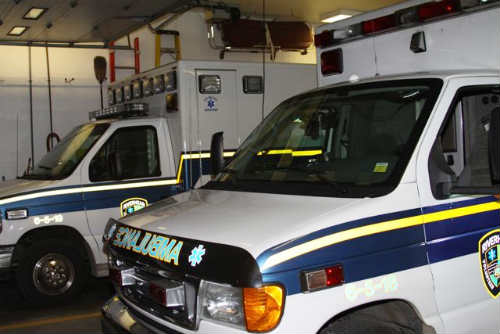 But ambulance corps officers say they don’t have the equipment, the staff or space in their already-cramped Osborn Avenue headquarters necessary to begin billing for services.
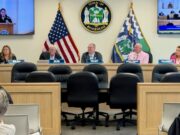
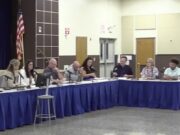
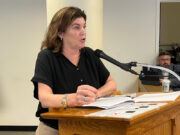
Veteran RVAC volunteers and current board members Bruce Talmage, Keith Lewin and Ron Rowe met with the town board Thursday to discuss the medical billing issue again.
The organization, which currently employs one part-time secretary, would need to hire a full-time administrative assistant in order to do the record-keeping required, said RVAC board member Bruce Talmage.
The corps would also need to equip each ambulance with at least one computer or tablet for entering electronic patient care reports in the field, he said.
And then there’s the issue of processing the data, forwarding it to the third-party billing agent and maintaining the database, said RVAC board member Keith Lewin.
“Once you go to billing we have to meet all HIPAA [the federal Health Insurance Portability and Accountability Act] requirements, including maintaining a dedicated, secure database, secure storage of information, and HIPAA training for all involved,” Lewin said.
“This is a major step in the organization,” Lewin said. “Once you go to billing, you change the nature of your service.”
The ambulance corps hasn’t even been able to research all that medical billing will entail in order to arrive at a clear understanding of the resources it would need to implement medical billing, the RVAC board members told the town board.
That angered Councilman John Dunleavy, a proponent of medical billing, who accused the corps of “stalling” on the issue and demanded a speedy resolution of outstanding issues.
“It’s not me, it’s election year and people want to — I’m looking at the taxpayers,” Dunleavy said during the work session. “I know you guys don’t want to do this, but stalling is not the way to go. OK?”
“We’re not stalling, John,” Lewin shot back.
“Over a year we’ve been talking about this and I think we should get together and be implementing something now, so our taxpayers will have a little relief,” Dunleavy said.
The councilman said RVAC has been negative about the idea from the beginning.
“Instead of saying ‘let’s be positive, let’s go out and get this information and give it to them, every time we bring up a question you give a negative response to it,” Dunleavy said.
“That’s how I earn my living,” Lewin answered. “I avoid problems by thinking ahead, thinking things through.”
Walter said the town and the ambulance corps has been discussing this for 18 months. “We’re no farther along now then we were 18 months ago,” he said. “How long will it take to do this, to give us a response?”
“I guess it’s a question of how much free time the volunteers have, with doing their other duties, to spend time doing this,” Talmage told him.
“We all have full-time jobs,” Lewin said. “We have to do this when we’re not doing what we’re paid to do. It’s not like we can sit and work on this for a month get this solved.”
“We’re moving as fast as we can with the resources that we have,” Talmage said.
Walter noted that it’s not even clear he has a majority of the town board willing to vote to implement medical billing. The third vote in favor of the plan last year, that of Councilwoman Jodi Giglio, now appears uncertain. When Walter polled the board Thursday, Councilman James Wooten and Councilman George Gabrielsen were still opposed, and Giglio’s support was qualified. She said she’d support it only “if it works for the ambulance district.” Giglio said there were too many unanswered questions to make an informed decision right now.
“If the ambulance district is saying it’s not going to be nothing but a headache and theyre going to have to hire more people and they dont have the facilities to carry it out…” Giglio said. “I need more information.”
Gabrielsen said he’s worried about people who don’t have insurance coverage for ambulance services, either because they don’t have insurance or because they have a “no-frills” plan that doesn’t cover ambulance services.
Gabrielsen said that the low-cost plans being purchased by people who are mandated to carry health insurance under the federal health care reform act, don’t cover the ambulance. He cited the “Healthy New York” plan as an example.
“What happens to them? They’re paying the ambulance district tax, and now they’re going to get hit with a $1,200 bill,” Gabrielsen said.
His opposition led to a dust-up with Dunleavy at the work session.
“I know you’re looking out after the farmers,” Dunleavy told Gabrielsen, who is a farmer. “I’m actually looking out for the whole Town of Riverhead, not just the farmers,” Dunleavy said.
“No, no, no,” Gabrielsen answered. “I have a bigger picture than that, not your narrow-minded interpreting of it,” he said.
“There’s probably hundreds of working people who have insurance but don’t have the coverage,” Gabrielsen said.
Walter said the town would issue “a strongly worded letter” and file it away, without ever pursuing collection against people who have no coverage.
But Gabrielsen said he was concerned that the specter of the obligation would make people who need emergency medical services reluctant to call for an ambulance.
Lewin agreed, saying people already ask RVAC EMTs how much the service will cost and do they really have to go to the hospital.
Lewin also noted that fire departments are currently prohibited by law from billing for ambulance services. Since Riverhead Town encompasses part of the Wading River Fire District, town residents in the Wading River Fire District would not have to pay for ambulance services, but residents outside that fire district would.
“Could you even do that, legally?” he asked.
A bill is currently pending in both chambers of the State Legislature that would end that prohibition, but with the legislature due to adjourn for the year on Friday, it’s not clear whether the bill will become law this year.
The RVAC board members agreed to attempt to collect the information the town board needs to attempt to implement medical billing by Jan. 1.
“It’s not that we’re not moving forward,” Talmage said. “We’re moving as fast as we can with the resources that we have.”
RiverheadLOCAL photos by Denise Civiletti
The survival of local journalism depends on your support.
We are a small family-owned operation. You rely on us to stay informed, and we depend on you to make our work possible. Just a few dollars can help us continue to bring this important service to our community.
Support RiverheadLOCAL today.
