










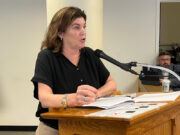


Business Spotlight: Glynis Berry, architect, artist, and co-owner, with her husband Hideaki Ariizumi, of the downtown Riverhead art gallery, art sites at 651 West Main Street, Riverhead.
WHERE DID YOU GROW UP?
I grew up in Hopedale, Massachusetts, a small factory town of 2,500 which started out as a Utopian society. It was a fully integrated community which had a green belt around it, a forest with a mill pond going into the factory right at the heart of town, and the best worker’s housing around. Growing up there had a huge impact on my vision of what a community should be.
WHAT CHILDHOOD INTERESTS OR EXPERIENCES LED YOU TO A CAREER IN ARCHITECTURE?
I actually went into architecture more because I didn’t like it, than because I did. I saw little crummy houses that were made from materials which could be so much better if they were put together in a different way. I was working at the American Museum of Natural History in NYC and was given the opportunity to go to Egypt on a dig. While I was there, I noticed that the indigenous architecture seemed to really fit the climate and lifestyle of the people living there.
WHEN DID YOU DEVELOP A PASSION FOR ART? 
I had not taken very much art in HS, but when I started college I began taking art classes and I fell in love with it! I really, really wanted to be an artist, until I got down to my last $ 50! Ever since then, I have always loved art, and I consider architecture a form of art. During my college years I worked in museums, and I am always amazed at people’s talent and their views on things.
WHERE DID YOU GO COLLEGE AND WHERE DID YOU WORK AFTER GRADUATION?
I received my undergraduate degree from Smith, and I went to Yale for architecture. My first job was at Alaska State museum in Juno. I was just going to visit a friend and ended up working for the best boss I ever had in my life, it was a magical year!
What I really wanted to do was get a Masters Degree in Fine Arts, and I went to Boston University for a year until I ran out of money! So, I went to NYC to find a real job, and my very first job was doing cut and paste (with real scissors and real paste) for Crown Publishing. My next job was running a small children’s museum in Manchester, Connecticut, which I loved!
I then went back to grad school, and received a fellowship to work in an architects studio in Japan. I lived in Japan for three years, where I met my husband and partner Hideaki. We came back to NYC together, and I began working at the Department of Transportation. I started out in urban planning, then began looking at pedestrians and how they are actually a form of transportation. I was able to start the pedestrian and bicycle programs, which were new ideas to the DOT, which were then implemented.
I do enjoy the challenge of presenting ideas in new ways, I am now very involved in alternative septic systems. I believe this has the greatest impact on the health of our environment, and at this moment it becoming a very important topic in our communities.
WHY DID YOU DECIDE TO START YOUR OWN BUSINESS?
When I was in the city it was always in the back of my mind to go out on my own. I also knew I wanted to do something with art, as I was living vicariously through the artists I knew! We now have three parts of the business: A/B Studio, architecture studio; art sites, gallery; and Peconic Green Growth, a non-profit we just started in April. Our goal is to combine environment, community and art and look for ways they can interact. The non-profit supports our efforts to educate the public and the professional communities about alternative septic systems.
WHEN DID YOU COME OUT TO RIVERHEAD/NORTH FORK?
I was reading the paper and saw an auction for land in Greenport, I had never really thought about Long Island since I am a New Englander. We were not intending to move, we just wanted to design our own structure. We came and saw the North Fork and fell in love! We bought land in 1992 in Orient, and we built our own house. We became more and more connected to the people and the area, and it was hard to go back to NYC. Our first client was the curator of the Metropolitan Museum of Art, and it was a very small job, but we were on our way!

HOW DID YOU GET THE CONCEPT FOR ART SITES?
A dream, literally a dream! When I woke up, I told my husband I wanted to go look at stores, he thought I wanted to go shopping! We had already had a gallery in Greenport, our timing was right, and the response was very good. However, after three years we realized that we needed more space to combine the gallery and architecture in the same space. The price was going up quickly in Greenport so we began exploring other locations.
WHY DID YOU CHOOSE TO LOCATE ART SITES IN RIVERHEAD?
When we found this building, it was a wreck, but it made sense as it was the right amount of space. It had been a car dealership, then a transmission shop, and was abandoned, so we had to gut it completely.
We realized that our location in Riverhead would have distinct advantages and disadvantages. The gallery becomes more of a destination because most people do not just wander in and discover us. However, we are very centrally located so that our openings can attract much larger crowds from NYC and beyond.
For the architecture studio, it is a good location because we can get to know the other towns better, and also have access to many resources.
We like Riverhead, and see enormous potential here, but the potential must incorporate the existing people and character.
WHAT CHANGES HAVE YOU SEEN IN RIVERHEAD SINCE YOU OPENED ART SITES?
Not enough! I am not sure we have had any influence, but I am hoping with the non-profit that we can actually do more to affect positive change in Riverhead.
I continue to bring up ideas- I was thinking about the corner of Mill and West Main, the river is so nice right there, it has the post office, the restaurants, a lot of people living in the mobile home park. A few little nudges could really turn that into a great little river community.
I think what Nancy Stalker Swett’s group is doing for downtown Riverhead is terrific. Despite the frustration with the building owners on Main Street who are not selling, there are some great things going on downtown.
WHAT IS YOUR IDEAL VISION FOR THE FUTURE OF ART SITES AND RIVERHEAD?
With respect to art sites, we hope that people will enjoy the work we are doing. I am interested in infrastructure, and finding ways to incorporate art and artists into all aspects of our community!
For Riverhead, having an exciting downtown that really supports individual efforts, not just big business. It needs to be affordable and supportive to the arts, to attract a new generation of energy and ideas. It can be an incubator where people try new things, test things out and create a really vibrant neighborhood.
I just went to a meeting of American Planning Association and it was all about “Redesigning Suburbia”. We were discussing how people need dense downtown areas because they want to interface with other people, but also need to have access to nature and awareness of their environment.
My vision for Riverhead is a “green corridor” with parks and activities, and trails all up the river, with fingers that go into the communities and then bring it back into the downtown area. I enjoy being part of the beginning of something, injecting something new into the mix!

Dee Ann Federico, an interior designer and freelance writer, is the owner of Dee Ann Design in Riverhead. She established her design business in New York in 1995, after a successful international career in textile and fashion design.
The survival of local journalism depends on your support.
We are a small family-owned operation. You rely on us to stay informed, and we depend on you to make our work possible. Just a few dollars can help us continue to bring this important service to our community.
Support RiverheadLOCAL today.
