
























A proposed strategy developed by the state Department of Environmental Conservation to prevent pesticide pollution drew criticism from environmental advocates at a public hearing Wednesday night at Suffolk Community College in Riverhead.
More than 100 people — farmers, environmentalists, community members and elected officials — gathered at the campus to speak out on the proposed strategy, which lays out steps the DEC will take to identify problematic chemicals found in groundwater and decide what to do about them.
Critics said the strategy was not nearly aggressive enough protect Long Island’s groundwater.
Bob Deluca, director of the Group for the East End, said the strategy lacks the means to show success over time, lacks specific triggers for regulatory action, lacks targets for water quality and fails to address whether referenced programs indicated in the strategy are, in fact, working.
“All of those elements need to be built into what this originally was, a plan,” DeLuca said, referring to a DEC plan released in 2011. “The difference in terminology between a plan and a strategy is pretty clear. A strategy is a series of guidelines that lead to more discussions and more research and that’s fun, but a plan really is an action-oriented agenda, which lets the public know there will be some outcomes.”
“The so-called ‘strategy’ does not propose any measures to protect Long Island’s groundwater against toxic pesticide contamination,” according to the environmental advocacy group Citizens Campaign for the Environment.
“Instead, it simply calls for more meetings and more planning. Government and stakeholders have been meeting and planning for years. This DEC plan was supposed to put forth protective actions and measures that would prevent further degradation of Long Island’s drinking water supply. CCE is calling on the DEC to fulfill its mandate of pollution prevention and public health protection,” the organizaiton said in a statement on its website.
The DEC strategy “is about protecting industry,” according to testimony given by CCE executive director Adrienne Esposito at a state assembly public hearing held in Farmingdale the day before the DEC hearing in Riverhead.
“We agree that farmers need to farm and we want them to, but we need to farm in a way that isn’t poisoning groundwater,” Esposito said before Wednesday night’s hearing.
She said CCE has backed off advocating a zero-tolerance policy on all pesticides — banning all chemical pesticides from groundwater, regardless of how small the quantity — something farmers vehemently oppose. The group’s shift reflects its desire to work alongside farmers to protect both drinking water and agriculture.
 Instead, CCE advocates banning “the three worst pesticide offenders” on Long Island: metalaxyl, imidacloprid and atrazine. All three are toxic and all three have been found in groundwater and community drinking water wells throughout Long Island, Esposito said.
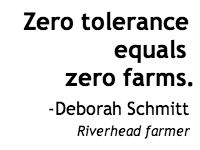
“Zero tolerance will put us out of business,” fourth-generation Riverhead farmer Deborah Schmitt told state regulators. “Zero tolerance equals zero farms.”
Schmitt made the analogy that pesticides are for plants what medicines are for humans.
Long Island Pine Barrens Society executive director Richard Amper responded, “Pesticides are to humans what poison is to humans.”
Amper said when it comes to the effectiveness of DEC water quality regulations thus far, the proof is in the pudding.
“The idea that the DEC is doing a good job is belied by the fact that [chemicals] are showing up in our water,” he said.
One hundred and seventeen chemicals have been found in Long Island groundwater since 1997, according to the DEC, though half of those chemicals are “legacy” compounds, meaning they are from chemicals no longer — or never — registered for use on Long Island or in New York.
Long Island Farm Bureau executive director Joe Gergela said Wednesday he hopes to protect farmers from being targeted for current water quality.
“The environmental community is pushing very hard to ban things and we’re pushing the other way saying, ‘Wait a minute, it’s a scientific process,'” Gergela said.
“We’re not going to eliminate everything that gets in groundwater,” Gergela noted. “We’d have to ban fuel, we’d have to ban detergents, just about anything we use on Long Island,” Gergela said. “That’s not a realistic goal. We need to balance it as best as we can. We’re concerned. We want to have new science, we follow best management practices as farmers. We’re very responsible and we’re very concerned. It’s not pleasurable to be a farmer today when society thinks we’re contaminating the water.”
Fighting between farmers and environmentalists takes away from the issue at hand, Gergela said.
“Let’s get away from the fighting,” he said. “We all care about the water. We need to work together. This is a scientific-based issue with political and public relations elements. Let the scientists do their jobs. We push public policy in certain directions, but at the end of the day we all need water,” Gergela said.
DEC Deputy Commissioner Eugene Leff said he sees common ground between the opposing sides. Both sides want to see some existing pesticides replaced by effective alternatives, which the strategy seeks to do, Leff said. The agency will continue to review written comments through April 30, adding the DEC may modify some aspects of the strategy before adopting a final version and convening the technical review and advisory committee.
Leff said after the meeting there was “very strong expression of the concerns of farmers that they might not have the tools available to conduct their agriculture. That was very strongly put tonight.
“At the same time, we heard the concerns about very low levels of pesticides in drinking water. We heard people say that even if there’s no scientific evidence of a risk to public health it would be preferable to eliminate pesticides in drinking water,” Leff said.
The deputy commissioner said he thought that the strategy will ultimately address concerns of environmentalists who criticized it in its current form.
RiverheadLOCAL file photo by Peter Blasl
{loadposition tab1}
The survival of local journalism depends on your support.
We are a small family-owned operation. You rely on us to stay informed, and we depend on you to make our work possible. Just a few dollars can help us continue to bring this important service to our community.
Support RiverheadLOCAL today.
