























Riverside will finally have public access to the river with the development of a park being designed by Southampton Town.
The new Maritime Trail Park in Riverside would feature two trails that bisect the park, a floating kayak launch, a fishing platform, a river overlook, a comfort station, multigenerational spaces and other features, as depicted on a preliminary plan drawn by landscape architects Araiys Design.
The Araiys plan was presented Tuesday night at a meeting of the Flanders, Riverside and Northampton Community Association, which held a community meeting to gather ideas for the design last month. The consultants are scheduled to present a near-final version of the plan to the Southampton Town Board on Nov.15.
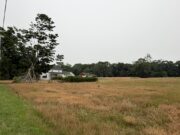
The main trail is a 1.6 mile multi-use path that would run along the riverbank, from Peconic Avenue on the west to Kirk Avenue on the east. It would have multiple access points, said Steve Nieroda of Araiys Design.
The second trail will be a pedestrian-only half-mile trail from Flanders Road to the Peconic River. There would be a 20-foot by 20-foot river overlook at the end of the trail, creating a destination point, Nieroda said.
The trail also features a “node,” a small circle near the entrance that connects the parking, adult fitness circuit, children’s sensory garden and comfort station to the southwest with a half-mile loop to the east that surrounds a high-point area dubbed “the green.”
The northwest quadrant of the site, which Nieroda described as the “most beautiful part of the park” would feature a floating kayak launch and a fishing platform.
Southampton Town Supervisor Jay Schneiderman, who was present Tuesday evening, said he thought the proposed overlook was too small and that more access points to the water needed to be considered where people “could congregate.” Many residents agreed and Nieroda said that they would take that into account for the next phase of the design.
Community members asked about stormwater and shoreline preservation and asked if a bulkhead was in the plans, like on the Riverhead side of the river. Nieroda said that as per the DEC bulk-heading is not permitted there anymore. Instead they will use a living shoreline technique, where they will create a more natural barrier with slopes and native plants as a buffer.

Riverside Rediscovered community liaison Sirios Barrios said that the addition of a playground would also be beneficial and would attract more visitors. Many agreed and said that a playground “makes you want to stay at the park.”
Nieroda said they would look into a “natural playground” to be incorporated in the design.
Another important part of the final phase of the design is the addition of data resulting from a “deep-dive” community and health survey conducted by Riverside Rediscovered in partnership with Dr. Pamela Linden from Stony Brook Research and Evaluation Consulting.
The idea behind the survey was to ask people about the possible uses of the park— and their concerns — as well as to assess the health of the community as a whole.
Respondents listed safety as the first most important part of a healthy community, followed by clean air and water and services for children. They cited crime, drugs and prostitution, among others, as the top three problems in Riverside.
In order to feel safe while using the park, respondents said that lighting, open spaces, bike patrols, callboxes and a good maintenance were key elements.
Schneiderman said in an interview that the town has increased police patrols and is more active in the Riverside and Flanders area. He said the new park will likely become a part of that effort.
“We would likely have to add this park to the regular patrol,” he said. “The police would determine how best to enforce the rules, but they would be certainly be keeping an eye on it.”
He added that “by putting a park like this you’ll see less negative things happen” and that by having “active park users walking down those trails it’s not a secret place anymore and it will discourage some of the things the community hopes it will discourage.”
FRNCA applied for a $100,000 DEC grant in July to pay for the next phase of the design, the construction plans, which will be done by another consultant. According to Fisher, the DEC has decided only to award them $50,000.
Schneiderman said that “even though so far everything has been paid with grant money” and they expect to receive more, some of the elements of the design might have to be phased, and warned residents that they “may not get all you see immediately.”
“At least we have a project to pitch,” he said. “Let’s get started.”
The survival of local journalism depends on your support.
We are a small family-owned operation. You rely on us to stay informed, and we depend on you to make our work possible. Just a few dollars can help us continue to bring this important service to our community.
Support RiverheadLOCAL today.
