





















Southampton Town gave residents of Riverside a look at some of the practical aspects of its new, $44 million sewer district Wednesday evening. The town’s consultants say they anticipate the system coming online in late 2029 or early 2030.
Funding the Riverside Wastewater Recovery System has been a project in the works for more than a decade, and it has been seen as a necessary tool in the revitalization of this neighborhood across the Peconic River from downtown Riverhead.
Investment here has stagnated in recent years, in part due to the inability to install more septic systems in an area with a high water table adjacent to the river.
The sewer district received a major boost in the fall of 2025, when it received $19 million in funds through the federal Infrastructure Investment and Jobs Act.
The New Plan
Consultants working with Southampton Town on the sewer system outlined some of its features for the crowd of residents who gathered at the Flanders Community Center April 29. Many had been asking for the town to come talk to them since it began redesigning some elements of its 11-year-old Riverside Revitalization Action Plan last year.
The original 2015 plan for the redevelopment called for the construction of up to 2,300 housing units, but the town learned since that it will be unable to build its initial, ambitious sewage treatment plant, due to the shallow water table and the impracticality of filtering the effluent through a constructed wetland as originally proposed.
The sewage treatment plant has been downgraded to 290,000 gallons per day of effluent from an original 800,000 gallons.
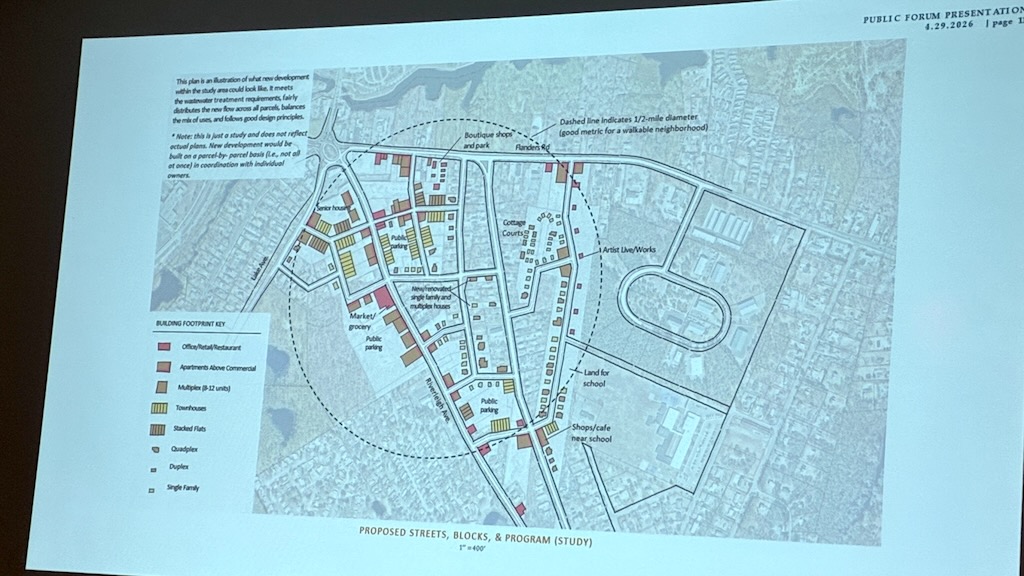
The latest plan for the neighborhood, presented at the meeting by Paul Knight of the firm Historical Concepts, calls for allowing the construction of an estimated 532 housing units, ranging in style and sized from 450 to 1,200 square feet, along with 198,000 square feet of commercial space.
Knight shared potential scenarios for commercial space in which 72,000 square feet could be offices; 45,000 could be retail; 15,000 could be restaurants and 20,000 could be a grocery store, with smaller portions of square footage available for gyms and dance studios, cafés and delis and bars.
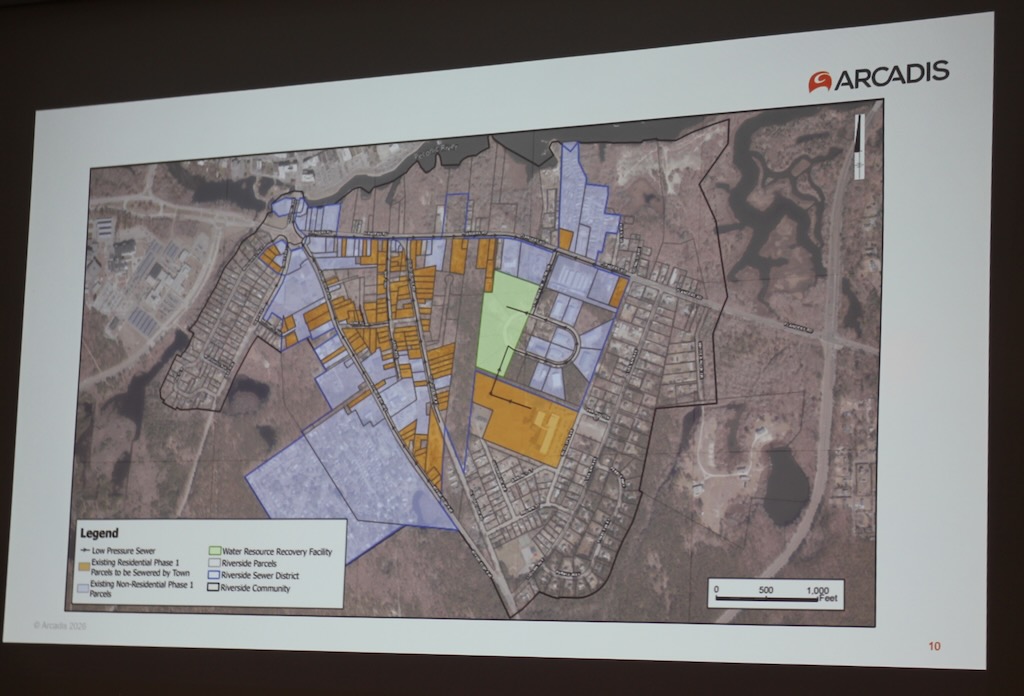
Representatives from the engineering firm Arcadis told the crowd the plant will be a low pressure sewer system, with a “grinder pump” placed in the ground at each individual property, which would macerate the contents of the effluent from each house before pumping it through a relatively small pipe into the sewer network.
Steve Hayduk, an engineer working with the town on the project, said several mobile home communities, which are expected to be connected to the system, will likely have a subsystem in which the effluent is pumped to a central area on site before being pumped to the plant.
Engineer Vanessa McPherson from Arcadis said their company is about 60% through designing the system, which will include green features like rain gardens that kids could visit as part of their classroom studies.
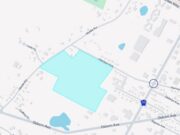
The Wastewater Recovery Facility, or WRF, would be inside a building on a site in the Enterprise Zone behind the Suffolk Credit Union branch on Flanders Road. McPherson said the building would be designed to mirror other prefab metal buildings in that industrial park, most of which are modern, attractive Morton buildings.
“It’s not like the old sewage treatment plants with the big pits everywhere,” said Town Planning and Development Administrator Janice Scherer, who added that the plant will be at least 250 feet away from any other building.
“It’s a building with built-in odor control, and if any odor did escape, it would be far enough away from anyone’s nose,” she said.

Who Will Pay For What?
A.J. Brooks, also of Arcadis, said the town will pay to hook up all existing homes within the boundaries of Phase 1 of the sewer district, including the installation of the grinder pumps, the abandonment of existing septic systems, and “maintenance of the system for the life of the system.”
Commercial property owners would have to pay to hook up to the sewer system.
Both commercial and residential hookups will eventually be mandatory, said Scherer, though property owners will be given a time period in which to join.
She added that sewer users will be charged for their use of the system, a cost the town anticipates will average about $250 per year.
Hayduk said the town can set the sewer rates using several different methods, including based on public water usage or based on the Suffolk County Health Department’s single family home equivalent calculation of 225 gallons per day of water use.
Neil Young of Flanders said he’s concerned that, because many people here don’t use their homes year-round, full-time residents would be subsidizing part-time residents’ use of the system unless it was based on actual water use.
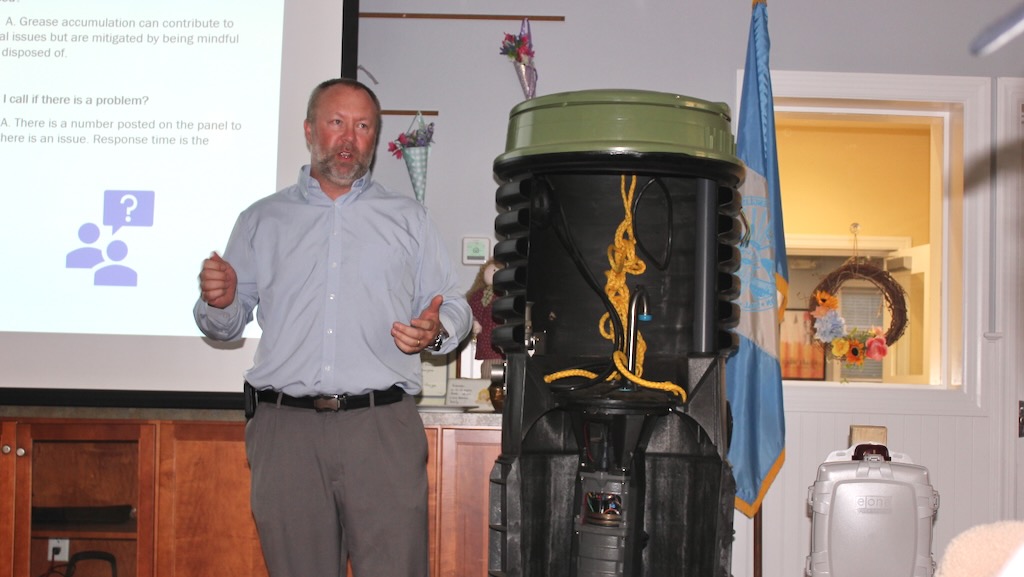
Sean Cameron of Site Specific Design gave an overview of the grinder pumps, which he said are 6 amp pumps that require a 30 amp breaker. He said the pumps run about 10 times a day for 30 seconds, and cost “on average less than $50 a year” in electric use. They are usually placed in peoples’ yards and their lids need to stick up several inches out of the ground for access and venting.
He recommended no one park on top of the lids when asked what would happen in neighborhoods where people often park several cars on their front lawns.
Cameron said the pumps have a built-in storage capacity that can handle short-term electrical outages, but they come with a generator hookup, and the town is looking into a “portable generator to provide power to evacuate the units until power is restored.”
He added that one of the most common issues with these systems is grease accumulation, and people who hook up to the sewer district will need to learn what not to flush down the drain in order to prolong the life of the grinder.
Survey and Questions
Arcadis is asking Riverside residents to fill out a detailed survey about their existing septic systems and other engineering aspects of their homes, to help them get a better idea of how each home will tie into the system. They said the survey must be filled out electronically, and it also asks residents to upload photos of parts of their homes. Arcadis representatives said they would visit properties to help residents fill out the surveys, particularly if they don’t have internet access.
The survey is expected to soon be posted online here: https://www.southamptontownny.gov/2144/Riverside-Water-Recovery-FacilitySTP
Members of the community were filled with questions about the sewer district and the plant — from the true costs and durability of the system to how well it will work in an area with overcrowded housing to whether the cost to hook up would scare new developers away.
Kathy Kruel said the neighborhood is filled with unregulated multifamily houses, and she’s concerned their sewer connection “is going to be breaking down every day…. A lot of these houses were made into two-family houses, and they have a lot of people in them.”
“When one of these lovely residences burns the pump up in two years, can you ask them to get a bigger one?” asked Carla Casper.
Cameron said that, if pumps are breaking down frequently, it would help the town “know who the abusers are, and that gives the town the opportunity to reach out to the owner of the property and say ‘we’ve got a problem.'”
Kruel asked what would happen at Habitat for Humanity homes recently built in the neighborhood that have new innovative alternative on-site septic systems.
Cameron said they would be required to hook up to the sewer plant, but the town would pay for the hookup and the decommissioning of the old system. Scherer said Habitat may be able to reuse their septic systems on another project.
Southampton Town Supervisor Maria Moore, who listened to the conversation along with State Assemblyman Tommy John Schiavoni and Town Councilmen Bill Pell and Tom Neely, said the sewage treatment plant will treat the wastewater in those homes more effectively than the advanced on-site systems.
Many in the crowd wondered if this technology would work.
Casper asked if a smaller pilot project could be installed “to make sure the community is comfortable with it. What happens if it doesn’t work?”
She also asked if it would treat PFAS, an emerging contaminant found in many household products.
“Why wouldn’t it work?” asked Scherer, who added that the cost of the necessary infrastructure would make a pilot project financially unfeasible. The other engineers and planners chimed in that this is widely used technology.
Sean McLean, a board member of the Flanders, Riverside & Northampton Community Association, whose firm, Renaissance Downtowns, worked with the community to create the original Riverside Revitalization Action Plan, said Suffolk County recently installed a very similar grinder pump sewage treatment system in Mastic, which he said had “similar ground and surface water conditions” to Riverside, and “they’re very happy with it.”
Brooks, the engineer from Arcadis, said “residential waste is not a major generator of PFAS,” but the plant is capable of adding carbon filtration if those compounds are found.
FRNCA Board Member Millie Roth said she’s concerned owners of commercial property may leave town if they have to pay to hook up to the sewer system.
“We will probably gain businesses — where they could only have dry uses, they can have a wet use,” said Scherer. “Someone who owns commercial property in this sewer district has a much greater opportunity to be agile and adjust to market conditions.”
The New Street Grid & Pedestrians
Neighbors also had quite a few questions about Historical Concepts’ plan to lay out a new grid of interconnecting streets throughout the community, and about whether it was wise to encourage walkability in an area that has suffered several recent pedestrian fatalities.
Casper said she didn’t think property owners would give up their land for a street.
“Historically, this area is not keen on giving up land,” she said.
Scherer said the roads would be created when owners of large parcels subdivide their land, as often happens in a subdivision, and property owners will be given bonus sewer usage rights as an incentive, which will allow them to develop their property more intensely.
Kruel said she lives across Route 105 from Riverside, in Flanders, and she can’t see herself walking there to visit the shops.
“I’d get run over on 105,” she said.
Scherer said the town envisions people living within the newly redeveloped downtown, and walking within the community to visit shops.
Councilman Neely said the town has built crosswalks that enable pedestrians to activate a ‘rapid flashing beacon’ to let motorists know they’re crossing on Montauk Highway in Bridgehampton, where he says 22,000 vehicles travel each day.
“We made those changes so Bridgehampton hamlet could remain a vital economic area, just like is envisioned here,” he said.
Scherer pledged to continue to hold meetings with the community.
“The only way we’re going to succeed is if we’re all in this together,” she said.
Correction: An earlier version of this story misspelled Steve Hayduk as Steve Hayduck. The correct spelling is Steve Hayduk.
The survival of local journalism depends on your support.
We are a small family-owned operation. You rely on us to stay informed, and we depend on you to make our work possible. Just a few dollars can help us continue to bring this important service to our community.
Support RiverheadLOCAL today.
