
























Suffolk County officials are pointing to the Navy’s cleanup of the Bethpage plume as a precedent — and warning they expect the same urgency in Calverton, where county testing shows contamination from the former Navy-owned Grumman manufacturing site continues to move through groundwater, surface water and fish habitat while federal cleanup efforts remain largely in the study phase.
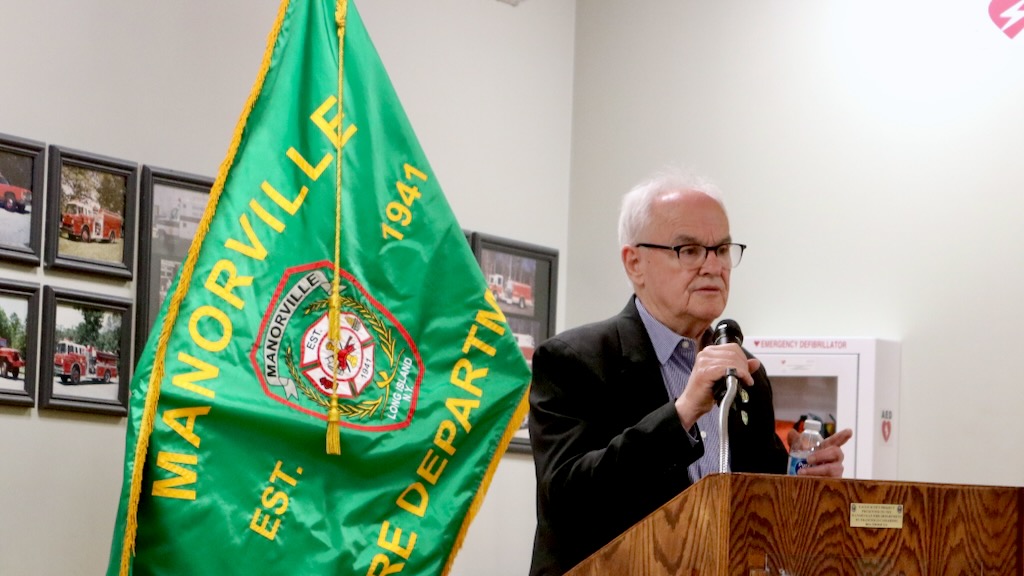
At a community meeting Tuesday night, County Executive Ed Romaine made clear Suffolk is no longer willing to wait.
“We are not without options,” Romaine said, emphasizing the county’s size, population and resources as he warned the county is not willing to tolerate indefinite delay from the Navy.
The contrast with Bethpage is hard to miss. There, after decades of delay and denial about groundwater contamination from a former Navy/Grumman site, the Navy and Northrop Grumman in 2020 agreed to a $406 million cleanup plan to halt the spread of a massive groundwater plume that had already polluted public water supply wells, according to the Associated Press.
That is the model Suffolk officials and environmental advocates say should now apply in Calverton: a former Navy/Grumman site, migrating contamination, public-water impacts, years of delay — and, eventually, an engineered containment plan funded by the responsible parties.
County Legislator Greg Doroski said the Calverton process remains stuck in the investigation phase after nearly 30 years and more than 60 RAB meetings. He pointed to Bethpage as proof that public pressure can force movement.
“How does the public motivate the Navy to get to the cleanup phase?” Doroski asked. “It’s happened in Bethpage, where they’ve allocated funds.”
Instead, nearly 30 years after operations ceased at the Calverton facility, officials and advocates say the Navy remains mired in incremental studies that proceed at the pace of “a pre-global warming glacier,” as Calverton Restoration Advisory Board member Adrienne Esposito put it at Tuesday night’s meeting.

Suffolk Health Commissioner Dr. Gregson Pigott said the stakes are high because Nassau and Suffolk have only one drinking water source: the sole-source aquifer.
“It’s very important to understand what’s going into that aquifer, what’s going into our groundwater, our surface waters,” Pigott said.
“What you’re going to see tonight … is quite eye-opening,” said Andrew Rapiejko, supervisor of Suffolk County’s Bureau of Groundwater Investigation and Management and a member of the Calverton RAB since 2007.
The Suffolk County Department of Health Services has conducted its own extensive sampling using test wells it drilled around the site. Its data revealed contaminant levels much higher than findings publicly released to the community by the Navy. Rapiejko said the Navy would not allow him to publicly share the county’s findings at the last RAB meeting in February.
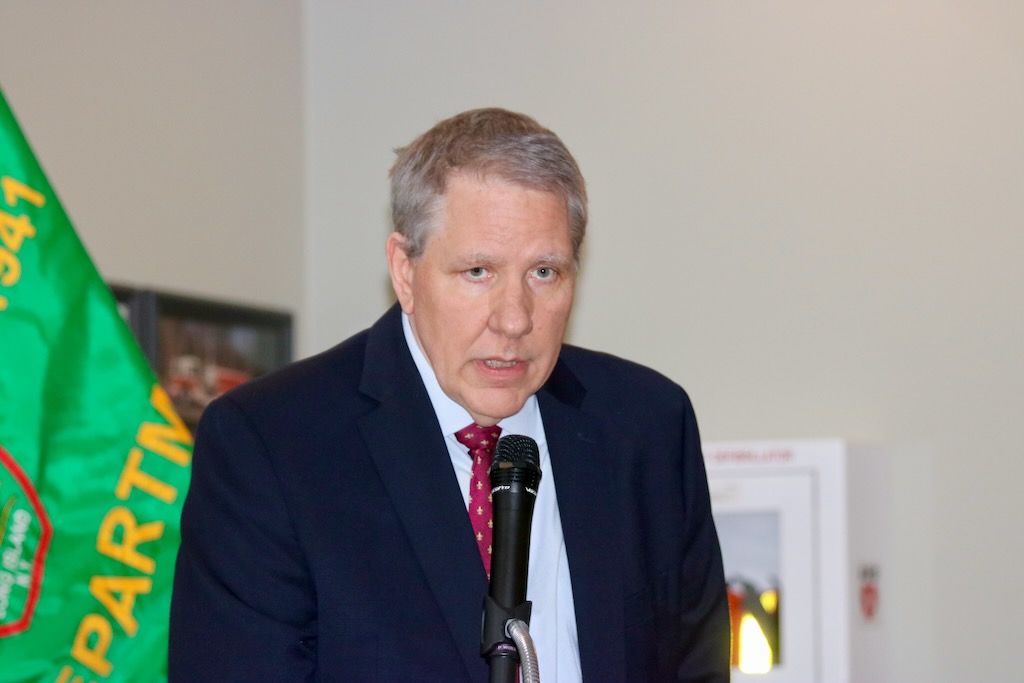
Rapiejko’s hour-long presentation detailed extensive contamination from known or suspected cancer-causing chemicals, including PFAS, 1,4-dioxane and volatile organic compounds, including trichloroethene, or TCE. In some cases, the contaminants were found at levels far exceeding state drinking water standards. His findings were based largely on independent testing conducted by the county health department.
He said the Navy’s practice of evaluating contaminants one at a time has slowed progress and failed to capture the full scope of the problem.
“Every other Superfund site I’ve ever worked on … you analyze for all the contaminants of concern,” Rapiejko said. “You just don’t analyze for one at a time.”
Rapiejko said the site sits on a groundwater divide, allowing contamination to move in multiple directions and at varying depths.
“This is probably one of the worst places to have a spill,” he said. “It’s called a deep recharge area, because…the depth of the contaminants will go very deep as well as going laterally.”
The county’s findings included PFAS in every groundwater sample collected in a key off-site study area, with some concentrations reaching thousands of parts per trillion. The state drinking water standard for certain PFAS compounds is 10 parts per trillion.
The county also found 1,4-dioxane at levels more than 10 times the state standard in some locations, Rapiejko said, and confirmed contamination entering the Peconic River.
Esposito, the longtime executive director of Citizens Campaign for the Environment, said proven cleanup methods already exist.
“This is not rocket science,” Esposito said. “Plumes are being cleaned up all across Long Island … You stick in an extraction well, you pull out the contamination and you treat it.”
“We’re really sick to death of waiting for the Navy to act,” she said.
Romaine pointed in particular to a roughly one-year delay in the Navy’s disclosure of PFAS levels found in fish at Swan Pond.
“How long did it take for the Navy to pass that information along?” Romaine asked. “One year.”
“We see movement, or we’re going to exercise whatever options we have,” he said.
Romaine said he intends to meet with Riverhead and Brookhaven officials and county legislators to discuss possible next steps.
Riverhead is in a unique position. The town owns most of the site formerly operated by Navy contractor Northrop Grumman. The Navy deeded the former Grumman property in Calverton to the town for $1 in 1998, but retained four parcels known to require environmental cleanup. Under the deed, those parcels were to remain in federal hands until the government determined that “all remedial action necessary to protect human health and the environment” had been completed. At that time, the Navy would issue a quitclaim deed to the Town of Riverhead.
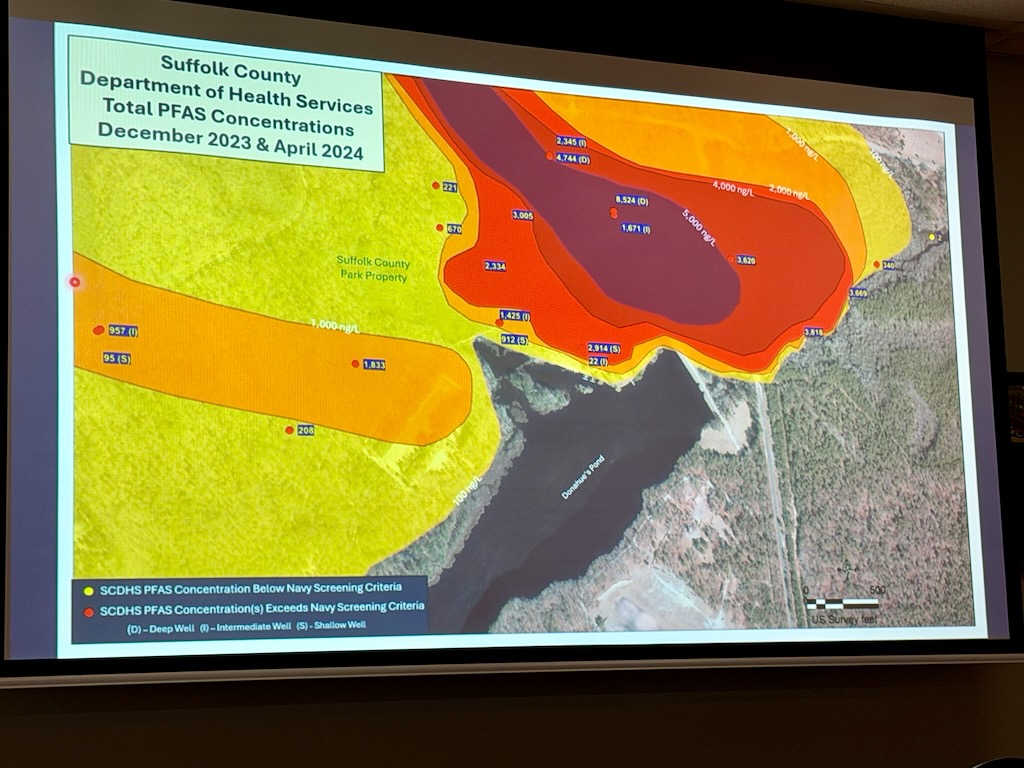
Nearly three decades later, county testing shows PFAS contamination continues to migrate beyond the former manufacturing site and is polluting the Peconic River, which flows south of the site. The county found PFAS in surface water at levels Rapiejko called unusually high for a flowing river.
PFAS contamination has also raised concerns about fish consumption. The state has already issued an advisory limiting consumption of yellow perch from Peconic Lake. County officials recently posted “no fishing” signs at Swan Pond after PFAS was found in fish there.
The decision frustrated local anglers, including Mark Fehner of Long Island Kayak Bass Fishing, who said Swan Pond and the Peconic River are important fishing areas for his club, which practices catch-and-release. Club members do not consume the fish they catch there.
“If we lose these waters … it’s going to put more pressure on every other lake,” Fehner said. “This isn’t just a local issue — it spreads.”
Rapiejko acknowledged those concerns but said the county acted cautiously while awaiting a formal state advisory.
Rapiejko recommended that the Navy immediately install groundwater treatment systems to intercept PFAS and 1,4-dioxane before they continue entering the river. He said the Navy should also test fish at multiple Peconic River locations, expand private well testing and investigate potential source areas the county has identified.
“A properly designed remediation system … you really can make an impact,” Rapiejko said. “You can do this.”
Meanwhile, tens of millions of dollars in public funds have been spent to connect homes south and southeast of the site to public water because private drinking water wells were contaminated by PFAS or are in the path of the Calverton plume. None of that money came from the Navy.
Riverhead Supervisor Jerry Halpin said after the meeting that the Navy must move beyond discussion.
“It’s time for the Navy to take accountability and begin action,” Halpin said. “They need to formulate an action plan and clean up our water so people have clean drinking water. It’s a basic human right.”
Council Member Ken Rothwell said the county’s testing leaves little room for dispute.
“The Navy cannot deny what sits before them — it’s in black and white,” Rothwell said. “They need to take action now.”
Riverhead Council Member Bob Kern said public pressure will be critical.
“Unless the Navy hears from a million and a half people, nothing is going to be done,” Kern said.
A consultant representing the Navy, Michelle Bostrom of Resolution Consultants, attended the meeting but did not speak beyond identifying herself when asked whether anyone from the Navy was present. She was observed taking notes throughout the presentation.
RiverheadLOCAL has reached out to the Navy for comment, but a spokesperson could not immediately be reached.
The survival of local journalism depends on your support.
We are a small family-owned operation. You rely on us to stay informed, and we depend on you to make our work possible. Just a few dollars can help us continue to bring this important service to our community.
Support RiverheadLOCAL today.
