
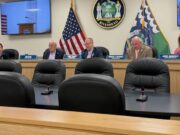











This week, the New York State Legislature will hold a public hearing to investigate the failures of the state’s utility and communication companies during Tropical Storm Isaias. On Long Island, to quote Yogi Berra, “it’s was déjà vu all over again.”
Watch the public hearing live online Thursday, Aug. 20 at 11 a.m.
Since 1985, we can tick off the names of the storms, Gloria, Bob, Sandy, and now Isais. We can also tick off the utility companies who responded, LILCO, LIPA, National Grid, and now PSEG-LI. The names of the storms and the utility companies change, but the story remains the same.
Storm warnings are issued for Long Island. We are assured by the utility company that every possible step has been taken to respond to the threat. The storm hits. The power goes out. The public can’t reach the utility company. The utility company assures everyone that power will be quickly restored. Days and often weeks go by before power is restored. Then the finger pointing begins. No one ever takes responsibility. The public pays the price.
Why do we always get the same catastrophic result? Because it was designed that way. The line from The Who’s 1971 hit “Won’t Get Fooled Again” comes to mind. “Meet the new boss, same as the old boss”.
While the name of the utility company and its leader change, the way our utility company is operated has not. There is a lack of transparency, oversight, and accountability, regardless of who runs the utility.
In 2013, after Superstorm Sandy, the State Legislature enacted the so-called “LIPA Reform Act”. I voted “no” It was clear this legislation would not change anything. First, responsibility for Long Island’s electric system was turned over to PSEG, a New Jersey company with no accountability to Long Island. Second, LIPA was reduced to a shell company, whose existence was continued only to maintain eligibility for federal tax benefits. LIPA’s board was still appointed by political leaders from Albany. LIPA’s authority to oversee the actions of PSEG-LI was limited. The State Comptroller’s oversight authority was eliminated. The New York State Public Service Commission (PSC), whose job it is to regulate utilities, was given no oversight at all.
Long Island’s electric company became the least regulated and accountable utility in the nation. What could go wrong? Everything.
Since, 2013, Long Island has seen the single largest rate increase in the history of LIPA. LIPA’s debt has continued to grow to an historic level. In spite of the fact that PSEG-LI was the recipient of more than $720 million in federal dollars, we were told the rate increases and the increased debt were needed to prepare for the next big storm. The infrastructure would be hardened, and communications would be improved. We would be ready. What did we get for our investment?
On August 4, 2020, Tropical Storm Isaias blew through Long Island. To be clear, this was not the 1938 Hurricane. It was not Superstorm Sandy. It wasn’t even Hurricane Gloria or Hurricane Bob. It was a tropical storm. Certainly, it was the most powerful storm during PSEG-LI’s tenure. However, for those of us who have lived on Long Island for any appreciable time, this would barely crack the Top 10 list.
The result was 420,000 customers without power and a communications system that failed in the first hour. Only PSEG-LI’s credibility with the public suffered more damage than Long Island’s electric system. LIPA and PSEG-LI made it worse by constantly misleading the public as to when power would be restored. The storm wasn’t nearly as big as Sandy, but the utility’s failure was. If builders built buildings like LIPA/PSEG-LI responded to the storm, civilization would have been destroyed by the first woodpecker that came along.
Calling for resignations or replacing PSEG-LI with another out-of-town utility won’t change anything. We need transparency, oversight, and accountability. In 1986, when LIPA was created, the vision of its sponsors was not the current “Rube Goldberg cartoon” organizational chart. Rather, the vision was to elect a LIPA board responsible to Long Islanders and to create a public power company to replace Long Island’s unaccountable, profit-driven, private utility (LILCO).
We should return to that vision. I have sponsored bills with Senator Jim Gaughran and Senator Ken LaValle that would (a) provide for an elected LIPA Board, (b) provide for a transparent ratemaking process, (c) give the PSC increased oversight over LIPA, and (d) restore the oversight authority of the State Comptroller.
As we move forward with an energy future that relies on renewable energy such as offshore wind and solar power, we deserve an electric company that is up to the task of implementing our new energy future. Transparency, oversight, and accountability will be critical. Let’s not get fooled again.
Fred Thiele (I-Sag Harbor) represents the First Assembly District in the New York State Assembly.
Editor’s note: The “In My Opinion” column is open to anyone who wants to submit a viewpoint on any topic. The opinions expressed in this column are those of the author and do not necessarily reflect the point of view of RiverheadLOCAL’s publishers. We welcome submissions. Be sure to include your email address and daytime phone number. Click here to
submit your opinion.
The survival of local journalism depends on your support.
We are a small family-owned operation. You rely on us to stay informed, and we depend on you to make our work possible. Just a few dollars can help us continue to bring this important service to our community.
Support RiverheadLOCAL today.
