






















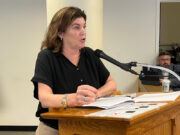


Denise Merrifield is one of two Republican & Conservative candidates for Riverhead Town council. The verbatim transcript below, made from an audio recording of the Oct. 9 interview, has been lightly edited for clarity (deleting repeated words etc.)
Please note that this conversation preceded this week’s Town Board vote to cancel the town’s contract with Calverton Aviation & Technology (CAT) to sell its industrially zoned land at the Calverton Enterprise Park.
Denise Civiletti: Should the IDA send the application — the CAT application — back to the Town Board, to find CAT does not have the financial wherewithal to develop a site — should that happen when you’re on the Town Board, if you get elected, would you vote to cancel the sale to CAT as provided in the March 2022 agreement between the town and CAT?
Denise Merrifield: Yes, I would, if they’re not found qualified and eligible. Yes, I would vote to cancel the sale.
Denise Civiletti: As you probably are aware, the planned development zoning district, which applies to the presently vacant land that’s now the subject of the sale, allows just about every commercial/industrial use as of right, with the exception of several that are allowed by special permit. Do you agree with that? Do you think that it would allow, for example, the construction of logistics centers in that area? Do you think that that zoning needs to be revised that was adopted after the 2016 plans for reuse plan for EPCAL? Do you agree with that zoning?
Denise Merrifield: First, I don’t know if the existing zoning allows for every kind of use right now, as part of that question. But I would want to make sure that the zoning — I would want to hold them to the zoning that one, noise pollution, air pollution, traffic, all of that is taken into consideration. I would want to make sure that — all of that — I’d hold them to the existing code, the zoning code that we have.
Denise Civiletti: The zoning — you have the exact language of it. I don’t know if we have that handy anywhere, but it kind of says any use that promotes economic development. I’m paraphrasing, that’s not exactly it. It’s really broad. It’s like a really broad, surprisingly broad, code.
Alek Lewis: Then there are supportive uses, supportive uses like residential.
Denise Merrifield: I don’t agree with residential use in there at all.
Denise Civiletti: That was very unpopular.
Denise Merrifield: I would want to take it on a case by case basis. I don’t want to just broadly say one thing or the other, I do want to wait for the comprehensive plan, also, to talk to this, because I think that’s very important. Because I think that plays a role into what can be developed there, and also how the square footage, for instance, like in the Industrial A [zone] and the industrial C [zone] over in the Calverton corridor. The group, I think it’s BFJ, they had one suggestion, I thought, that was very useful with putting TDRs on that kind of industrial build, and concentrating the floor space to make it smaller, and if they want a larger floor space, pay for that with TDRs. That will help land preservation. So I think everything’s on the table in terms of moving forward. But I do think with the guidance of the comprehensive plan —
Denise Civiletti: I don’t think this [comprehensive plan] is actually addressing the zoning inside the fence.
Alek Lewis: Primarily because, in the contract of sale to CAT, the town isn’t allowed to change the zoning for five years.
Denise Merrifield: Presuming this doesn’t go — if it’s canceled — these are things I’m looking forward to doing if this is not a sale.
Alek Lewis: But the point is, the comp plan isn’t analyzing that, because it’s sort of up in the air right now.
Denise Civiletti: They’re not going to be making recommendations on what goes in.
Denise Merrifield: You can utilize those recommendations, that’s what I’m saying. That type of recommendation that they’re looking for, over in the industrial corridor — use that same type of rationale, that kind of business plan basically, for inside the fence, so to speak. Outside the fence, inside the fence.
Alek Lewis: If that happens, and you vote, and the Town Board cancels the agreement with CAT, what’s the plan going forward with that?
Denise Merrifield: First of all, there should be a new marketability study. I do agree with Tim Hubbard on that point, that that was done so long ago, and I’m sure today, that property is worth a lot more than what it was back then. And also, different types of uses, not necessarily industrial uses. I know they’ve been trying for years to get tech, high tech in there. I would still like to see something like that. I’m open to all kinds of considerations.
But I do not want mega warehouses. I don’t want them anywhere in the town. I don’t think they provide a lot of jobs for anybody. I do think that they create a great deal of traffic that I don’t think anybody wants, anywhere in the town. So, basically, what I’m doing is, I’m saying what I don’t want. I have an open idea of what I am willing to look at, if I were to be on the Town Board.
Alek Lewis: Could you define what you mean by ‘mega warehouses?’
Denise Merrifield: Huge monolithic things that we see over in, say, Pennsylvania, or out in California. I’ve seen in some of the articles that you’ve printed, where these things are like five blocks long, they’re immense. And they’re a blight. I think they’re a blight on the community.
Denise Civiletti: At least one or two of those pictures were from a warehouse, because I researched what the picture was a picture of, that’s actually not any bigger than what’s been proposed on Middle Road.
Denise Merrifield: Well, I’m not in favor of mega warehouses.
Denise Civiletti: I know, I know.
Denise Merrifield: I’m not saying I don’t want warehouses. I want to make sure I’m not sounding like I’m saying two different things. I’m just not for immense, huge warehouses, that are, I feel, a blight on a community; that don’t offer a lot of job opportunity.
But I am for some warehouses. You do need economic growth. There is an industrial corridor over there, that is zoned industrial, and that area can help economic growth with the town, can help with taxes, can create revenue for the town. So I’m not saying no to any type of warehouse, but I think it’s a case by case basis. I think it’s also: What’s the impact on the local community? That’s what I mean about the comprehensive plan. What’s the road going to look like, in terms of traffic that would be on that road? I travel that road, right off of Bean & Bagel (Cafe), and down the road further, that I know they’re working on — is it 2025 that they’re revamping Edwards Avenue. Honestly, that should have been done years and years ago, when they put the FedEx building [in]. I travel that way to work all the time when it worked in the DA’s office down towards the court center and there should have been a turning lane in there, back then. I thought it was ridiculous. They put sidewalks to nowhere there.
But back to your point, I do think that there should be some type of industrial development in the area. But I do not think it should be mega warehouses. I think it should be, as I’ve always been saying, smart economic growth. I do think it should have setbacks so that it’s not visible to the public, much the way solar farms do now, where they try to create buffers where you can’t really see any of it. I know in particular, there’s one on [Route] 25A over Shoreham that was a golf course right on the road, that they’ve placed it back far enough and placed enough treeline where it’s not visible to the eye. So I am for things like that, with all of those caveats. Traffic considerations, beautification of an area, and utilization of the land that could be for industrial growth. But not monstrosities. I don’t think that’s useful.
Alek Lewis: So I was about to ask, because you seem to be familiar with what BFJ is planning for revamping the industrial zoning: How do you reconcile the ‘I don’t want mega warehouse’ position with the fact that what they’ve proposed with BFJ is being allowed to use the TDRs to increase the height to, I believe, it’s a 40 feet maximum, and then increase the floor-area ratio, although the I believe the floor-area ratio would be smaller. But how do you reconcile those positions?
Denise Merrifield: I said in the beginning, it’s a case by case basis. There are some situations where maybe you could allow it. Again, remember, what is that for? The reason that you might allow a little height and a little length is for TDRs, because — what is that for? Land preservation, farm preservation. That’s what everybody in our town wants — beautification. To keep this a country town where we have those farms. You can’t expect the taxpayer to pay for that, we could never do it. So you have to have commercial development that can help contribute to paying for that. That is one way. I’m not saying you let you know, we turn into Long Island City to preserve some farmland, I just want to make sure everybody’s understanding me. For some, it has a trade off and the trade off is: Do we get to keep some beautiful farm country in order to allow some of that? Because I feel that’s the greatest goal for the community. Everybody wants the land. The present mission is to keep the farmland preserved, and that TDR opportunity to use it in those situations, not every one of them — that’s what I want to make clear. Not every one, not carte blanche. Not ‘Oh, sure, just build, build, build.’ But I do want to say on a case by case basis, location by location.
Denise Civiletti: Do you think there’s just too much industrially zoned land in Riverhead? Particularly in Calverton? Should there just be less of it?
Denise Merrifield: No, I don’t think so. I think that every town should have some industrial development. I do. But I would like to keep — we did have an immense farm community. What did we have 2000 [acres] that we’ve preserved, now, we want to go for another 7000 [acres]? I would love to see if we could preserve even more. But I don’t necessarily think that you have to scale back the industrial [zoning]. I agree a lot with things that are discussed in the comprehensive plan, changing it from some of it from [industrial] ‘A’ to maybe making it all [industrial] ‘C,’ maybe not having it all one particular type.
Denise Civiletti: So there’s been a lot of talk about the exemptions that current board members have, for things like the moratorium, where projects that are in the pipeline, and the definition, what that means exactly keeps changing here and there, it keeps getting rethunk, I guess, but when it comes time to adopt zoning, to implement the comp plan, once that’s finished, there’s going to be the opportunity to decide whether or not you’re going to exempt things that are already in progress to some extent, people that have filed applications, people that have begun the environmental review process, that kind of thing– to exempt them from the new zoning. Would you favor that? I mean, that’s been something that’s been favored by the Republican majority on the board. Do you think that’s a good idea?
Alek Lewis: And where do you draw the line on exemptions?
Denise Merrifield: First of all, I agree with a moratorium until a comprehensive plan. You’re talking about the industrial build one right now, right?
Denise Civiletti: Well, I was using that as an example, and only as an example, of the issue of carving out exemptions from the application of that law.
Denise Merrifield: I can speak to the industrial build with regard to that, that’s where I’m going to give my answer.
Denise Civiletti: Let me try again. When they adopt the master plan and the comp plan update, right? In order to turn that into land use rules, it has to be adopted in the code. So when you do that, would you favor exempting pending applications, let’s say, from the new code?
Denise Merrifield: I’m going to speak again to the industrial builds. With regard to that, I think that it should be stopped. Because what is the point of the comprehensive plan, if everybody is just going to keep rushing in right now? We would lose an opportunity to get the TDRs that we want.
Denise Civiletti: That’s to the moratorium.
Denise Merrifield: I do agree with — I’m sorry. I apologize. I thought the question was, ‘Would I agree, in moratoriums, including items that are in the application process already?’ I’m like, yes.
Denise Civiletti: I just used the moratorium as an example. Let’s say the comp plan recommends industrial zoning that requires greater setbacks, that requires smaller footprints, that requires fewer uses. Now, somebody, because they didn’t put a moratorium in, somebody filed an application. That application is being reviewed. Should that application be allowed to proceed under the old code? Or will the new code requirements apply to it?
Denise Merrifield: I think that’s a process, when it comes to the laws that they enact, whether or not they’re going to grandfather or not. That would be something to determine, whether they could do that or not. I’ll say legally, I don’t have that specific knowledge right now, whether or not they legally have the right to say ‘you can’t be grandfathered, you have to actually apply to this.’ I leave that to the town attorney right now.
Denise Civiletti: If the law allows that, you’d consider it, then?
Denise Merrifield: If the law allows us to say ‘you’re in the pipeline, but we want to change our code right now,’ if the law allows us to do that, then I would like that, because I really do want to follow the comprehensive plan. I think that’s best for the community. And [for] the developers, it depends on what they’re looking to build.
Denise Civiletti: Are you familiar with the county’s sewer septic proposal for the eighth of a percent sales tax increase?
Denise Merrifield: No, I’m more familiar with the fact that they want to do the pipeline across the Peconic Bay. I’m familiar with that proposal.
Denise Civiletti: Alright. The County Executive [Steve Bellone] and the county administration, they got a law passed in Albany that would allow the county to raise the sales tax an eighth of a percent, specifically to fund the installation of advanced septic systems, and all those innovative septic systems that cost a lot of money. They’re hard for people to put in.
Denise Merrifield: I do know something about this, in that county exec Bellone wanted to give people — it had something to do with — if you purchase this, you were going to get an exemption on your taxes, or something, and it turned out to be with that.
Denise Civiletti: But this was something that was passed this last session up in Albany, and it gives the county the ability to do this — but it would have to be subject to a referendum, it has to go on the ballot.
So the county, the administration, tried to get this done. It got hung up in the legislature, there was a lot of dispute about it. Frankly, pretty much along party lines, especially the second time around. There was a lot of Republican opposition to it, with Western Suffolk legislators, saying that it spent too much, or that the law would allocate too much of that sales tax revenue to advanced septic systems, which primarily benefits the East End, and not enough to sewer district improvements, which would benefit the western towns of Suffolk. Because the eastern towns of Suffolk don’t really have [sewer systems], Riverhead is kind of the exception to that rule with our sewer system. So, just wondering if you support that, or would express support for that or not.
Denise Merrifield: Well, I don’t really know enough about that to answer you right now, and it doesn’t really specifically apply to Riverhead.
Denise Civiletti: Well, it would, because it wouldn’t give people who are not in the sewer district, for example, access to grant funding coming through that revenue stream to install these advanced septic systems.
Denise Merrifield: Where is that? Which people?
Denise Civiletti: People who are not in the Riverhead Sewer District.
Denise Merrifield: I know. I’m asking where that is.
Denise Civiletti: A good part of the town is not in the sewer district. I don’t have the map committed to memory, but it’s pretty much downtown, Route 58 — it’s not north of [Route] 58; I live north of [Route] 58 and we don’t have a sewer, we have a cesspool. Then there’s all kinds of people along the [Peconic] Bay, in Aquebogue, in Jamesport, everywhere north of [Route] 58, is outside the sewer district. I mean, it’s a good chunk of the town.
Denise Merrifield: I apologize, I don’t have enough working knowledge right now.
Denise Civiletti: To be fair, you wouldn’t have a vote on it either, other than as a resident. But I was wondering if there would be support for it, like would you advocate for something like that? But it’s fair to say you don’t know.
Denise Merrifield: I’ll answer the question when I have more information given.
Denise Civiletti: That’s great. We talked about TDRs and farmland preservation already. You’ve made your position about the Riverhead IDA pretty clear. You support the institution to promote economic development in Riverhead.
Denise Merrifield: Rather than some other agency doing it.
Denise Civiletti: So besides transparency, would you like to see any other changes in the IDA’s activity in any way? Maybe the kinds of things that they provide assistance for? The kinds of follow-up and monitoring of the results of the benefits? Things like that. Do you have any thoughts about that kind of thing?
Denise Merrifield: Well, I definitely support the position in Albany right now to not allow the IDAs to exempt school tax. I fully support that. I know you can’t do that on a local level, it has to be done by the state. So I would support that. I do think that they should still have to pay the school taxes. That’s something I’d like to see change.
Alek Lewis: Obviously, affordability is a huge thing on Long Island. We have an affordability crisis. Do you think there’s an affordable housing crisis in Riverhead? And what should the town’s role to make living here in Riverhead more affordable?
Denise Merrifield: Well, from my understanding, we have 30% low-income housing in the town, and I believe we have more than any other eastern town on Long Island. So, I think we’re doing a pretty good job with affordable housing. I know a number of the apartments downtown are also affordable housing units. So, I think that’s a great help and assistance to helping affordability for people.
Alek Lewis: So, to be clear, you don’t think that there’s an affordable housing crisis in Riverhead?
Denise Merrifield: That’s not what I’m saying. I’m saying there’s an affordable housing crisis throughout the country. We have homelessness everywhere in the country. So, my position is: I think that Riverhead is doing more than their fair share in trying to help that situation out.
Alek Lewis: Do you think anything else should be done to address that on the town level, or no?
Denise Merrifield: I think they have tried to address it by increasing low-income housing for affordability, as I said, more so than any other eastern town has on Long Island. I think they should get credit for that, in terms of trying to really help the situation.
Alek Lewis: Related to that: would you support the town adopting a 0.5% real estate transfer tax to generate revenue for a town-sponsored affordable housing initiative? If so, what would you like to see that money used for?
Denise Merrifield: If I understand your question, I think that we already do have something in that effect with the downtown revitalization initiative and other grant money that came in, it was to help with housing for low-income and affordability.
Alek Lewis: I’m specifically talking about the Peconic Community Housing Fund, I think is an actual name. It’s the law that was passed in Albany by Assemblyman [Fred Thiele] and Senator [Anthony Palumbo] that allows East End towns to put on the ballot referendum for an additional half-percent real estate transfer tax on top of the real estate transfer tax with the Community Preservation Fund for farmland preservation and using that money — you accumulate that for community housing initiatives, subsidizing housing on the town level.
Denise Civiletti: That could also consist of, just to clarify, things like grants for down payment assistance, grants for closing costs assistance, not just subsidizing the development of larger-scale projects. It could help provide grants for people to create accessory apartments.
Alek Lewis: Riverhead was the only East End town not to adopt this last year.
Denise Merrifield: Well, I don’t, from my standpoint as a taxpayer in Riverhead, I don’t want to put any more additional taxes on our residents right now, especially considering the budget that is being proposed. In considering inflation as it is in this country right now, at this time, I don’t think it would be a helpful thing for the residents. I do not think so. I think that would be an additional burden on the residents that are in the town right now —
Denise Civiletti: When they go to sell their home.
Denise Merrifield: When they go to sell their home —
Denise Civiletti: It’s a transfer tax.
Denise Merrifield: Same thing. I mean, because even if you sell your home, you’re going somewhere else where — we have a lot of inflation in the country.
Denise Civiletti: I just want to make sure we’re all clear what we’re asking you.
Denise Merrifield: I don’t want to penalize people for selling their home and sometimes that might be viewed that way if they have to pay additional taxes to get out, basically. I just don’t think that the economic situation that the country is in right now, and the town is in right now — I wouldn’t be in favor of something like that right now. I’m all in-favor of grants for low income and affordable housing. I think the town does a really good job right now of trying to get as much grant money as possible to help the community in those areas.
Denise Civiletti: I have a question that relates to undocumented residents. You’ve stated unequivocally your opposition to allow what you refer to as unvetted migrants. Putting aside the whole issue of asylum seekers, to set that aside — our economy here, particularly you talk about wanting to preserve agriculture and farming, our farming economy here is very, very reliant on undocumented residents.
People that came in, crossed the border, could have been two years ago, could have been 10 years ago, but they came in and they don’t have documents. The farming community has advocated for an increase in the number of the agricultural work visas forever. There have been some small adjustments to that, which allow people to come here to work and then go back, and then come back again. It’s a very small percentage of the farmers’ actual workforce here.
So, I’m just wondering, what do you do to reconcile opposition to unvetted/undocumented migrants, which everybody understands people coming in without documentation and not living here legally and not being able to live in a community legally. How do you reconcile that to what the farming community really needs? Because they’re desperate for labor. My point being: there’s another side to that, that has a very real local impact here for a community that we all profess the value of and want to preserve and encourage to continue. Farming.
What do you say to the farmers that say they need this labor? Recognizing that you’re not going to be in congress, where you can’t do anything about that.
Denise Merrifield: Is this a compound question? What’s the one question?
Denise Civiletti: This is the dilemma though, don’t you see? The question is — it’s complicated. You’re seeing why?
Denise Merrifield: If I understand the question, tell me if I’ve got this right, you’re saying: there’s the economic side, versus —
Denise Civiletti: It’s their workforce.
Denise Merrifield: Well, it’s not their entire workforce.
Denise Civiletti: It’s most of their workforce.
Denise Merrifield: Back to the very beginning, I want to first say that I am absolutely for legal immigration into this country. Everybody has come from somewhere else. I would love as many people as possible to come into this country, but legally. Obviously, I would want to help them, and encourage people to come into this country legally from every part of the world. I can’t separate the unvetted, in the sense that, if you’re looking to sacrifice safety for people for economic reasons, for economic reasons, I can’t separate the two. In the sense that ‘putting aside unvetted,’ I can’t put aside unvetted.
Denise Civiletti: Let’s put aside the so-called asylum seeker issue.
Denise Merrifield: That’s what I mean. The unvetted part is part of that, when you say asylum seeker, because they’re not vetted, the asylum seekers. You don’t know the health backgrounds of these individuals, you don’t know the criminal records of these people — you really don’t. So I can’t say that I would say ‘oh, well forgo all of that worry and concern,’ because maybe these — I don’t know, these people. One of the things that always concerned me was: those people don’t have to get vaccines when they come into this country. All of us do, all of us had to get vaccines, but they didn’t. So that’s a health concern. And then, like I said, there are people that do have criminal backgrounds. Some people, I know from my experience as a [district attorney], reenter the country illegally, just use a different name, and they actually come back to the same communities they were in, even. So, that’s what I mean about: there is a real issue about unvetted [people]. So, what, do I think that we should just ignore all the safety concerns for the sake of the economics of the farmers?
Denise Civiletti: Have you spoken to the Farm Bureau about these issues?
Denise Merrifield: No. You asked me how I make a distinction.
Denise Civiletti: How do you reconcile between wanting to, for lack of a better way to put it, restrict undocumented immigration, which I think, if given a perfect world, I don’t think anybody disagrees with that — but between wanting to do that, wanting to accomplish that, and addressing the actual, real current needs of your constituents and an important part of our economy here, and our way of life. Everybody wants farming.
Denise Merrifield: Well, they’re not the only constituent — that’s the issue. Then, with them, comes a whole bunch of other burdens to the rest of the taxpayers in the community. The farmer shouldn’t necessarily just get an economic benefit while everyone — for instance, the schools. The schools are tremendously overburdened as it is right now, so that person comes in with their family, the taxpayers are paying for everything to do with that child in the school. I know from watching the Town Board meetings that the school is upset just about people coming to the apartments in downtown, saying that they don’t have the room. So you bring in the undocumented families, their children are going to go to school, that’s a burden on the rest of the taxpayers.
This is not a slight against those migrant work individuals, but they’re not legally allowed to work in the country, for the most part, so they can’t even contribute to the school taxes, to help support the economy. The same thing with all the other services that they get in the town. I know, for instance, when I was at the [Riverhead Country Fair] on Sunday, I spoke to a woman named Gwen, lovely lady from Harvest Church. She has that pantry, there’s seven food pantries in the town right now, and she serves 65 families every week — 65 families every Tuesday, in addition to the number of families she serves twice monthly. She said they don’t have enough for people. So, those are real economic concerns, and burdens on everybody else in the community. I don’t think that the farmers, I don’t think the farmers should get a benefit that put additional burdens on every other taxpayer in the town.
Alek Lewis: You said, during a candidate forum, that a priority of yours was engaging with the town’s youth.
Denise Merrifield: Yes.
Alek Lewis: How do you accomplish that goal, as a practical matter?
Denise Merrifield: One of the recommendations I would like to propose is: there are a number of activities that the town has, the bowling alley, this new hockey rink, this new wave park, Splish Splash — just to name a few. I would like to see these different business entities contribute and give back to the community and allow the children of the middle school and high school ages to be able to attend these events, maybe once a month. “Like maybe one time on a Tuesday, the bowling alley lets all the kids in the school district go there, and the next week the hockey rink lets them have free sessions at the hockey rink. That’s what I mean about engaging youth and giving them places to go.
Alek Lewis: That’s great, but how do you do that as a town councilwoman?
Denise Merrifield: I would hope that it would be a great idea. I would like to see the businesses agree to do that with the town, and maybe — I think they would, I think they would.
Alek Lewis: Like town-sponsored events?
Denise Merrifield: Just the businesses sponsoring the event, not necessarily the town paying. You show your school ID. For instance, my kids grew up in the Shoreham-Wading River school district, but they’re Riverhead residents. So, you show your Riverhead library card, or you show your school pass, and you can go free that night. I’d like to see the businesses do that, give back to the community, not necessarily be the town doing that, maybe in the future, with other businesses, maybe make that part of a contract. That you give back to the community. I can go on and on, because I am all about the kids. I’ve been working in child abuse and domestic violence in the DA’s office all these years, and seeing what happens to youth when you don’t have positive alternatives to just hanging out, getting into trouble, basically.
For instance, maybe you’d have the different businesses that come in chip in to help fix the skatepark that’s in disrepair, maybe have all of them chip in to do something to fix that. Those are just some ideas, because I did go to CAP, at the fire department, and it was one of the things I walked away with. Over in the fire department, months ago, they had a bunch of kids from the high school surveyed. They had everybody in the room guess how many liquor and beer places, that weren’t bars, that you could obtain alcohol. And the number was huge, compared to places kids could go. And it just struck me, like we have to do something about this. Because you’re sending the message, otherwise, just drink, just get high. Don’t do productive things; have fun away from those types of activities. I could go on and on.
The survival of local journalism depends on your support.
We are a small family-owned operation. You rely on us to stay informed, and we depend on you to make our work possible. Just a few dollars can help us continue to bring this important service to our community.
Support RiverheadLOCAL today.
