





















Big changes are ahead for local elections, after Gov. Kathy Hochul on Friday signed a bill moving most town and county elections to even-numbered years beginning in 2026.
The bill, passed by the State Legislature in the closing hours of the legislative session in June, will align most local elections outside of New York City with federal and state elections. The stated goal of the measure is to boost voter participation in local elections, according to Democrats who control both chambers and pushed for its adoption. The bill was vehemently opposed by Republicans, who argued it was an attack on local control in counties outside of New York City.
Hochul announced Friday evening she had signed the bill into law.
“By consolidating more elections in even-numbered years when most voters are already planning to participate in an election, this change will increase voter participation in important local races,” Hochul said in a press release. The governor pointed to turnout numbers in recent elections, noting “millions more New Yorkers participated in elections in 2020, when approximately 64 percent of eligible voters cast their ballots, than in 2021, when just 25 percent of eligible voters turned out to take part in local elections around the state.”
“The purpose of our bill to move local elections to higher-turnout even years is simple—to ensure as many voters as possible can weigh in on their local leadership,” bill sponsor State Sen. James Skoufis (D-Orange County) said on the social media platform X, after the governor announced Friday evening she had signed the bill into law.
“This is the first step of many to ensure that every election is a representative one,” Skoufis said.
The legislation does not affect elections in New York City and certain county offices statewide, such as sheriffs, district attorneys, county clerks and county judges, which require an amendment to the state constitution for a change in election years, according to the bill’s sponsors. The governor on Friday announced her support for a future amendment to the New York State Constitution that would align elections for all offices, which she called “a fiscally responsible approach that would reduce the taxpayer cost of election administration by avoiding the need for elections to be held every single year.”
Senate Minority Leader Rob Ortt called the measure a “bill ending local elections.” In a statement issued after the governor’s announcement, Ortt said “the touted benefits are a total sham concocted to hide Democrat’s goal of expanding one-party control to every level of government.
“Local elected officials from both parties have raised serious concerns that moving local elections will quash discussion on important community issues and inject national partisan politics into races for our local offices,” Ortt said.
The New York State Association of Counties opposed the bill, arguing that it will take the focus off important local issues.
Steven Losquadro, legal counsel to the Suffolk County Republican Committee said in an interview Wednesday the change will mean “local issues will be drowned out… lost in all the mega-spending that comes with federal and state races.”
The change does not bode well for good government on the local level, he said.
““Local government touches us most fundamentally. Local government has the greatest impact on our lives, because of quality of life — zoning, road maintenance, garbage collection. Local issues are going to be drowned out,” Losquadro said.
The ballot itself will marginalize local races, he said. Federal and state offices will be at the top of the ballot, and local offices will be at the bottom, Losquadro said.
“What happens to the down-ballot races that are the things that concern us the most in our everyday lives? I think it’s a travesty. I really do,” he said. “It seems to favor New York City and Albany interests, as opposed to Long Island and suburban interests,” Losquadro said.
Suffolk County Republican Party Chairman Jesse Garcia called the change an effort to “rig local elections to favor Democrats.”
In Riverhead, where the town supervisor has a two-year term, the person elected supervisor in the next local election, coming up in 2025, will be elected to a one-year term. Another election for town supervisor will take place in 2026.
Town council members elected in 2025 will be elected to a three-year term, which will begin in January 2026 and expire Dec. 31, 2028. Thereafter the four-year terms of office will be filled in even-numbered years. Town council members elected in 2027 would be elected to a three-year term beginning in January 2028 and expiring Dec. 31, 2030, after which the four-year terms will be filled in even-numbered years.
The changes do not affect the terms of office of persons elected this year.
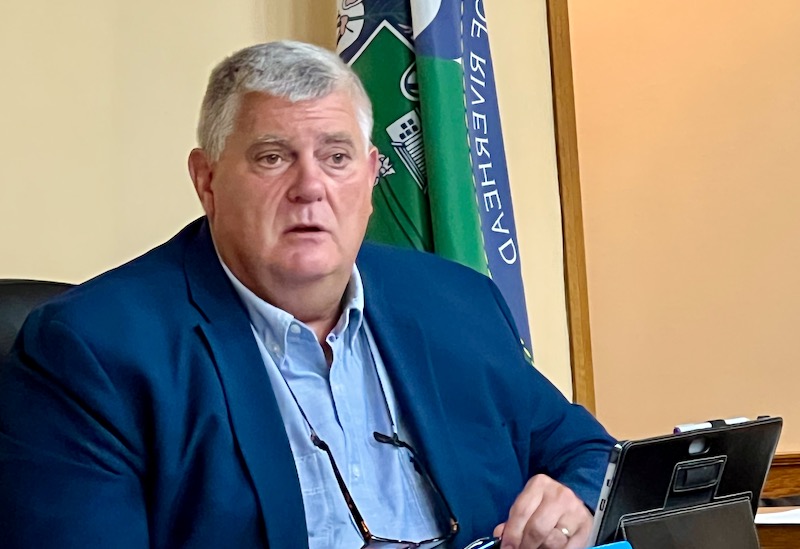
Riverhead Supervisor-elect Tim Hubbard (R ) said the change forcing a town supervisor to have a one-year term in 2026 is “absolutely ridiculous.” As it is, he said, “two years is too short.” It’s going to be costly to hold town elections two years in a row, as well. “It just doesn’t make any sense.”
Hubbard said the transition to even-numbered years will create issues with the town’s 12-year term limits for town supervisor and council members. “For the board members that run in ’25, for a three-year term, they’re not going to be able to serve three full terms. Because the third one, will put them over the 12-year limit,” he said.
Hubbard also expressed concern that local issues will be lost in the noise of federal and state elections. Local issues deserve more attention from local residents, not less, he said. And while he would like to see greater participation in local elections, he doesn’t think switching them to even-numbered years is the way to accomplish it.
The odd-numbered year, local elections in Riverhead Town typically draw a voter turnout of about 40% of registered voters. Turnout for local elections in western Suffolk towns is typically much lower, with some under 20%, according to data published by the Suffolk County Board of Elections; turnout for local elections in the five East End towns is similar to turnout in Riverhead.
Turnout in presidential election years — every four years in even-numbered years — is typically about 70% or even a bit more in Suffolk County, according to county election data.
Turnout in “mid-term” federal and state elections — held every four years in even-numbered years midway between the presidential election years — is lower than in presidential election years, mostly between 45% and 55%.
Riverhead Town Democratic Committee Chairperson Laura Jens-Smith, a one term Riverhead Town supervisor, said she thinks the change is good. It will make voting in local elections more convenient for more people, she said.
“Any election that has more people voting in it is better,” Jens-Smith said.
She said she doesn’t think local issues will necessarily be eclipsed in even-year elections. The switch may even help engage voters in local issues.
“I think sometimes when you have a bigger election, people are more in tune to what’s going on,” Jens-Smith said. “With more publicity, maybe people will pay more attention to local issues. I think it has the potential to help.”
The survival of local journalism depends on your support.
We are a small family-owned operation. You rely on us to stay informed, and we depend on you to make our work possible. Just a few dollars can help us continue to bring this important service to our community.
Support RiverheadLOCAL today.
