
















The developer of the first building going up in a special district created to revitalize the area around the Riverhead railroad station is mired in debt totaling more than $16 million, according to pending lawsuits, judgments and contractors’ liens.
Work on the five-story, mixed-use building at 205 Osborn Avenue, at the corner of Court Street, has been stalled for months, catching the attention of passersby and people who work in the area. Since at least late spring, there’s been no sign of work at the construction site, where the building sits unfinished, a shell without exterior siding, its first-floor windows and doors boarded up with plywood.
The developer, G2D Construction Corp., owes $1.87 million to several different contractors hired to work on the project, known as Station One, according to Suffolk County records of mechanics liens filed against the property. These include contractors hired to provide concrete foundation materials, roofing, HVAC and plumbing fixtures, doors and glass, and fire sprinklers, according to the lien documents. One contractor has filed a notice of pendency and foreclosure of lien action against the company.
In addition, GD2 principal Gregory DeRosa of Oyster Bay is named as a defendant in seven additional lawsuits filed over the last few months in State Supreme Court in both Suffolk and Nassau counties, by lenders and a former business partner, claiming DeRosa defaulted on payment agreements.
Three of the lawsuits involve “merchant cash advance” agreements, in which the borrower — the “merchant” — promises future income in exchange for often quick, very expensive funding to provide cash flow for its business.

In two cash advance agreements, G2D and DeRosa promised income from multiple business entities — nearly all of which are real estate developments owned by limited liability companies owned by DeRosa, according to the documents — in exchange for nearly $1 million in funding provided to G2D Development Corp. and the various “merchant” entities listed in the agreements. These “merchant entities” include both 205 Osborn Avenue LLC, which owns the Station One site, and 331 East Main Street LLC, the name of the company that owns the mixed-use apartment building at that address, completed by G2D in 2022.
The agreements, with Parkview Advance and Celtic Advance, carry estimated annual percentage rates (APRs) of 251.38% and 381.23% respectively, according to the documents. Each also required payment of tens of thousands of dollars in fees, which were deducted up front from the funding amounts. Each required daily payments — $7,248.04 to Parkview and $12,622.23 to Celtic — which were to be deducted from a designated bank account that G2D and DeRosa promised to keep open and into which they promised to have all income from the various businesses deposited, the documents state. DeRosa signed a personal guaranty for each agreement.
Diverting the income from the designated bank account would constitute a default, according to the agreements. The lawsuits filed this month by Parkview and Celtic claim that G2D and DeRosa changed the designated bank account without authorization and stopped making the payments required by the agreements.
A third cash advance agreement, with Blade Funding, also resulted in litigation alleging G2D’s default. G2D and DeRosa in July entered into a settlement with Blade, agreeing to pay Blade $1 million plus interest and attorneys’ fees. G2D and DeRosa then signed a confession of judgment — a document agreeing to the entry of judgment without trial — for the full amount of the settlement.
DeRosa has signed three other confessions of judgment obligating him to pay roughly more than $8.7 million, plus interest, in three lawsuits filed by lenders, court records show.
DeRosa is also being sued by a former partner in a Huntington development. DeRosa had agreed to pay the partner for his 49% stake in the development, Gateway Plaza, but defaulted on the agreement, according to documents filed in court. The former partner is suing DeRosa for the nearly $4.5 million he claims is owed, plus interest.
G2D also has an outstanding $12.75 million mortgage loan secured by the 205 Osborn Avenue property. There is no indication in property records that the mortgage is in default.
G2D owes the Riverhead Water District a substantial sum for the water main extension to the Osborn Avenue site, according to Water District Superintendent Frank Mancini. He said Friday that G2D promptly paid 20% of the estimated $521,000 cost of the extension, but the district has yet to receive a check for the balance, which the town requires before it awards a contract for the work. Mancini said he received an email from G2D staff on Aug. 27 stating they were working on a check for the rest of the water main, but has yet to hear back. Mancini added that G2D were “the nicest developers to work with” and had, before this, paid all of their bills on time.
There is also a lien filed against G2D’s apartment building at 331 East Main Street. G2D owes $149,009 to a contractor, Shalbro Construction Group LLC, for scaffolding work on the building, known as The Shipyard.
DeRosa did not return emails seeking comment for this article.
The mechanics liens and lawsuits were all filed this year. These recent developments, coupled with work at the Osborn Avenue site apparently stopping, raises the question of when — or whether — Station One, a project meant to kick off revitalization of the long-blighted area, will be completed.

Station One is being developed as a market-rate building with 37 “boutique” apartments. The building was scheduled to be finished and occupied in late 2023 or early 2024, according to the developer’s application to the Riverhead Industrial Development Agency for financial assistance.
The Shipyard was the first of the downtown apartment buildings to offer market-rate apartments, as opposed to income- and rent-restricted housing. Town officials say market-rate apartments will attract tenants with greater disposable incomes who will be able to patronize businesses in the area. The Shipyard’s rentals are marketed as “luxury waterfront apartments;” six of those apartments are currently for lease at $2,850 to $4,250 per month, according to listings on Realtor.com.
Both of G2D’s developments in Riverhead are considered central to revitalization efforts downtown. Riverhead Supervisor Tim Hubbard did not return multiple calls requesting comment for this article.
The corner of Osborn Avenue and Court Street was once the site of a long-blighted former medical office, before G2D bought the property for $2.55 million in February 2022, and demolished it to make way for Station One. That was after the Town Board voted in January 2021 to create the Railroad Avenue Overlay District, which allowed increased density and a greater variety of uses — including five-story mixed-use apartment buildings — in the area surrounding the train station.
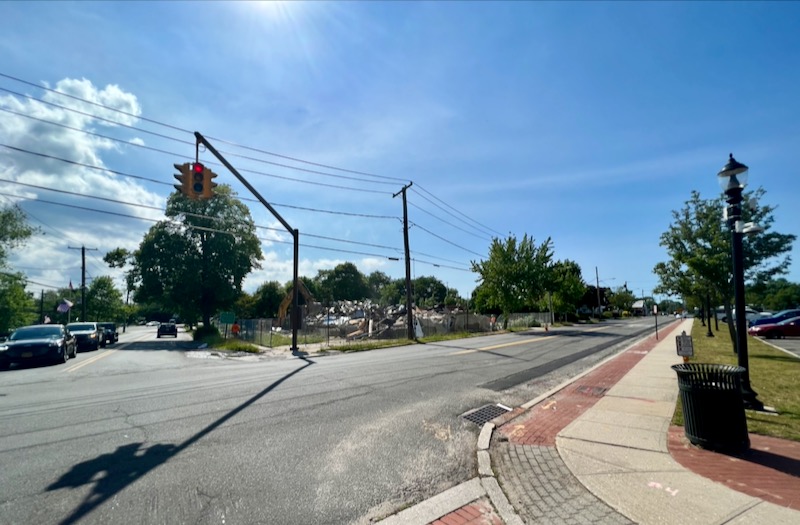
Station One received final site plan approval in July 2022. The same month, the Riverhead Industrial Development Agency approved financial assistance for the developer, including a 10-year property tax reduction and mortgage recording tax and sales tax exemptions. G2D, in its application to the IDA, said the $19.6 million project would “not be financially feasible” without IDA assistance.
The Shipyard also received a 10-year property tax reduction and sales and mortgage recording tax exemptions from the Riverhead IDA. Costs for that building were estimated at $13.1 million.
The projects’ benefits from the IDA come with conditions. One of them is that the company must “promptly secure payment of all such unpaid items by filing a bond” satisfactory to the IDA and remove liens, according to the IDA’s lease and project agreement. “Mechanics’ Liens shall be discharged or bonded within thirty (30) days of the filing or perfection thereof,” the agreement states.
In response to an email seeking comment on the liens and also asking whether G2D’s projects have made required payments to the Riverhead IDA, Executive Director Tracy Stark-James said the project is “in compliance,” without further elaboration. She did not respond to a second email seeking clarification as to why the unsatisfied liens do not violate the developer’s agreement with the RIDA.
In addition to its two projects in Riverhead, G2D has 18 other developments, most on Long Island and already completed and operational, according to the company’s website.
Editor’s note: This article was finalized on the morning of Sept. 10 and reflects court cases filed against DeRosa and/or GD2 Construction Corp. or G2D Development Corp. as of Sept. 9. Two additional actions against DeRosa and/or G2D appeared in court records on Sept. 10, after this article was written but before it was published. One involves another cash advance agreement. The other involves a short-term note. In the action filed to recover amounts due under the note, DeRosa signed an affidavit confessing judgment in favor of the creditor in the sum of $750,000 plus interest, and a proposed confession of judgment appears in the court record, pending approval by the court.
The survival of local journalism depends on your support.
We are a small family-owned operation. You rely on us to stay informed, and we depend on you to make our work possible. Just a few dollars can help us continue to bring this important service to our community.
Support RiverheadLOCAL today.
