








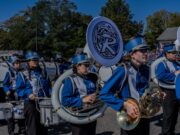







At the end of a late summer day of blue skies and bright sunshine — a day not unlike the Tuesday in September 2001 that changed the world — a crowd gathered at the Sept. 11 memorial in Riverhead to remember that fateful day. See photo gallery below.
The annual service is organized each year by the Sound Park Heights Civic Association at the small park on Sound Avenue dedicated to the memory of the people who died on Sept. 11, 2001. Two residents who grew up spending summers with their families in the Reeves Park community on the Sound lost their lives in the terror attacks as they tried to save others: NYC firefighters Thomas Kelly, 38, and Jonathan Ielpi, 29.
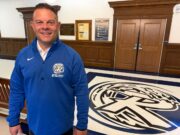
Opening the ceremony, which was preceded by a candlelight walk from Marine Street to Sound Avenue, civic president Thomas O’Haire spoke about the need to remember the events of that day and the days that followed.
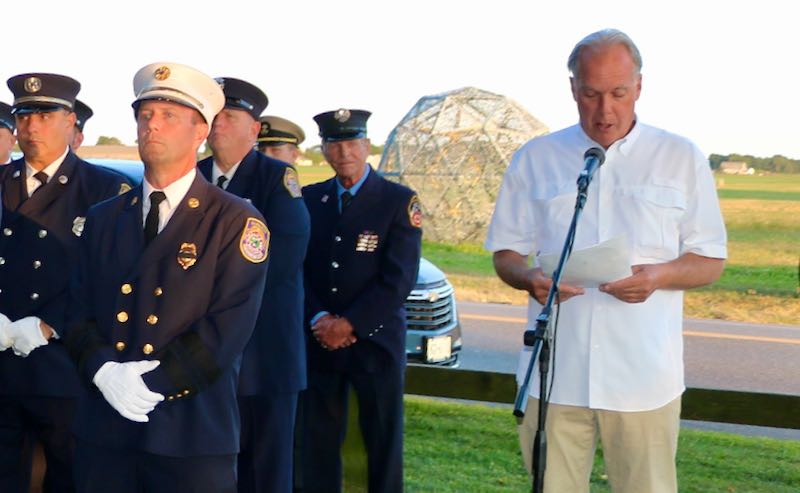
The incomprehensible destruction that occurred right before our eyes. The chaos that followed. The innocent lives lost. The heroes who sacrificed their own lives as they raced to save others. The acts of heroism and the kindness of strangers. The unity of the American people in the days and weeks after the terrorist attacks. The resolve that we would “never forget.”
A generation has passed and so many who witnessed that day and lived through the aftermath are gone. Too many who worked to recover the remains of the 2,753 people killed at the World Trade Center on Sept. 11, 2001, and who worked on clean-up efforts there, have died of illnesses related to the toxic environment at the site that came to be known as Ground Zero. Others are still suffering.
How do those of us who lived through that time and remember that day from our own experience as bystanders convey its meaning to the next generation and the one after that, describe what it was like to witness on live TV the sight of a commercial jetliner crashing into the skyscraper at 2 World Trade Center, as skyscraper at 1 World Trade Center stood aflame?
In a world before smartphones, a world before constant communication via texting and social media, reports came to us on television and radio of other hijacked jetliners. Less than an hour after American Airlines Flight 11 crashed into the north tower at 1 World Trade Center, entering the skyscraper between the 93rd and 99th floors of the 110-floor building, a third hijacked jet crashed into the Pentagon in Washington D.C.
America was under attack.
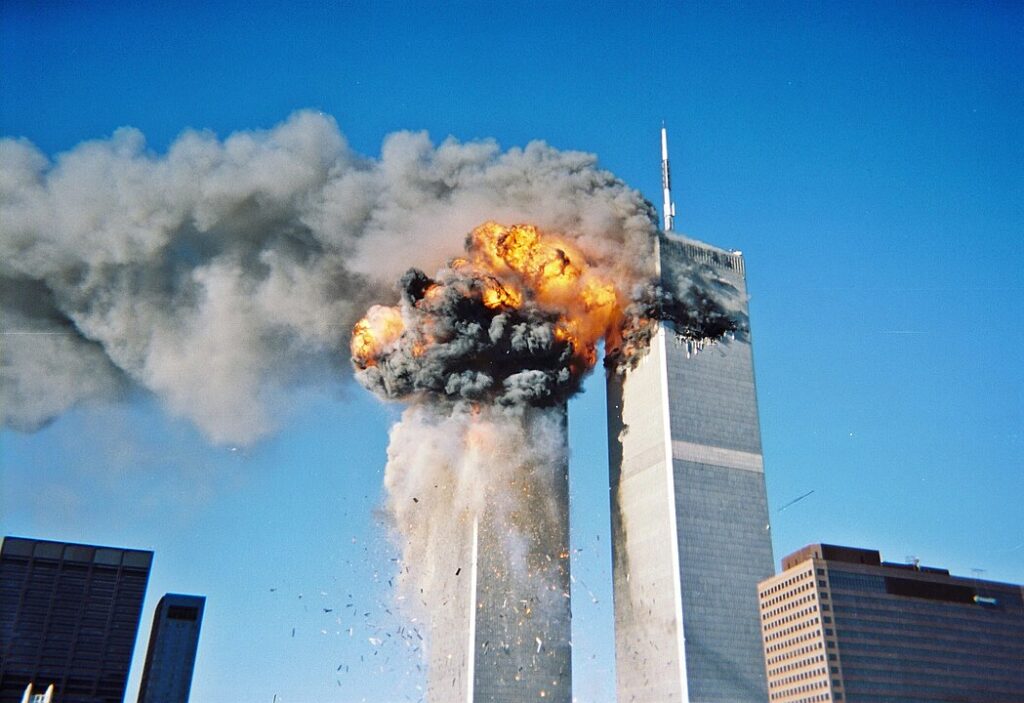
All air traffic was grounded. Military fighter jets were scrambled. It was hard to wrap our heads around all that was happening. We braced ourselves for whatever might be coming next, even as we frantically tried to reach family members who worked in lower Manhattan or in the nation’s capital. For the first time, most Americans experienced and understood the terror of terrorism.
On live TV, we witnessed federal buildings being evacuated, chaos in the streets of New York City, flames and billowing smoke against the backdrop of a deep blue sky over lower Manhattan, aerial shots of the partially destroyed Pentagon, also in flames and smoke.
Then we witnessed, also on live TV, the truly incomprehensible spectacle of one of the towers collapsing onto itself, disappearing in a thick cloud of smoke and dust as the other tower still stood burning.
Before we could even process what we’d just seen, a fourth hijacked jet, diverted from its intended target in Washington, D.C., crashed in western Pennsylvania after a passenger revolt thwarted the hijackers’ plan. All on board were killed.
Just 25 minutes later, as news spread of a fourth hijacked jet crashing, we watched the north tower of the World Trade Center collapse onto itself and disappear into a cloud of thick dust and smoke, just as its twin had done barely a half-hour before.
It was only 10:30 in the morning.
Then the skies fell quiet that day. Airspaces over the U.S. and Canada were closed. Flights were grounded and remained grounded for three days. The silence was eerie.
Soon to follow were the dramatic scenes of people covered in dust and ash, running through the streets of lower Manhattan, running to escape a roaring wall of debris and smoke that pursued them. Photos of stunned survivors seeking shelter in nearby shops and hallways as the suffocating eruption of debris from the collapsed towers blocked light and air all around them.
All these years later, it’s still somehow incomprehensible.
The events of that morning upended our lives and continue to affect how we live more than two decades later. For the first time, we felt truly vulnerable, right here at home. It was a major paradigm shift.
How can we possibly convey what it was like to live through that day and the ones that followed — the trauma of it, even for those of us who were mere bystanders, watching on a television set in the safety of our own homes here in Riverhead?
There are no words. But that doesn’t mean we shouldn’t keep trying.
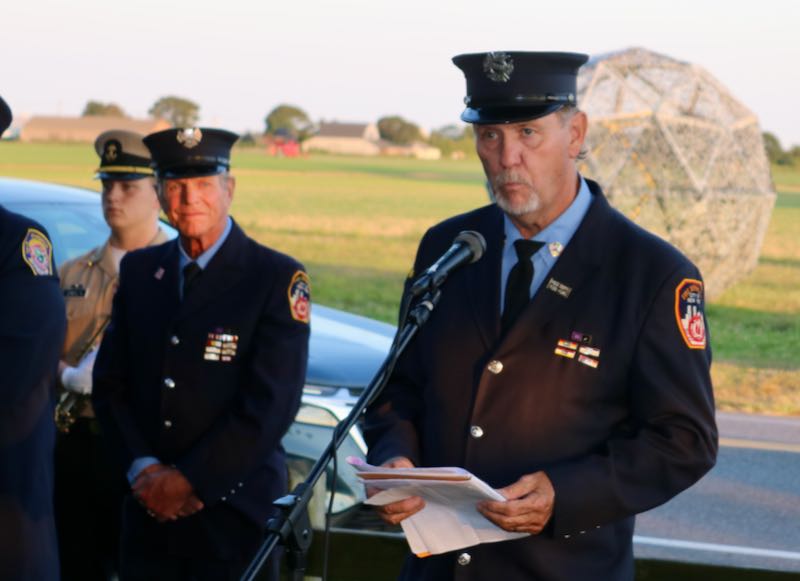
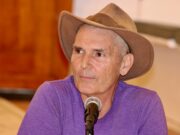
As retired NYC firefighter Bob Kelly, whose brother Thomas was killed in the collapse of the south tower, told the gathering at the Sound Avenue memorial last night, “There’s a whole generation of people that never even saw this day. That’s okay. That’s why we’re here.”
His brother Tommy and his entire company, FDNY Ladder Co. 105 in Brooklyn, were killed after they went into the south tower to save lives. They were among 343 NYC firefighters to die at the World Trade Center that day.
Bob Kelly, who like every other first responder in NYC and beyond that day, raced to the World Trade Center site, spent the days and weeks after the attack, with thousands of firefighters, police officers and emergency workers from across the region, working at Ground Zero — first, in a desperate quest to rescue survivors and then, hoping to recover remains.
He and the others who bore that burden for all of us, saw things they will never forget and probably have no desire to describe to the rest of us. But every year on Sept. 11, Kelly works through the pain of those memories to honor the dead and, after an exhausting day of services and ceremonies in New York City, returns to his beloved Reeves Park to remind us all to “never forget” and to encourage those who remember that day to share those memories with others, especially young people.
As seen through the long lens of time, we know Sept. 11 taught us about our vulnerability as a nation, about the privilege of safety and security we had enjoyed, about the heroes who walk among us who rush into danger to help others on any given day — and who responded without hesitation to the scenes of the worst attacks on domestic soil America had ever experienced.
Kelly spoke of one of his heroes, Jean Palombo, the wife of firefighter Frank Palombo, who died on Sept. 11, leaving her to raise their family of 10 children alone.
“She raised some beautiful children and a great family,” Kelly said. “Two of them became New York City firefighters. Today I was at a mass that we go to every year at the Cathedral of St. Joseph in Brooklyn,” he said. “It honors all the deceased firefighters from Battalion 57 and all those friends and family that we’ve lost.” The Bishop of the Archdiocese of Brooklyn presides over the mass most years, Kelly said. And he did so this year.
“He had a special assistant with him this year, a recently ordained priest, Anthony Palombo, one of Jean and Frank’s 10 children,” Kelly said. “He did a beautiful job with the mass. So I just want to thank you for that.”
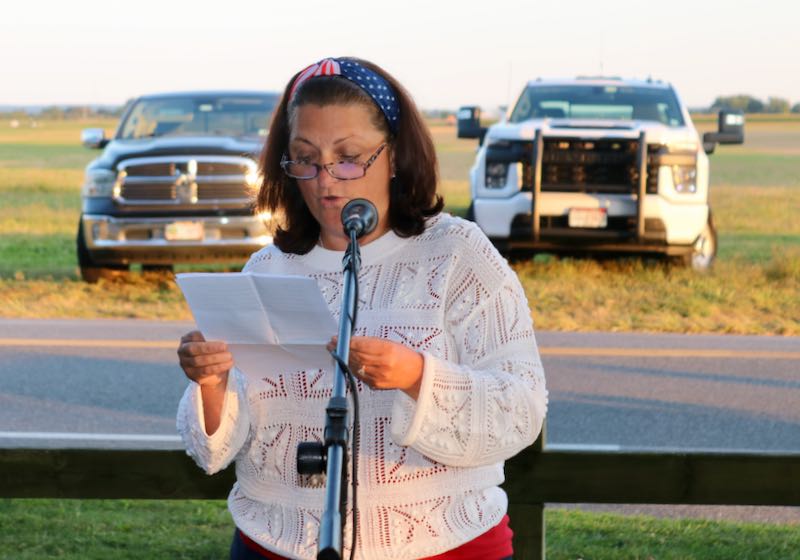
Ann Marie Holleran, sister of Jonathan Ielpi, said as an educator, she believes it her duty to teach the next generation not only about the horrific events of that day, but about the “kindness, compassion, bravery and heroic actions of first responders and ordinary citizens” on Sept. 11, 2001, “to ensure they never forget the sacrifices made by so many like my brother, Jonathan, and Tommy [Kelly], who on that awful day, put the lives of others before themselves.”
She shared something she wrote and read to her students yesterday morning.
“Someone once said, be kind to others. Your act of kindness might become somebody’s memory of a lifetime,” Holleran said. “During the 9/11 attacks and the hours that followed, stories of random acts of kindness and compassion, heroism and bravery, began to emerge and ripple across the world. These stories became etched into our memories, memories that will last a lifetime,” she said.
“Stories like that of police officer Maura Smith, who stood at the bottom of a ramp in the burning south tower directing frightened individuals to safety. Her act of compassion and kindness saved the lives of many people, but resulted in her death when the tower collapsed.
“Or the story of American flight 93 which was full of hero passengers who bravely took control of the cockpit and prevented the plane from crashing into the White House or Capitol building. Their actions resulted in the death of all the passengers when it crashed into the field in Shanksville, Pennsylvania, but it saved countless other lives.
“Or the story of my brother, my hero, firefighter Jonathan Lee Ielpi, whose heroism and bravery helped save hundreds of people escaping the South Tower. My brother’s act of kindness towards strangers, his acts of courage and heroism and his willingness to put others’ lives before his own, led ultimately to his death when the south tower collapsed on Sept. 11, 2001,” she said.
But Ielpi’s actions and the actions of other heroes that day meant that people survived, Holleran said. “Families were reunited with loved ones, and an unwavering commitment to the fundamental value of human life became evident through the kindness of strangers and unselfish acts of heroism. These acts created a ripple effect throughout the world and are forever etched into the minds and memories of so many,” she said.
“Today, on the 23rd anniversary, take time to remember all the victims who died and their families who still miss them each and every day, and honor those victims every day by performing one random act of kindness, which will have a ripple effect in the days to come,” Holleran said.
“And think of these words from Scott Adams,” she said, recalling a quote from the creator of the Dilbert comic strip.
“Remember, there is no such thing as a small act of kindness. Every act creates a ripple with no logical end.”
RiverheadLOCAL photo gallery by Denise Civiletti


The survival of local journalism depends on your support.
We are a small family-owned operation. You rely on us to stay informed, and we depend on you to make our work possible. Just a few dollars can help us continue to bring this important service to our community.
Support RiverheadLOCAL today.
