























Today is Martin Luther King Jr. Day, a state and federal holiday commemorating the birth of the great American civil rights leader, the Rev. Martin Luther King Jr.
King was born Jan. 15, 1929 in Atlanta, Georgia. He entered college at age 15 and followed his father and grandfather into the Baptist ministry. He received a bachelor of divinity from Crozer Theological Seminary in 1951 and a Ph.D from Boston University in 1955.
Pastor, missionary and one of the most gifted orators in American history, King became the leader of the American civil rights movement in the 1950s and ’60s. He has been heralded as the most compelling and effective civil rights leader in history.
Inspired by Mahatma Gandhi, he adopted Gandhi’s method of nonviolent resistance as “the most potent weapon available to oppressed people in their struggle for justice and human dignity.”
A founder of the Southern Christian Leadership Conference, King organized and led marches, peaceful demonstrations and sit-ins to highlight racial inequality. King led a bus boycott aimed at ending segregation of public transportation in Montgomery, Alabama. During a campaign in Alabama to abolish segregated lunch counters, King was arrested and jailed. While in his cell, King wrote the now-famous “Letter From the Birmingham Jail,” written to fellow clergymen about his philosophy of nonviolent resistance.
On Aug. 28, 1963, King participated in the March on Washington for Jobs and Freedom. That day, on the steps of the Lincoln Memorial, King delivered his famous “I Have a Dream” speech to a crowd of 250,000 people, a gathering he called “the greatest demonstration for freedom in the history of our nation.”
In this eloquent and inspirational oratory, King decried racial segregation and injustice as a default by America on the promise of equality for all citizens, warning, “There will be neither rest nor tranquility in America until the Negro is granted his citizenship rights. The whirlwinds of revolt will continue to shake the foundations of our nation until the bright day of justice emerges.”
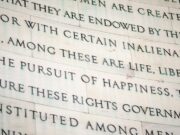
“So even though we face the difficulties of today and tomorrow, I still have a dream,” King told the crowd. “It is a dream deeply rooted in the American dream. I have a dream that one day this nation will rise up and live out the true meaning of its creed: We hold these truths to be self-evident, that all men are created equal,” King said.
He described his dream that “one day on the red hills of Georgia, the sons of former slaves and the sons of former slave owners will be able to sit down together at the table of brotherhood,” that “one day even the state of Mississippi, a state sweltering with the heat of injustice, sweltering with the heat of oppression, will be transformed into an oasis of freedom and justice,” that his “four little children will one day live in a nation where they will not be judged by the color of their skin but by the content of their character.”
King’s activism and the movement he led brought real change, with the enactment of the Civil Rights Act of 1964, benchmark federal legislation that prohibited discrimination based on race, color, religion, sex or national origin. King received the Nobel Prize for Peace in December 1964. Its provisions barred discrimination in hiring, promoting and firing, in public accommodations and in federally funded programs. It strengthened the enforcement of voting rights and desegregation of schools.
King received the Nobel Prize for Peace in December 1964.
In January 1965, King and the Southern Christian Leadership Conference joined with the Student Nonviolent Coordinating Committee to lead a campaign based in Selma, Alabama focused on the disenfranchisement of Black Americans.
The movement highlighted the means used to prevent Black citizens from exercising their right to vote — arbitrary literacy tests and poll taxes, intimidation, harassment and violence. The campaign organized marches and its participants were met with violent opposition, including the fatal shooting by a state trooper of a 26-year-old church deacon in February and a brutal attack on the marchers by white law enforcement officers on March 7 as the marchers attempted to cross the Edmund Pettus Bridge. The date became known as “Bloody Sunday.” Television coverage sparked national outrage.
On March 15, President Lyndon Johnson told Congress in a televised address, “Their cause must be our cause too. Because it is not just Negroes, but really it is all of us, who must overcome the crippling legacy of bigotry and injustice. And we shall overcome,” Johnson said. On March 17, 1965 Johnson submitted voting rights legislation to Congress. On Aug. 6, Johnson signed the Voting Rights Act of 1965 into law.
In the late 1960s King expanded his work to focus on poverty and opposition to the war in Vietnam.
On April 4, 1968, King was assassinated by a sniper while the leader was standing on the balcony of a hotel in Memphis, Tennessee. James Earl Ray, an escaped convict, confessed and pleaded guilty in the killing. He was sentenced to life in prison and died there on April 23, 1998.
A federal holiday honoring King was signed into law on Nov. 2, 1983 by President Ronald Reagan. It was observed for the first time in 1986. Martin Luther King Jr. Day was observed in all 50 states for the first time in 2000.
Martin Luther King Jr. Day: holiday closings
All government offices, courts and schools are closed.
Banks are closed. Th N.Y. Stock Exchange, NASDAQ and all bond markets are closed.
All post offices are closed. There is no mail delivery.
UPS is closed but UPS Express Critical service will be available. FedEx offices are open and Fed Ex will have modified services.
Municipal trash collection in Riverhead will follow its normal schedule today.
Riverhead Free Library is closed.
The LIRR is operating on a regular weekday schedule today, with off-peak fares in effect all day.
The survival of local journalism depends on your support.
We are a small family-owned operation. You rely on us to stay informed, and we depend on you to make our work possible. Just a few dollars can help us continue to bring this important service to our community.
Support RiverheadLOCAL today.
