
























A proposed Riverhead zoning amendment that would increase allowable impervious surface coverage in several commercial districts drew sharp criticism Tuesday after the town’s senior planner acknowledged the measure conflicts with recommendations in the town’s newly adopted comprehensive plan.
The proposal — advanced at the request of the Town Board’s Business Advisory Committee — would increase maximum impervious surface coverage from 80% to 90% in the DC-3 and PB districts, from 60% to 75% in the CRC district and from 40% to 50% in the PRC district.
Impervious surfaces such as pavement, rooftops and parking lots prevent rainwater from soaking into the ground, increasing runoff into local waterways while reducing groundwater recharge. The issue has become increasingly important on Long Island amid concerns about flooding, stormwater pollution and aquifer protection.
The town’s 2024 comprehensive plan calls for limiting and reducing impervious surfaces to decrease stormwater runoff and environmental impacts.
The Town Board revised zoning regulations last year to “close a loophole” in the code that developers and applicants were taking advantage of “to over-intensify the development on properties,” according to Senior Planner Greg Bergman.
Pervious pavers had been allowed as an alternative to required drainage structures, Bergman explained to the Town Board at its April 9 work session. But they were being used instead to increase development density.
“Instead of saying, ‘I’m going to use this [pervious pavers] as an alternative to drainage,’ applications were coming in where the entire supply of parking was being provided by pervious pavers, which would allow a much larger structure than would otherwise be permitted,” Bergman told the board April 9.
The town closed that loophole with last year’s code amendment, effectively stopping applicants from counting certain pervious-paver parking areas as permeable surfaces for zoning purposes.
The Business Advisory Committee pushed back against the change and, after it was adopted, began pressing for an amendment to increase impervious lot coverage maximums. Committee members and then-chairperson Martin Sendlewski, a Riverhead architect who represents developers before the Town Board, Planning Board and Zoning Board of Appeals, met with the Town Board to advocate changes several times over the past year.
On April 9, a board majority instructed Bergman to prepare the requested revisions for a public hearing, which was then scheduled for the May 5 meeting.
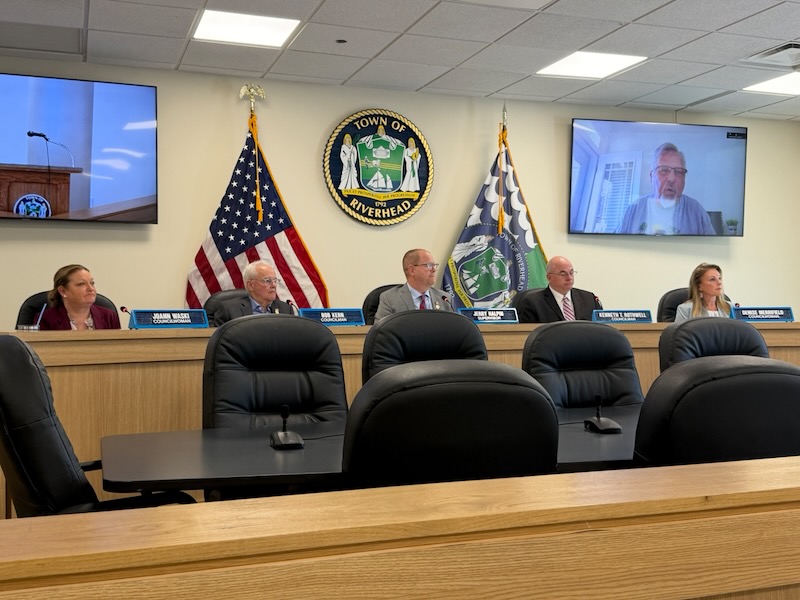
During Tuesday’s hearing, Greater Calverton Civic Association President Toqui Terchun reminded the board of the comprehensive plan’s recommendations.
Former supervisor Laura Jens-Smith followed Terchun to the podium and asked the board to explain the rationale for the changes, since they contradict the comprehensive plan. She asked whether the Business Advisory Committee relied on any study completed by or for the town.
Council Member Ken Rothwell said the proposal originated with the Business Advisory Committee and had been discussed at multiple Town Board work sessions over roughly the past year and a half.
“This is something that they’ve been asking for for a period of time,” Rothwell said. “This is an opportunity today to kind of get some public feedback.”
Rothwell said when different committees make recommendations, Town Board members “try to move things forward, at least to … a public hearing so that you kind of validate the work that the committees are doing.”
“We don’t want to be gatekeepers to any of the committees,” Rothwell said.
Senior Planner Matt Charters was called into the hearing Tuesday to answer the public’s questions. He acknowledged that the proposal “does contradict the language in the comp plan in terms of impervious surface.”
Charters cited a site plan that was taking advantage of the loophole Bergman described.
“So we changed the code to prevent that,” Charters said. “This sort of goes the other way. I don’t know what else I can really say.”
Sendlewski, who participated remotely in Tuesday’s hearing, said the earlier code change created problems for commercial property owners and exposed inconsistencies in the town’s dimensional regulations.
Sendlewski argued current zoning requirements often make it impossible for property owners to fully utilize allowable building coverage without obtaining zoning variances because parking requirements consume too much site area.
He said the proposed amendments are intended to reconcile conflicts between parking requirements and dimensional regulations.
“Our logic was, why do you have zoning that automatically requires a property owner to go for a variance just to build out the allowable lot coverage?” he said.
“The proposed amendment is in direct contradiction to our comprehensive plan,” Barbara Blass of Jamesport, a former Town Board member and former chairperson of the Planning Board, said during Tuesday’s hearing.
“The board adopted and approved a goal to ‘limit future increases in impervious surfaces,’” Blass said.
Blass said increasing allowable impervious coverage could worsen flooding, stormwater runoff and water-quality impacts.
The hearing was left open for 10 days to allow additional written public comment.
The survival of local journalism depends on your support.
We are a small family-owned operation. You rely on us to stay informed, and we depend on you to make our work possible. Just a few dollars can help us continue to bring this important service to our community.
Support RiverheadLOCAL today.
