

















Here’s a different perspective for celebrating Irish heritage this St. Patrick’s Day.
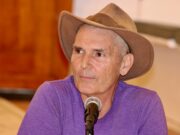
Learn about the “special bond” between Ireland and Cuba Sunday afternoon in a presentation by Riverhead resident John McAuliff at Riverhead Free Library.
The Irish and Cuban peoples “have shared an experience of living in the shadow of a powerful neighbor,” Michael Higgins, president of Ireland, said while visiting Cuba in 2017. “We are two island nations who have been marked by colonization and that have had to wrestle their freedom from the grip of empires.”
McAuliff quotes Higgins at the top of a paper on the topic he presented at the American Irish Historical Society in New York City in September.
Of Irish heritage himself, McAuliff took an interest in the connection after traveling to Cuba for a conference in 1997.
McAuliff, who earned his bachelor’s degree in history, became fascinated with the many connections between the Cuban and Irish peoples, and has studied, researched and written extensively on the bond between the two countries and their citizens.
The connection is traced back to Irish migrants to Spain in the 17th and 18th centuries. The Irish were awarded Spanish citizenship upon arrival in Spain as persecuted Catholics, and fought for Spain in the Spanish army’s Hibernian regiments. Many of the Irish soldiers were posted to Cuba and married into the Cuban aristocracy, according to the Cuban-American writer Manuel Tellechea. Irish people held high positions in the Cuban government and military.
McAuliff grew especially interested in Felix Varela, of the Spanish colony of East Florida. There, Varela was inspired by an Irish priest and learned the Irish language, then attended university and seminary in Cuba, where he was ordained and taught philosophy. He later became a representative of Cuba in the Spanish Court, and, a proponent of self-government, he signed an invalidation of the Spanish king — for which he was sentenced to death. Varela found asylum in the United States, arriving in New York in 1823, McAuliff writes in his paper. As a parish priest, first in Philadelphia and then in New York, Varela “became a compassionate advocate for the poor, especially for Irish immigrants in whose language he became fluent. He wrote, ‘I work hard to help Irish families build schools for their children, and I tend cholera patients, and I defend Irish American boys and girls against insults from mobs who hate them just because their parents are immigrants.’” Varela spent the rest of his life ministering to his Irish flock in New York.
“Irish emigrants and their descendants in Spain and in North America found their way to Cuba throughout the 17th, 18th and 19th centuries,” McAuliff writes.

The Irish presence in Cuba is visible in the history and place names of the island, such as O’Reilly Street in Havana, where a plaque memorializes the relationship between the two countries: “Two island peoples in the same sea of struggle and hope. Cuba and Ireland.”
“Irish Americans in the mid-19th century built Cuban railroads, served as engineers in its sugar mills, created schools, organized the first labor action repressed by Spanish colonial authorities and were executed for support of slave rebellions and independence,” according to McAuliff.
Éamon de Valera, the New York-born son of a Cuban father and Irish mother who both emigrated to New York, was sent to Ireland after his father died and become a leader of the Easter rising and later president of Ireland.
“Cuba’s iconic revolutionary Che Guevara was from Argentina but his grandmother Anna Lynch hailed from County Galway,” writes McAulif.
Then there’s Tammany Hall and Dynamite Johnny O’Brien. Tammany Hall — the General Committee of the Democratic-Republican Party —provided employment and shelter for Irish immigrants to New York who left Ireland during the famine of the mid-19th century. Tammany also provided help and financial support to Cuban groups in their struggle for independence.
Dynamite Johnny O’Brien, born in New York in 1837 to Irish immigrants, became an arms smuggler, delivering weapons and personnel to Cuba during its war of independence from Spain. His efforts were so appreciated he was named Havana’s first port captain.
McAuliff is the founder and executive director of the US-Indochina Reconciliation Project, now known as the Fund for Reconciliation and Development (1985-present), was a Peace Corps volunteer in rural Peru (1964-1966), the national president of the Committee of Returned Volunteers (1968-1970), the associate editor of the Irish Edition newspaper in Philadelphia (1983-1984) and is the coordinator of the Vietnam Peace Commemoration Committee and Cuba/US People to People Partnership.
He will discuss the stories highlighted here, and more, exploring the underlying ties of the two countries’ struggles for freedom from colonial rule, during his talk at the Riverhead library on Sunday. The talk takes place from 1:30 to 3:00 p.m.
Riverhead Free Library is located at 330 Court Street in Riverhead. The parking lot and building entrance are located on Osborn Avenue.
Correction: This article originally stated an incorrect time for this event. This event runs from 1:30 to 3 p.m.
The survival of local journalism depends on your support.
We are a small family-owned operation. You rely on us to stay informed, and we depend on you to make our work possible. Just a few dollars can help us continue to bring this important service to our community.
Support RiverheadLOCAL today.
