

















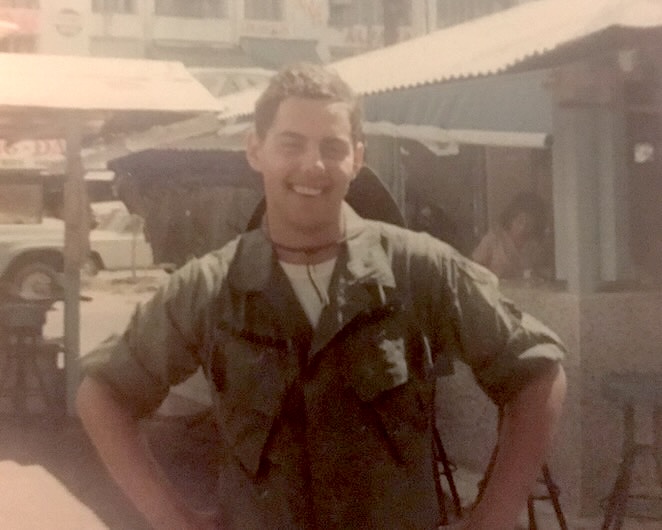
Longtime Riverhead resident Fred McLaughlin knows he was one of the lucky ones.
He was drafted into the U.S. Army on Feb 1, 1967, a year of major escalation for the United States in Vietnam. It was the peak year for bombing sorties flown as part of the massive Operation Rolling Thunder campaign.
A native of Bay Ridge, Brooklyn, McLaughlin was 20 years old when he entered the army. He was sent to Fort Sheridan, an Army post north of Chicago, on Lake Michigan. That winter saw temperatures 20 degrees below zero. He was sent to Officer Candidate School in Kansas before shipping out to Vietnam and arrived in-country as a corporal, a non-commissioned officer.
“It was a good rank to have,” he said. “You get to supervise and tell other people what to do instead of having to do it yourself,” he cracked.
As soon as the door to the plane opened, he felt the heat like a smack in the face. “I went from 20-below to temperatures that felt like a furnace,” McLaughlin said.
“My first job there was burning doo-doo,” he said, referring to the practice of open-air incineration of human wastes.
Next, McLaughlin was sent to Long Binh Jail as an MP. “We called it LBJ,” he recalled, a dig at the then-president of the U.S. “I was there four or five months. I worked the stockade and in July of ‘68, they burned the place down. They rioted and they burned the place down. There was some 700-something prisoners there. It was pretty crazy,” he said.
“So I was pretty lucky, though. You know, I wasn’t out in the jungles. I did some convoys now and then. But all in all, I was very fortunate,” he said.
He was transferred out of Long Binh Jail to “a desk job,” he said. That was also a stroke of good luck.
But an argument with his sergeant earned him a transfer “up north” to Qui Nhon, which McLaughlin said was “a hot spot that would’ve been a lot more dangerous.
“But I ran into a buddy and he got me a job in Nha Trang,” McLaughlin said. “I was protected by the South Koreans there. I stayed there until I got the fateful call that my mom died,” he said.
McLaughlin’s mother died suddenly of an aneurysm at age 41.
He shipped out. Back in the U.S., he had to go straight to the funeral home where his mother’s wake was being held.
Since he was nearing the end of his tour of duty, he wasn’t sent back to Vietnam, he said. He remained in the states.
McLaughlin wasn’t in Vietnam for very long before he decided the war was “a stupid war when you really come down to it.” It didn’t accomplish anything, he said.
“You get over there and you start seeing the waste,” McLaughlin said. “There was a lot of trucks and jeeps and tanks and everything. They were just, I don’t know —It was just a lot of waste over there. Never mind the physical waste of people over there, people losing their lives or just getting screwed up,” he said. “I mean, it was just a messed up war.”
McLaughlin, now 77, scoffs at “the politicians” of the day, who maintained that “everything’s good. Let’s go, America. But it just turned out it was wrong. We shouldn’t have been there.” The U.S. “took over for France,” he said. “We took their place, and we lost. And it was misguided all the way.”
McLaughlin said he came back home to a Brooklyn neighborhood that remained very pro-war. So he kept quiet. “I didn’t talk about it much,” he said.
“When Iraq came around, I was very against it,” he said. He even attended protest marches. “I was totally against the war, and it turned out to be another tragedy for a lot of people.” Afghanistan, too, he said.
“It’s a waste of life. What does it accomplish?”
McLaughlin had a surreal experience at the Vietnam Memorial, a granite memorial on which the name of every Vietnam War casualty is engraved.
“Back in the ‘80s, when I first went to the wall with my family, my son, I gave him a list of guys I was with, and he looked everybody up, and he got everybody and he was thrilled that he found all the names I gave him, and he goes, ‘And I got yours, too, Dad.’”
“What? Mine too?”
“So some guy from Newton, Massachusetts, was killed over there, and his name was Frederick J. McLaughlin.” Same middle initial. But the other Frederick McLaughlin’s middle name was Joseph, he said. “So that’s the only difference.” McLaughlin’s middle name is Jerome.
The eerie similarities don’t stop there, though. It turns out the other McLaughlin was sent home in October of 1968 because his mother was dying. She died Nov. 7, 1968, just a week before his own mother died.
Frederick McLaughlin was sent back to Vietnam after his mom’s funeral.
“And on Jan. 27 of ’69, he was wounded, and on Feb. 10, he died.” He was 26 years old.
He has a bridge named after him in Newton, Massachusetts.
McLaughlin eventually moved to Riverhead and became a partner in a funeral home here. He later served 28 years on the Riverhead Zoning Board of Appeals, retiring in December 2023 after 16 years in the role.
New details about his time in Vietnam still come back to him at odd times, he said.
“It’s crazy. It’s amazing, actually. How things — often little things — just keep coming back to haunt you.”
This story is part of RiverheadLOCAL’s coverage of local residents and their connections to the Vietnam War, which ended 50 years ago on April 30. You can read more stories in the series here.
The survival of local journalism depends on your support.
We are a small family-owned operation. You rely on us to stay informed, and we depend on you to make our work possible. Just a few dollars can help us continue to bring this important service to our community.
Support RiverheadLOCAL today.
