





























Peconic Bay Medical Center marked the opening Monday of its new Bill and Ruth Ann Harnisch Neurosciences Center, a major expansion of stroke and brain care that hospital leaders say will bring life-saving treatment closer to patients across the East End.
At a ribbon-cutting ceremony in Riverhead, PBMC President Amy Loeb said the new center is designed to eliminate a longstanding gap in access to advanced stroke care for residents of eastern Suffolk County, who have often had to be transported west for treatment during critical medical emergencies.
“For too long residents experiencing severe stroke symptoms had to be transported really great distances, 45 minutes or more for care,” Loeb said. “And we know what that means. These are vulnerable moments where every second matters.”
Once the program begins treating patients in April, PBMC is expected to become the only hospital in eastern Suffolk County capable of performing cerebral mechanical thrombectomy, a minimally invasive procedure used to remove blood clots causing certain major ischemic strokes.
The new capability could significantly reduce the time it takes for some stroke patients to receive specialized intervention, improving the chances of preserving brain function and reducing long-term disability.
“Today, that reality changes with this center,” Loeb said. “We now deliver thrombectomy-capable stroke care right here, faster interventions, preserved brain function, more people walking, speaking and returning to their lives, more families staying together.”
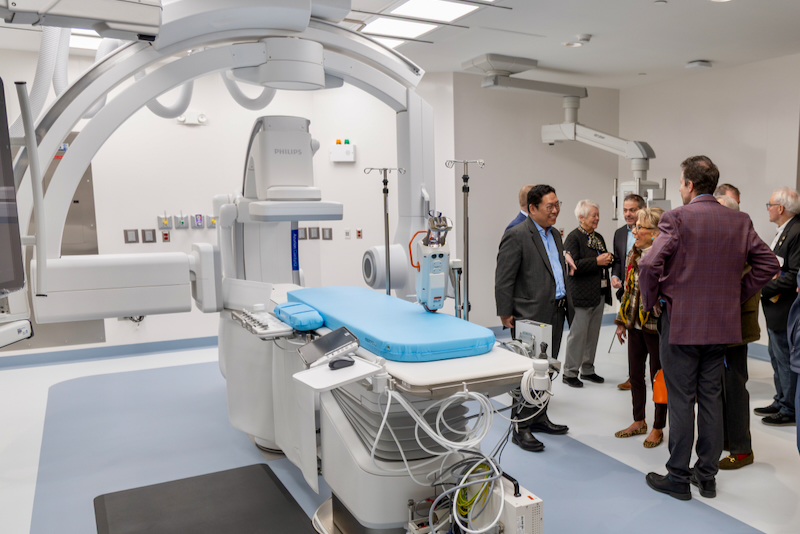
Dr. Richard Jung, the interventional neurologist who will lead PBMC’s cerebrovascular program, said in a phone interview earlier Monday that the new center will allow patients on the East End to receive treatment more quickly closer to home instead of losing precious time to ambulance transfers to Stony Brook University Hospital or South Shore University Hospital.
“In order for somebody to have treatment for a large vessel stroke … you’ve got to do that in a specialized center,” Jung said. “The closest one to Riverhead are out in Stony Brook or Bay Shore, and so it’s far away. It’s like 45 minutes to an hour each way.”
For patients coming from the North Fork, South Fork and points farther east, that travel time can be even longer.
Mechanical thrombectomy is a catheter-based procedure used to remove a clot blocking blood flow to the brain. Jung described it as a treatment in which a doctor inserts a catheter through an artery in the leg or wrist and threads it up to the blocked artery in the brain, where the clot can be removed by suction or with a retrievable stent-like device.
Jung said recently updated national stroke treatment guidelines have expanded the number of patients who may qualify for the procedure.
“Basically, it’s expanded the indication for mechanical thrombectomy so that more people would be considered eligible for the treatment,” he said.
The hospital has not yet begun procedures in the new center. Jung said the program is expected to start in mid-April, after final state sign-offs and radiation safety studies are completed. Loeb said the center is expected to see its first patient later next month.
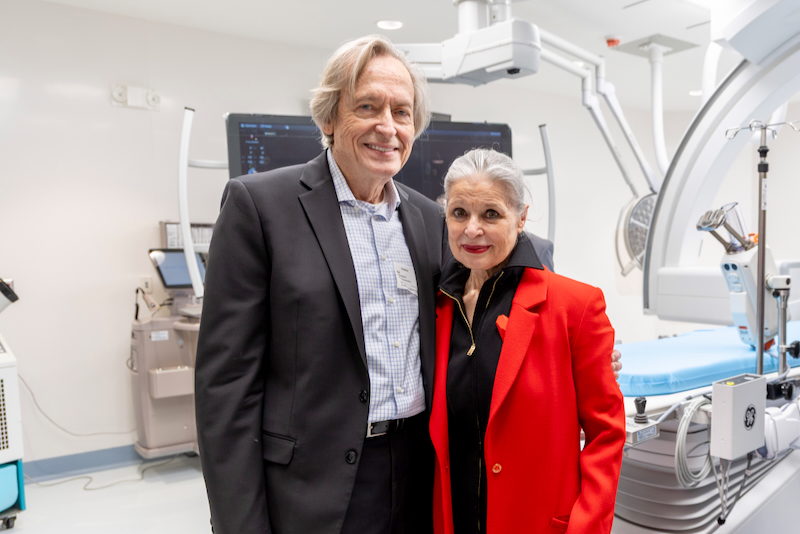
Hospital leaders and donors described the center Monday as the product of both philanthropy and a broader vision for raising the level of care available locally.
The center was made possible through a major gift from Bill and Ruth Ann Harnisch, whose names now appear on the facility.
See prior story: $5 million gift advances PBMC’s plan for neurosciences center in Riverhead
“We know this stroke center will save lives and, no doubt, improve post-stroke outcomes as well,” Bill Harnisch said at Monday’s ceremony. “Every minute counts in stroke, and having this stroke center here in Riverhead will cut time to treatment dramatically for those of us living on the North Fork, the South Fork and points west.”
Ruth Ann Harnisch said the project reflects a belief that the East End deserves both strong community support and high-quality health care close to home.
“Amy has said repeatedly, this extraordinary community deserves extraordinary health care,” she said. “And we say extraordinary health care deserves extraordinary community support.”
Loeb said the center represents more than just a physical expansion inside the hospital.
“This is a program. It’s a destination, and it will be world class,” she said.
She also announced Monday that two cranial neurosurgeons have signed on to join PBMC this summer, expanding the hospital’s neurosciences capabilities beyond stroke treatment alone.
For the public, Jung said, the most important message is that stroke symptoms should never be ignored.
He said people sometimes dismiss mild symptoms and decide to “sleep it off,” only to wake up with far more serious deficits.
Jung urged people to remember the acronym “BE FAST,” a stroke warning mnemonic that stands for balance, eyes, face, arm, speech and time.
Sudden loss of balance, vision changes, facial droop, weakness in an arm or leg, slurred speech or abnormal speech should be treated as an emergency, he said.
“Even if it’s not something big, a small stroke-like symptom can lead to something big and needs to be evaluated right away,” Jung said.
The survival of local journalism depends on your support.
We are a small family-owned operation. You rely on us to stay informed, and we depend on you to make our work possible. Just a few dollars can help us continue to bring this important service to our community.
Support RiverheadLOCAL today.
