

























Plans are taking shape for the future of the East End Arts Council campus within Riverhead’s town square redevelopment.
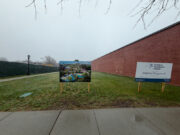
Riverhead Town and arts council officials envision the organization’s historic East Main Street buildings being moved out of the floodplain and raised to street level as part of a redesigned arts campus that could eventually include expanded facilities, green space and a performance area.
The plans, which have not been publicly discussed in detail, are still conceptual, according to Riverhead Community Development Planning and Building Administrator Dawn Thomas. Final design and construction drawings will be prepared after an engineering firm is selected through a request for proposals process.
In separate interviews Monday, Thomas and East End Arts Executive Director Wendy Weiss outlined a concept that would keep all of the existing buildings on the property while reorganizing the site to make the campus more visible, accessible and functional — and to protect the historic structures from flooding.
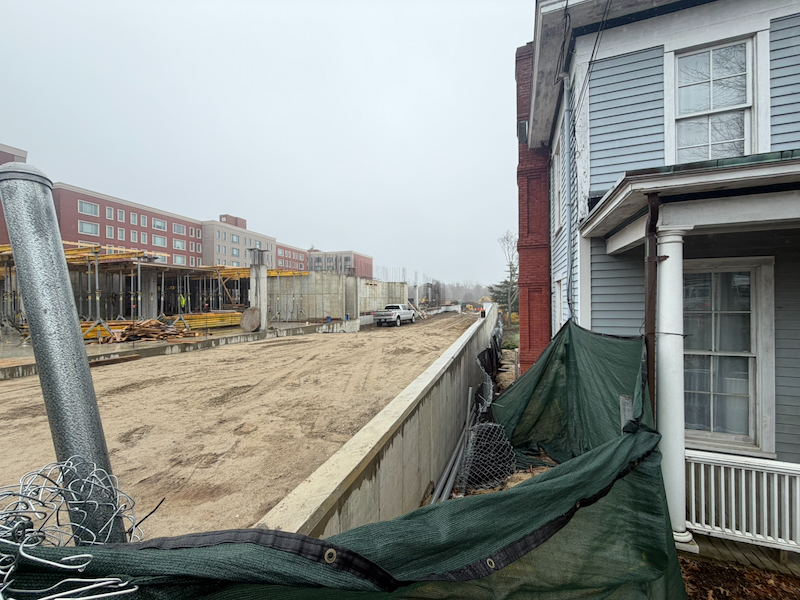
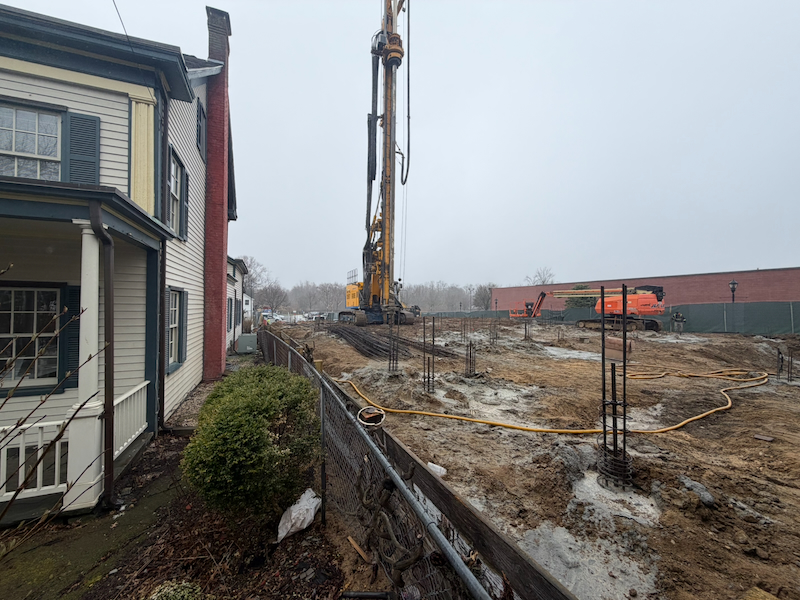
The central move is to relocate the buildings from the lower-lying area of the site, which Thomas described as “the bathtub,” up to a higher elevation closer to East Main Street.
“The goal is to get those buildings all out of the floodplain and up on Main Street where they’re protected as historic resources,” Thomas said.
That shift would do more than address floodplain concerns, officials said.
It would also make the campus feel more welcoming from the street, eliminate the sense that the arts council sits sunken behind a barrier and create room for a more coherent arrangement of buildings, open space and pedestrian access.
Weiss said the current grade difference can make the campus feel set apart.
“It makes people hesitant to step into it, like, ‘Am I allowed in here?’” she said.
Weiss said every design option presented so far keeps the buildings on the site, though their locations would change and the long-term plan could include either additions to existing structures or a new building added to the campus.
“One of the designs that we all really were excited about had a completely new building added to the campus,” Weiss said. But, she added, her board is also considering whether some needed expansion could instead be incorporated into existing buildings, particularly if the project has to be built in phases.
Thomas said the Davis-Corwin house — the arts council’s gallery building at 133 East Main Street — would be moved east to create a fire lane between the building and the planned five-story hotel-condominium to be developed at 127 East Main Street. The Fresh Pond schoolhouse and the Benjamin barn would also be moved out of the floodplain, while the Benjamin house itself, used by the arts council as instruction space, would remain where it is and be raised to street level, Thomas said.
The broader idea, she said, is to create more of a true campus, with room not only for the existing buildings but for future uses such as a sculpture garden and whatever may come next.
“This is the plan,” Thomas said. “It’s to create the right space for East End Arts to grow and thrive.”
That planning process, she said, was partly driven by the recognition that the arts council had spent years focused on day-to-day survival rather than long-range physical planning.
Through a grant-funded study, the town engaged DXA Studio, the architecture and design firm led by Jordan Rogove, to work with the East End Arts Council to develop a vision for the site. Thomas said the work was done largely between the firm and the arts council, with town officials stepping back while the organization thought through its long-term needs.
Weiss said that process has helped clarify not only how the campus could look, but what it should do.
Among the priorities she identified are better accessibility to music and art school spaces, stronger visibility within a downtown increasingly defined by larger new buildings, and preservation of outdoor green space in an area that otherwise will become much more built out.
“The town square part will be pretty much paved over, with the exception of some trees and the playground,” Weiss said.
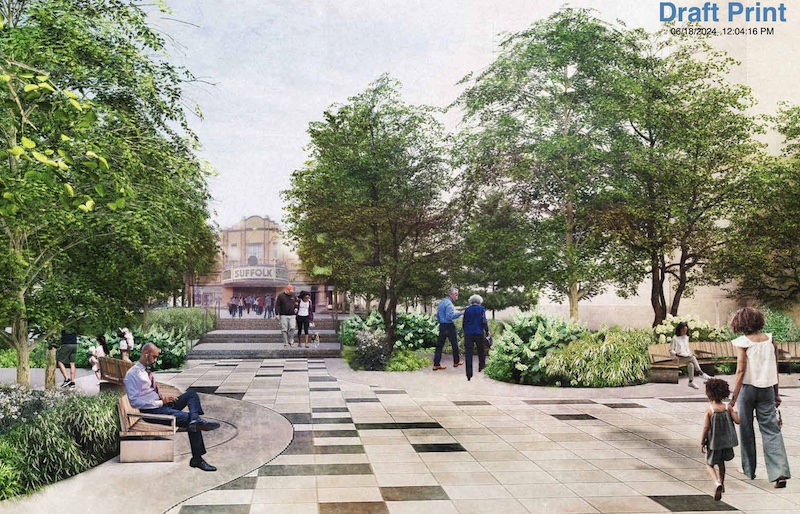
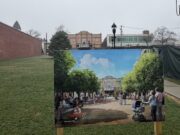
Renderings of the space between the hotel and the building at 111 East Main Street, owned by the Long Island Science Center, show a pedestrian plaza with seating areas and walkways. That area, directly opposite the Suffolk Theater, has been a green space since the town purchased and demolished the buildings at 117 and 121 East Main Street several years ago.
“Our campus will really be the only grass space,” Weiss said.
She said the design team has also been thinking about how to ensure the arts council still reads as an important destination and not a leftover cluster of small buildings overshadowed by surrounding multi-story development. Immediately east of the Benjamin building, a five-story mixed-use building is currently under construction by Heatherwood.
The historic Benjamin barn remains one of the more intriguing but uncertain pieces of the campus.
Weiss said she would love to see it become a ceramics studio, which she said would fill a real need in the area. The arts council already has a kiln, she said, and a dedicated ceramics space would allow it to offer something not readily available elsewhere nearby.
Thomas said a similar idea had been pursued before with a state grant, but the numbers did not work.
A previous plan to rehabilitate the barn for ceramics use was bid at about $900,000 after being designed with the help of consultants, she said, far above the available funding.
“We’re not going to bond for a ceramic studio,” Thomas said.
Even so, she said the barn is still worth preserving if a realistic use can be found.
“It’s a very cool structure,” she said, though she acknowledged that it is in rough shape and may be better suited for a lower-intensity use that would not require a fully conditioned interior.
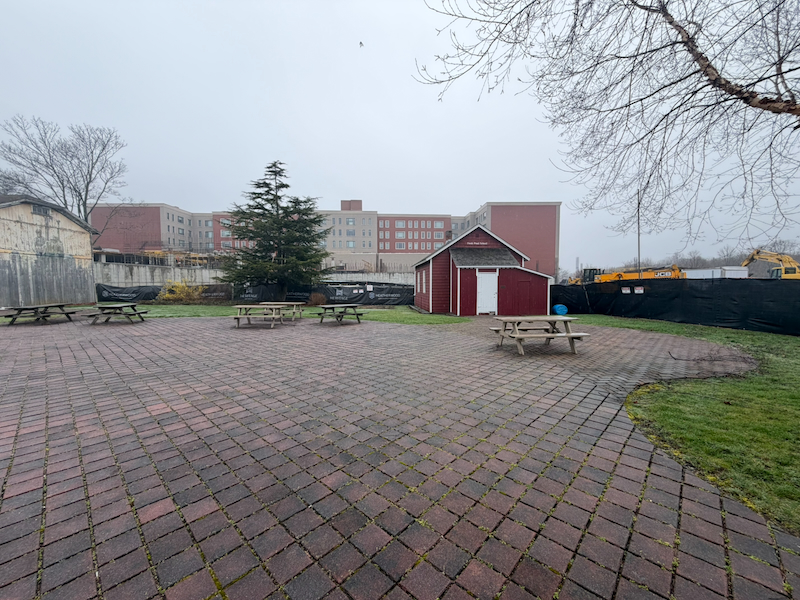
Below the planned new building line along Main Street, the sloping portion of the site could eventually become another important feature of the campus.
Thomas said the drop in elevation creates an opportunity for some kind of amphitheater or bandshell area, though she emphasized that no final design exists for that element.
The town previously did preliminary work on a bandshell concept through a grant-funded process tied to the Brownfield Opportunity Area program, including a market study intended to help determine what size performance space would make sense. But Thomas said town officials now want to learn from real-world use of the emerging town square before settling on a final design for that area.
“There’s a value to actual real-time use,” she said.
Rather than locking in a final concept too quickly, she said, the town wants to consider how the square functions, whether a fixed bandshell is the right answer and how flexible the lower portion of the site should be.
That could mean a more traditional performance space, she said, or something more multipurpose that leaves room for other uses.
For now, the more immediate work is procedural.
Thomas said the East End Arts board first needs to settle on a preferred concept or a small number of options from the DXA work. Those would then be presented to the Town Board, which controls the property and would ultimately decide how to proceed.
After that, the town expects to issue an RFP for a design professional to prepare the construction drawings needed to move the buildings. Only after that work is done would the town solicit bids for the relocation of the buildings.
Thomas said the process is moving toward that next stage and suggested the relocation work could happen as soon as the fall.
“It’s pretty imminent,” she said.
Weiss offered a similar timeframe, saying some initial site work might begin in late spring or early summer, but that she does not expect major visible activity until later in the year.
Both women said the process has been collaborative.
Weiss said she had initially worried that the arts council might not be a full participant in the larger downtown redevelopment process, but said she now feels the organization has been heard.
“It’s been nice that we’re all working together,” she said.
Thomas, in turn, praised Weiss’s leadership and said the arts council is engaged in shaping its own future rather than simply reacting to the town’s construction schedule.
If all goes as envisioned, the result of this ambitious project would be more than the relocation of a few historic buildings, Weiss said. It would make the property and its cultural and historic attractions more visible and accessible to the public and better connected to the town square and the broader downtown redevelopment now reshaping the block.
A campus with deep roots in the community

The East End Arts Council’s ties to the Main Street riverfront campus go back almost 50 years. It first took occupancy of the circa 1840 Davis-Corwin house, the oldest home on Main Street, in 1977, after the property was purchased by Northville Industries, which leased it to the town for community purposes.
The other buildings on the campus at the time were the Benjamin house, circa 1860, which became home to the Eastern Suffolk School of Music; the Benjamin barn, also circa 1860; and the carriage house, which dates to at least the 1870s. The town moved the one-room Fresh Pond schoolhouse to the site in 1978.
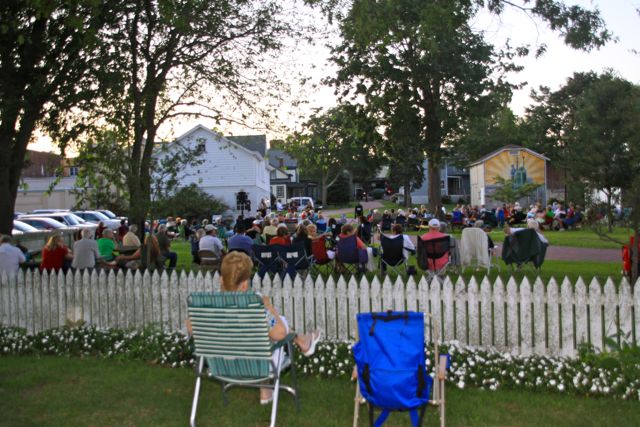
The campus has long served as a downtown community green space and as a longtime venue for Townscape’s summer concert series and other events.
It has also been used by Townscape during the Riverhead Country Fair each October, where visitors can view agricultural products, baked goods, quilts and artwork, antique tractors and early farm machines displayed by the Long Island Antique Power Association, and performances by community groups.
Since 1996, the space has been put to similar use during the Community Mosaic Street-Painting Festival, an event founded and sponsored by the arts council that will mark its 30th anniversary this year — for the first time on West Second Street, due to downtown construction.
The survival of local journalism depends on your support.
We are a small family-owned operation. You rely on us to stay informed, and we depend on you to make our work possible. Just a few dollars can help us continue to bring this important service to our community.
Support RiverheadLOCAL today.
