

























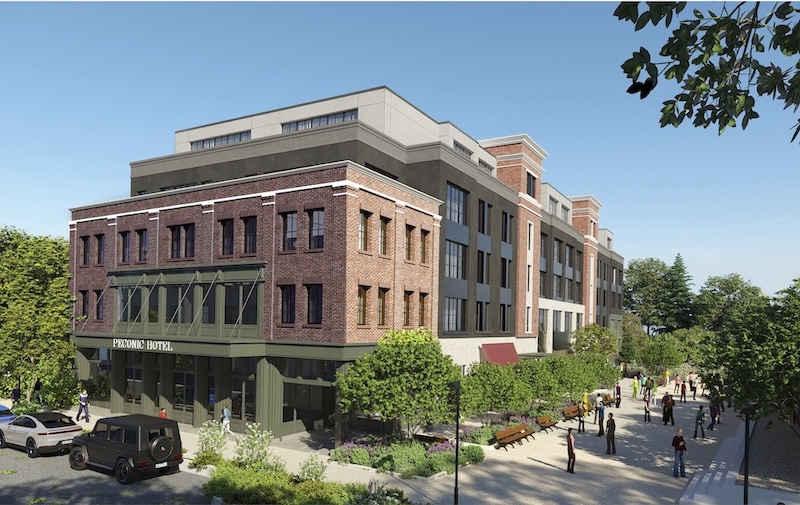
The Riverhead Town Board voted 5-0 Tuesday to approve site plan and special permit applications for the proposed Peconic River Hotel, clearing a major local land-use hurdle for the five-story, 94-room hotel planned for East Main Street along to the future town square.
The approval covers applications filed by J. Petrocelli Riverhead Town Square LLC for the hotel, planned on a roughly 0.42-acre site at 117-127 E. Main St. The 69,738-square-foot building is proposed to include hotel rooms, retail space, a restaurant, café, hotel lobby and amenities, as well as nine parking spaces on the building’s lower level for hotel staff.
Merrifield called the project “a tremendous asset,” saying it would bring people and tourism downtown and help commercial tax revenue.
“This hotel, the beautiful Tapestry Hilton Hotel, would be greatly helping the local businesses in our downtown area,” Merrifield said. She said downtown restaurants, the Suffolk Theater and the Jazz Loft would benefit from visitors staying for a weekend at the hotel.
Merrifield also rejected objections focused on parking. “To say that 94 parking spaces is a huge detriment and problem for our town parking is just unpersuasive,” she said.
Rothwell said the vote marked another step in the town’s long-running downtown revitalization effort.
“For the past five years, five and a half years since I came in office, we have been working on this project from day one, and I promised upon arrival that the focus was revitalization,” Rothwell said. “This is another key component and a key step towards moving forward and keeping those promises.”
Rothwell said he had lunch in a downtown restaurant Tuesday afternoon and it was “quite quiet.”
“I just hope that projects like this moving forward will put people in those seats and fill those restaurants, so our businesses can survive,” he said. “This is a path moving forward, and it’s promises kept.”
The approval is subject to a long list of conditions, including final water and sewer district approvals, Suffolk County Department of Health Services approval, stormwater pollution prevention plan approval, Fire Marshal construction permits, final approval of building material samples by the Architectural Review Board and compliance with comments from the town engineer and the town’s Town Square design consultant.
The resolution gives the applicant three years to complete construction and begin the specially permitted hotel use. The site plan approval is valid for 36 months, with the possibility of one 12-month extension by the Town Board.
The Town Board held a public hearing on the hotel applications June 10 and kept written comments open for 10 days afterward. Before the vote Tuesday, speakers again raised concerns about parking, environmental review, public financial assistance, public costs and the effect of the hotel on the planned town square.
Former supervisor Laura Jens-Smith of Laurel questioned whether a parking agreement referenced in the master developer agreement should have been in place before site plan approval.
Town Attorney Erik Howard said the parking agreement “will be negotiated shortly” and “will be incorporated into the approval” when it is completed.
Jens-Smith also urged the board not to vote Tuesday, saying the project is in an area designated by New York State as a potential environmental justice area and arguing that the town had not met public outreach requirements referenced in Suffolk County Planning Commission comments on the application.
“This community deserves a process the law promises,” Jens-Smith said. “I’m asking you to table this vote and come back when the record shows real compliance.”
Howard said the Suffolk County Planning Commission’s statements were comments, not binding conditions. “The town board is not jurisdictionally bound by comments,” he said. “If the town board is inclined to vote on this resolution today, they can vote on the resolution.”
John McAuliff of Rolling Woods questioned the scale of the project and the way critics’ materials are handled during public hearings. Referring to images he said he submitted to the town, McAuliff said, “Essentially the town square, about half of it, is going to be occupied by the hotel, and it’s then going to be concrete from Main Street down.”
McAuliff also raised questions about the developer’s pending application for Riverhead Industrial Development Agency financial assistance and about how parking would be allocated among the hotel and existing downtown businesses.
“Will it be the Suffolk Theater, Maximus, the beauty shop and the bagel shop, or will it be Mr. Petrocelli’s clients?” McAuliff asked. “Who’s going to have the parking spaces closest?”
Waski said she would “personally assure” McAuliff that downtown businesses would not be harmed by the hotel’s parking arrangements.
“I will make sure that downtown businesses do not have a negative effect on parking,” Waski said. “I don’t believe that Mr. Petrocelli has any ill intention of hurting any of the businesses.”
Waski said the emergence of a downtown parking problem is a sign of progress. “It is a good thing that we are turning the page to have a parking problem because it means that what has been happening downtown is working,” she said.
Kern also defended the project as part of downtown’s recovery. “For a good 15 years, everybody in Riverhead was complaining about the ghost town that downtown was,” Kern said. “Now the ghosts are disappearing and people are coming.”
Martin Sendlewski, speaking via Zoom, said he supports downtown reinvigoration but questioned how the town could approve the site plan and special permit before the parking agreement or even its basic framework was available.
“Parking is certainly one of the most important elements of any successful downtown,” Sendlewski said. “We certainly don’t want to create a problem, especially since the garage is likely years off.”
Ron Hariri of Aquebogue also criticized the approval, saying the unresolved parking issue made the site plan approval premature. He called the developer’s election to extend the closing date for six months, as provided by the contract, “a red flag” about possible financing or investor issues.
The hotel is part of the broader downtown riverfront redevelopment plan advanced through the town’s master developer agreement with Petrocelli for the Town Square project. The project has evolved from an earlier mixed-use concept that included condominium units to the current hotel-only proposal.
In its approval Tuesday, the board relied on the town’s prior environmental review of the Riverhead Downtown Revitalization Projects. The Town Board adopted a negative declaration for those projects in March 2025, finding they would not result in significant adverse environmental impacts. A consistency analysis submitted for the hotel application concluded the change from the earlier residential component to a 94-room hotel did not significantly alter the environmental record or require substantial additional review.
The approval comes one day after the Riverhead Industrial Development Agency accepted an amended application from J. Petrocelli Riverhead Town Square LLC for financial assistance for the project.
The IDA application was originally submitted in November 2025 and amended June 12 to reflect the project’s revised hotel-only use. The amended IDA application describes the project as a branded 94-room hotel with multiple retail outlets and first-floor specialty retail, restaurant and food hall or food court space totaling about 8,800 square feet, according to the resolution. It estimates total project costs at about $35.1 million. The application itself was has not yet been made available to the public.
The IDA resolution does not approve financial assistance. It accepts the amended application for review and authorizes IDA Chairman James Farley to engage Camoin Associates to prepare an absorption and impact study at the applicant’s expense.
The IDA will hold a public hearing before deciding whether to approve financial assistance, but no hearing date has been set. Under the resolution, the public hearing would follow completion of the IDA’s due diligence, including the Camoin study and any other reports or materials the agency requires.
The developer has said it is seeking sales and use tax exemptions, mortgage recording tax exemptions and real property tax abatements through a payment-in-lieu-of-taxes agreement.
The survival of local journalism depends on your support.
We are a small family-owned operation. You rely on us to stay informed, and we depend on you to make our work possible. Just a few dollars can help us continue to bring this important service to our community.
Support RiverheadLOCAL today.
