


























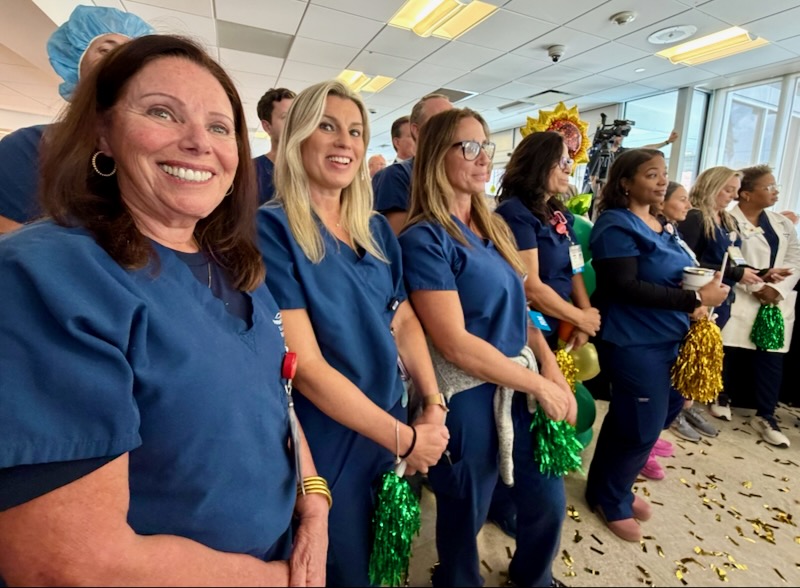
Peconic Bay Medical Center’s main lobby was packed Wednesday afternoon with nurses, staff, hospital leaders and supporters gathered shoulder to shoulder for an announcement years in the making.
The mood was jubilant. Christine Kippley, PBMC’s vice president of patient care services and chief nursing officer, opened her remarks with both arms raised.
“We’re a Magnet hospital!” she said.
The Riverhead hospital announced Wednesday that it has received Magnet Recognition from the American Nurses Credentialing Center, a national designation for nursing excellence, quality patient care and measurable outcomes.
Hospital officials called the recognition one of the most significant honors a health care organization can receive for nursing. According to ANCC, 649 hospitals in the United States hold Magnet status, representing 10.6% of U.S. hospitals.
For PBMC, leaders said, the designation was not the result of one department, one program or one application. It was the result of a years-long effort to strengthen nursing practice across the hospital while PBMC continued to expand clinical services for the East End.
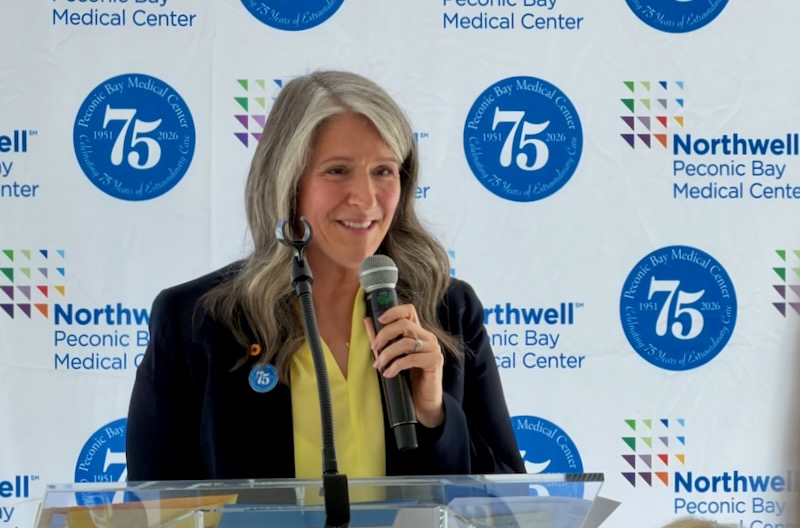
“This is not just about one program, one department,” PBMC President Amy Loeb said during the ceremony. “This is about the hospital.”
Loeb, a registered nurse who was hired as PBMC’s chief nursing officer in late 2015 and was later named hospital president, said Magnet designation had long been a goal for the hospital. She credited former PBMC President and CEO Andrew Mitchell and PBMC board chair Sherry Patterson with launching the effort, and Kippley with carrying it forward through the disruption of the COVID-19 pandemic.
“When I became CNO in late 2015, my focus was Magnet because I truly believed in the framework and I truly believed in this organization,” Loeb said.
Loeb said pursuing Magnet meant pushing the hospital toward excellence while continuing to meet the needs of a growing and aging patient population. She pointed to the emergency department and the hospital’s medical-surgical areas, which she called “the workhorse of this building.”
“You see so many patients, and the patients are getting older. The care is more complex,” Loeb said. “We’re building these programs, and yet you’re still growing in terms of your outcomes. To do both at the same time is really, really amazing, and also really, really hard.”
The Magnet Recognition Program evaluates organizations under a framework that includes transformational leadership, structural empowerment, exemplary professional practice, new knowledge and innovation, and empirical quality results.
At Wednesday’s event, an ANCC representative speaking by video conference said PBMC outperformed benchmarks in examples that included central line-associated bloodstream infections, patient burns, nurse-sensitive clinical quality indicators in ambulatory care, percutaneous coronary intervention in the cardiac catheterization lab and patient experience data related to education in ambulatory care.
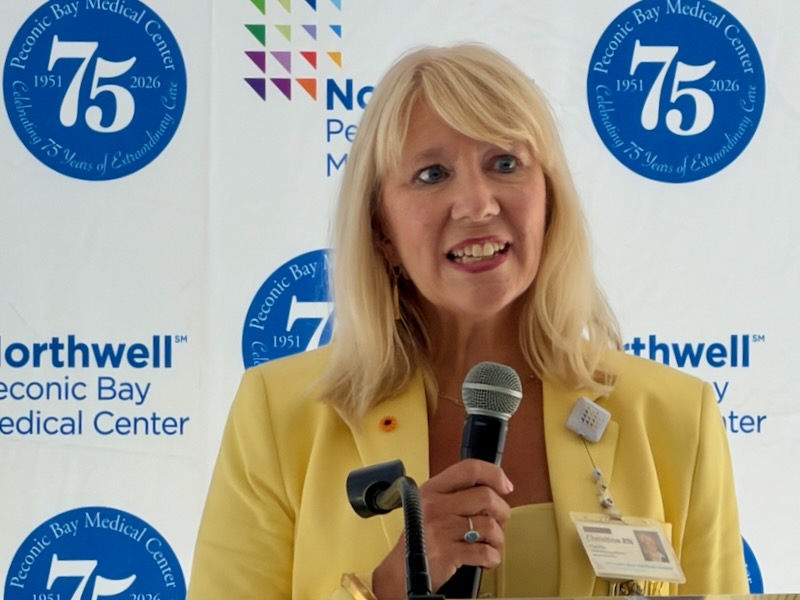
Kippley said people had asked during the process why a community hospital needed Magnet designation. The recognition can help attract nurses and other medical professionals, she said, but its deeper meaning is what it tells patients and families who come through PBMC’s doors.
“The most important reason is the message that it sends to our community,” Kippley said. “It says that the nurses who care for you are deeply committed.”
She described nursing as rewarding but difficult work: long hours, heartbreaking losses, learning new skills, studying for certification exams, adapting to new technology and training new staff members.
“That takes commitment. That is commitment,” Kippley said.
Near the end of her remarks, Kippley grew emotional as she reflected on the people who had worked toward the designation together.
“Titles and awards and accomplishments come and go,” she said. “But what stays with you are the people.”
Tara Anglin, PBMC’s vice president of patient and customer experience, said in an interview after the ceremony that the designation validates the work nurses do every day.
“It’s a big deal,” Anglin said. “It is a very big deal.”
Anglin said the recognition carries special meaning for a hospital in Riverhead.
“No one wants to be in the hospital,” she said. “But when you need it, you want to know that you have the best of the best care close to home,” she said.
“It’s just been so amazing to watch the journey here from when Amy came as the CNO, and all the things we’ve gone through,” Anglin said.
“Ninety percent of care to patients comes from the hands and the hearts and the minds of nurses,” she said.
Mitchell, who led PBMC for more than two decades, said after the ceremony that the designation reflects the quality of nursing at the hospital.
“I think it’s a testimony to the outstanding nursing that goes on here every day,” Mitchell said.
Loeb said maintaining Magnet status will require PBMC to keep improving. The designation is valid for four years, during which hospitals must continue meeting Magnet standards.
Over the next four years, Loeb said, PBMC will have to continue outperforming national benchmarks in nursing outcomes, nursing-sensitive indicators, patient experience, infection rates and falls, while also contributing to the community and advancing nursing research and evidence-based practice.
“You basically are required to build on this foundation,” Loeb said in an interview after the ceremony. “That’s why I refer to it as the new start line.”

PBMC’s designation comes during a period of growth for the hospital, including the opening of the Bill and Ruth Ann Harnisch Neurosciences Center, the development of Eastern Suffolk County’s only thrombectomy-capable stroke program, the opening of the Kanas Family Simulation Lab and plans for the Emilie Roy Corey Center for Women and Infants.
“This is where we begin again to raise the standard,” Loeb told the crowd. “For 75 years, this community hospital has provided extraordinary care, growing and growing, and now we begin again.”
With PBMC’s designation, there are now 14 Magnet hospitals in Nassau and Suffolk counties, based on ANCC’s public Magnet facility list and PBMC’s announcement. The others are Good Samaritan Hospital Medical Center in West Islip; Huntington Hospital; Mount Sinai South Nassau in Oceanside; Glen Cove Hospital; Long Island Jewish Valley Stream Hospital; Mather Hospital in Port Jefferson; North Shore University Hospital in Manhasset; Plainview Hospital; Syosset Hospital; NYU Langone Hospital-Long Island in Mineola; St. Francis Hospital & Heart Center in Roslyn; South Shore University Hospital in Bay Shore; and Stony Brook University Hospital.
Kippley told the nurses and staff gathered in the lobby that the recognition belonged to all of them.
“We can look at each other today, and we can say that we all did this together,” she said.
The American Nurses Credentialing Center is a subsidiary of the American Nurses Association. ANCC recognizes healthcare organizations that promote nursing excellence and quality patient outcomes while providing safe, positive work environments.
The survival of local journalism depends on your support.
We are a small family-owned operation. You rely on us to stay informed, and we depend on you to make our work possible. Just a few dollars can help us continue to bring this important service to our community.
Support RiverheadLOCAL today.
