

























Local officials and residents pressed the Suffolk County Water Authority Wednesday to slow or reopen its environmental review of the North Fork Water Main Project, saying the impacts of the authority’s newly preferred Main Road route have not been adequately studied in the Draft Environmental Impact Statement.
The DEIS, developed to study the proposed route along Sound Avenue, does not contain enough information to assess impacts to traffic, wetlands, schools and utilities of the chosen preferred alternative along Main Road, speakers at the Aug. 26 hearing on the DEIS.
The hearing at the Riverhead library was the third held this month on the DEIS for the proposed water main, which is intended to move water from SCWA’s wells in Flanders to customers in Southold town. The other hearings were in Southold Town and at the SCWA’s Westhampton office.
SCWA officials opened the hearing by describing the project as necessary to address peak summer demand, low tank levels, saltwater intrusion and emerging contaminants affecting the North Fork water supply.
SCWA CEO Jeff Szabo said conservation efforts, including rebates, tiered rates, odd-even watering rules and public messaging, have not solved the summer supply problem. He pointed to the 250,000-gallon Moore’s Lane tank in Greenport, which he said can drop to only a few feet of water during high-demand periods.
“This is a real concern,” Szabo said. “This is what makes us lose sleep, tanks like this.”
“Conservation is helping, but it will never be enough, right?” Szabo said.
Szabo also defended the environmental review process, saying SCWA changed its preferred route after hearing concerns about the original Sound Avenue alignment.
“I’m really proud to stand here before you to say the SEQRA process worked. This is how it was intended to work,” Szabo said.
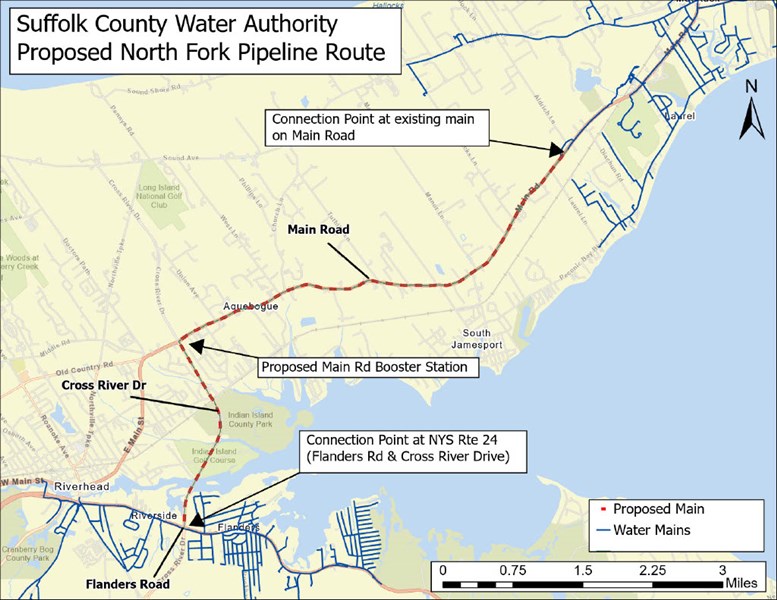
The DEIS evaluates the Sound Avenue route as the proposed action and the Main Road route as the preferred alternative. The Main Road route would run north from Flanders along County Road 105, cross under the Peconic River and Long Island Rail Road, use SCWA-owned property near Route 105 and Main Road for a booster station, then continue east along Main Road to connect with SCWA’s Southold system near the Riverhead-Southold town line in Laurel.
Szabo said public comments on the earlier plan were clear: “Stay off Sound Avenue. It’s narrow, it’s historic. We can’t have a water main project disrupting commerce and the folks up there.”
“So, we heard you,” he said.
See: ‘We’ve heard you’: Water Authority CEO discusses revised North Fork Water Main route (Aug. 24, 2026)
Riverhead resident Mike Foley disputed Szabo’s claim. “I’d like to call BS on that to start,” Foley said. “You stopped it because it wasn’t a sound plan to begin. It was the wrong direction, that wasn’t going to provide adequate pressure. So for whatever reason, all of your experts couldn’t figure it out.”
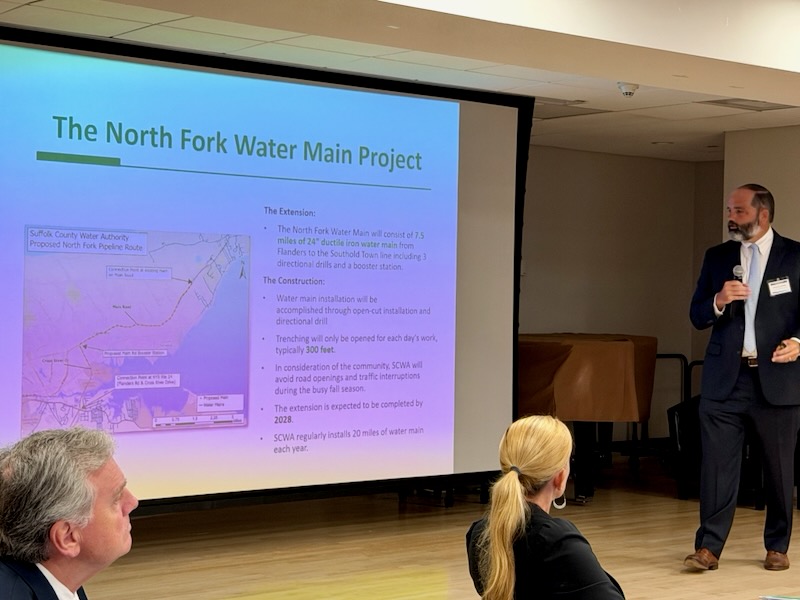
Brendan Warner, SCWA’s director of construction and maintenance, said “the water main extension itself is 7.5 miles of 24-in ductile iron water main.” Phase 1 would provide water as far east as Greenport He said the work would be done primarily by open-cut trenching, advancing about 300 feet per day in typical conditions, with directional drilling used where needed. SCWA expects to complete the project by 2028, he said.
Warner said the project would use existing SCWA wells in Southampton and would not require new wells. He said the Main Road preferred alternative is estimated at about $22 million and has been budgeted within SCWA’s capital program.
Phase 2 of the project involves long-range planning and would extend the SCWA main another 5.82 miles between East Marion and Orient. It carries an estimated cost of more than $16 million at the current time, according to the DEIS.
Warner also noted one of the central points of contention in Riverhead: “there are no customer connections in Riverhead along the route.”
That point was repeated throughout the public comment portion of the hearing.
Frank Mancini, superintendent of the Riverhead Water District, said he had reviewed the new plan and was concerned that SCWA’s proposed 24-inch transmission main appears to run close to the district’s existing 12-inch main serving Main Road customers.
“This represents a problem for the Riverhead Water District,” Mancini said.
Mancini said disturbing soil around older water mains can cause settlement and future failures. It also makes repairs to the town’s water mains more difficult. Mancini asked SCWA to either provide more space between the lines or consider some form of financial protection if future failures occur.
Former Riverhead council member Barbara Blass of Jamesport said the switch from Sound Avenue to Main Road left the SEQRA record focused on a different project than the one now preferred by SCWA.
“A change of project during SEQRA is completely acceptable, but what is not acceptable is that for almost a year and a half, all the SEQRA documents, assessment forms, narrative attachments, draft and final scope, public meetings, ENB notices, and the Monroe test all pertain to a different action,” Blass said.
“For almost a year and a half, we’ve been focusing on and discussing the proposed action that could not function without building a second pump station somewhere or a 50% increase in the size of the pipe. The proposed action was not suitably designed to adequately meet the goals of the project according to the hydrogeological analysis contained in the DEIS,” Blass said.
“This change of plan was not a case of ‘We’ve heard you.’ It’s more like, ‘Oakdale, we have a problem,’” Blass said, referring to the location of SCWA’s main office.
“The SEQRA record is less than sound,” she said.
Blass said the DEIS does not contain enough traffic information to evaluate the Main Road route, particularly near Aquebogue Elementary School, which, she noted, is not even mentioned in the document, though it has an enrollment of 450 students, she said.
“There is no substantive traffic information in this DEIS, no traffic counts, patterns, seasonal fluctuation, etc.,” she said.
First District County Legislator Greg Doroski also focused on the lack of direct benefit to Riverhead. “This project delivers no service connections to Riverhead residents, while running the construction, the road disruption, and potential wetlands risk through the town for its full length,” Doroski said.
Doroski questioned what benefit SCWA would offer Riverhead for hosting the infrastructure and said the authority needs to do more to repair its relationship with the Riverhead Town Board. He also raised concerns about the Meetinghouse Creek area near Route 25 and Church Lane, where the town has undertaken a stormwater and wetland restoration project with the Peconic Estuary Partnership and DEC.
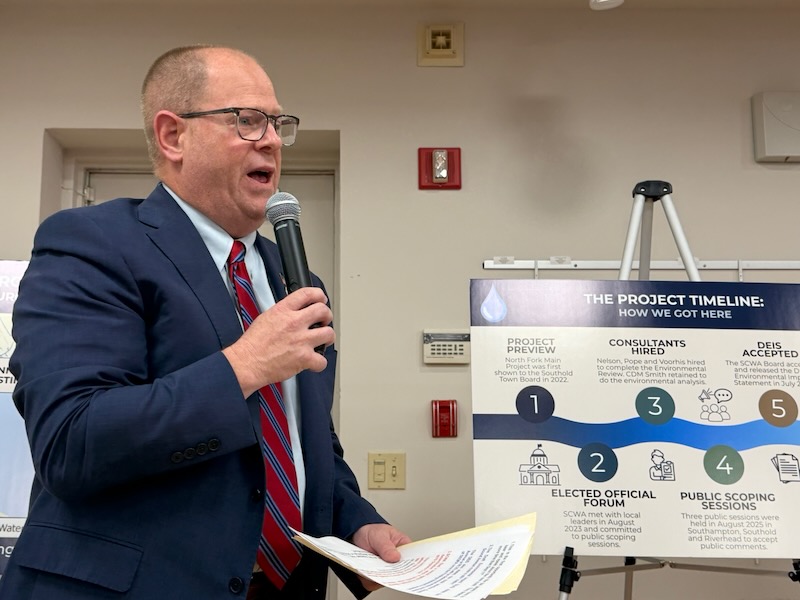
Riverhead Supervisor Jerry Halpin said the town does not oppose clean water for the East End, but objects to the way the project is proceeding.
“I’m always for clean water for people. That is not the point of this,” Halpin said.
Halpin asked SCWA to wait for completion of a U.S. Geological Survey study before finalizing the review and said the authority’s proposed off-season construction schedule does not reflect Riverhead’s year-round traffic and business activity.
“[T]here is no off-season to Riverhead because we are a fully functioning, year-round, explosive town that is doing great things,” Halpin said.
The town’s environmental consultant, Jeffrey Seeman, expanded on those concerns in written comments submitted on behalf of the Town Board. Seeman said the DEIS functions more like a route selection study and generic environmental impact statement than a detailed, site-specific DEIS. He said the document lacks field wetland delineations, sufficient utility information, site-specific plans, traffic counts and enough analysis of how the Main Road route would affect Aquebogue and Jamesport.
At the hearing, Seeman said “there are no traffic counts,” and said the lack of data makes it impossible to justify seasonal or peak-hour traffic conclusions.
Seeman also said residents and businesses along Main Road may not have participated earlier in the process because Sound Avenue had been described as the primary route. By relying on comments received before the route shift, he said, SCWA may have missed the people most directly affected by the preferred alternative.
“So while you’re suggesting that you’ve heard from us, you might not have heard from them,” Seeman said.
A resident in the area of the new route, Kathleen Courtney of Aquebogue also criticized the change. “It shouldn’t merely be incorporated into the revision. A fresh determination may show similar reasons to not use the Main Road,” Courtney said. “I see a lot of indeterminate language without timelines, describing all of the disruption that will result from this project. I know that you have to break a few eggshells to make an omelet, but can there please be another way to do this? You’re going to wreck a community,” Courtney said.
Residents in Flanders brought the concerns of residents there to the hearing. SCWA provides public water to Riverside and Flanders, as well as to parts of Southold Town.
“Every summer we get notified to stop watering …because of the water pressure,” longtime Flanders resident Kathy Kruel said. “Now you’re going to take this from [Flanders] to what we thought was Southold, and what I’m hearing here now is it’s going to end up in Phase Two, probably going out to Orient. So that means even more water coming out of our community,” Kruel said.
Kruel pointed out that the Town of Southampton is working to revitalize the hamlet of Riverside and that will increase water demand. “What’s going to happen when we revitalize Riverside and a lot of our water is being sent all the way out to Southold? That’s a big problem to me because that hits us personally, and I don’t understand why it’s coming from our area instead of someplace that’s closer,” Kruel said. “So what’s going to happen to the water for us in our community when things get revitalized,” she asked. “What’s going to happen to all of us when the water’s taken from our community and being sent someplace else?”
Flanders resident Robert Summerlin made similar points. “My question is very simple: Are you providing a service to the town of Southold, to the people of Southold, or are you providing service to developers that want to develop in Southold and further?” The water authority is already telling Flanders residents to conserve water, including by watering their lawns on alternate days, he said. “How are you going to supply water 7.5 miles out to Southold if you’re telling us to conserve here…?” Summerlin asked.
Dan O’Rourke of CDM Smith, an engineering firm that does groundwater modeling in Suffolk County, said the firm studied the impacts on the water table in both the South Shore low pressure zone, where the water authority’s wellfielde that will supply the North Fork main are located, and the Southold zone and found them to be negligible.
It looked at “the drawdown from any increased pumping, and then looked at “any water table mounding that would result from adding new customers over time,” O’Rourke said.
The results show that the groundwater mounding in Southold is very minimal and the water table drawdown in the area of the South Shore wellfields is also very minimal, O’Rourke said. He said there would be “no detrimental impact…to either drawdown or mounding.” The fluctuations seen in the modeling are “generally within the seasonal fluctuations,” O’Rourke said. “We also looked at the impact of stream flow…on the south shore,” he said, and it was “well within the normal flow pattern of all of those creeks.”
Benja Schwartz of Cutchogue said SCWA did not study impacts on wastewater, and it should because the availability of water will inevitably mean new development, which will mean more wastewater to deal with.
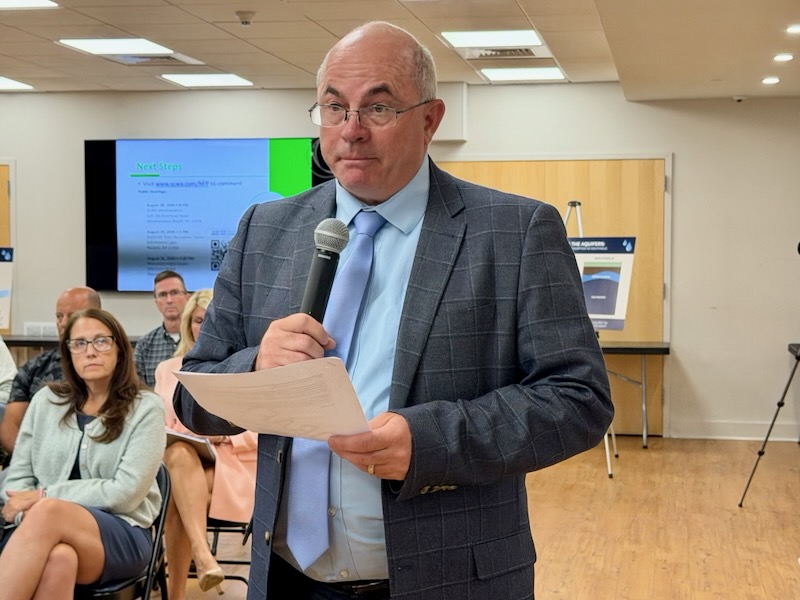
Riverhead Council Member Ken Rothwell challenged the validity of SCWA’s Monroe balancing test determination.
“A quorum of the Suffolk County Water Authority Board was not present during any of the Monroe hearings held on October 7th, 8th, and 9th,” Rothwell said. “It is my understanding a Monroe balance test hearing is an official public proceeding held by a local government board, such as a town board or government authority or zoning board, to weigh competing public interests and decide if a public project is immune from local zoning rules,” he said.
“Without a quorum, a governing body lacks the legal authority to transact business, hold formal hearings, or pass binding resolutions. Any official decisions, votes, or formal proceedings undertaken without a quorum are legally invalid,” Rothwell said.
The Monroe dispute centers on whether SCWA is immune from Riverhead zoning and land-use requirements for the project.
Not every speaker opposed the project. Mark Woolley of Riverhead said he supported SCWA’s effort to bring reliable public water to communities that need it, while acknowledging Mancini’s concerns about the Riverhead Water District.
“I support your proposal, I support the project, I support what you’re trying to do,” Woolley said.
Woolley said his principal concern is the pending litigation between SCWA and Riverhead and the legal costs borne by Riverhead taxpayers.
The hearing took place as the town and SCWA remain in court over the Monroe issue. SCWA sued Riverhead in February, seeking a judgment that the project is exempt from town zoning and land-use regulation and challenging the Town Board’s earlier determination that SCWA must comply with local approvals.
State Supreme Court Justice Alison Napolitano denied Riverhead’s motion to dismiss the case on July 21, allowing SCWA’s Article 78 and declaratory judgment claims to continue. The ruling was not a final decision on whether SCWA is immune from local regulation.
In an Aug. 20 joint letter, attorneys for both sides asked the court for a conference in late August or early September to discuss, among other things, how SCWA’s revised route and booster station location affect the existing claims and the record. The Article 78 petition is currently returnable Sept. 23.
The Riverhead Town Board has scheduled a new Monroe balancing test hearing for Sept. 1. The town’s Aug. 18 resolution says Riverhead objects to SCWA treating the town as an interested agency rather than an involved agency in the environmental review and objects to SCWA relying on a Monroe determination based on the earlier Sound Avenue route for a revised project now proposed along Main Road.
SCWA closed the Riverhead DEIS hearing shortly after 6 p.m. Written comments on the DEIS are being accepted until Sept. 25 at 5 p.m. SCWA must respond to substantive comments in a final environmental impact statement before issuing findings under SEQRA.
See more coverage of this topic
The survival of local journalism depends on your support.
We are a small family-owned operation. You rely on us to stay informed, and we depend on you to make our work possible. Just a few dollars can help us continue to bring this important service to our community.
Support RiverheadLOCAL today.
