





















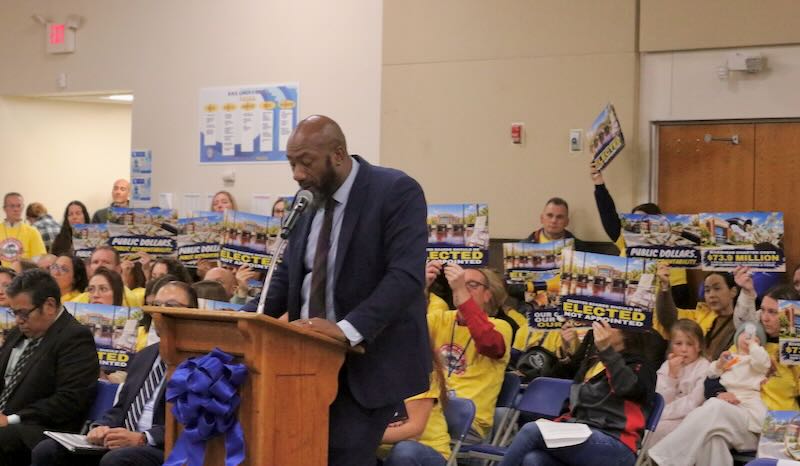
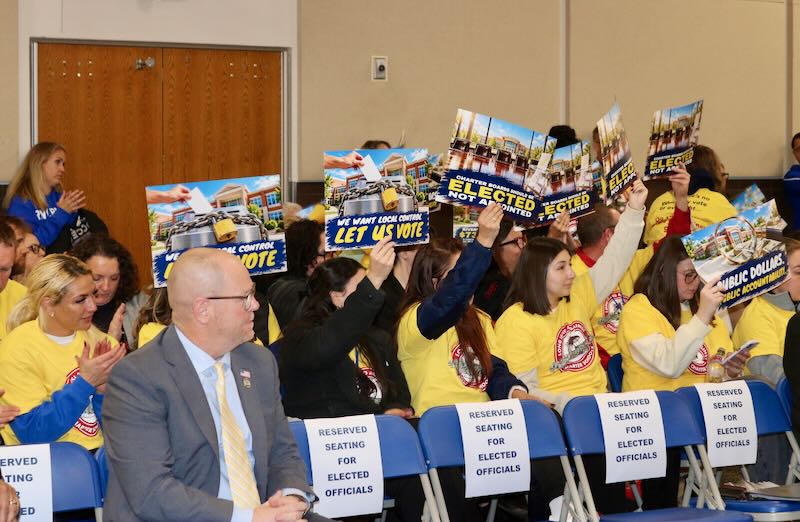
Teachers union leaders, parents and state lawmakers urged New York education officials to reject Riverhead Charter School’s five-year renewal Wednesday night, filling a Riverhead school board hearing with objections to charter-school funding, governance and the impact on district students.
The room overflowed with attendees, many wearing bright yellow shirts imprinted with a “Long Island Against Charter Schools” logo.
Riverhead Charter School Superintendent Raymond Ankrum was the only speaker supporting renewal. While no speakers identified themselves as RCS parents, written submissions included parents describing children who were thriving at the school and staff defending its work.
The Riverhead Board of Education was required by state law to hold the hearing but it has no authority to approve or deny the charter school’s renewal. The Board of Regents, which originally chartered RCS in 2001, will decide whether it can continue operating beyond June 2027.
The proposed renewal would run from July 1, 2027 through June 30, 2032, authorizing kindergarten through grade 12 and up to 1,244 students each year of the five-year charter. The state’s public notice lists no proposed charter revisions. The enrollment ceiling is the same one approved during the previous renewal.
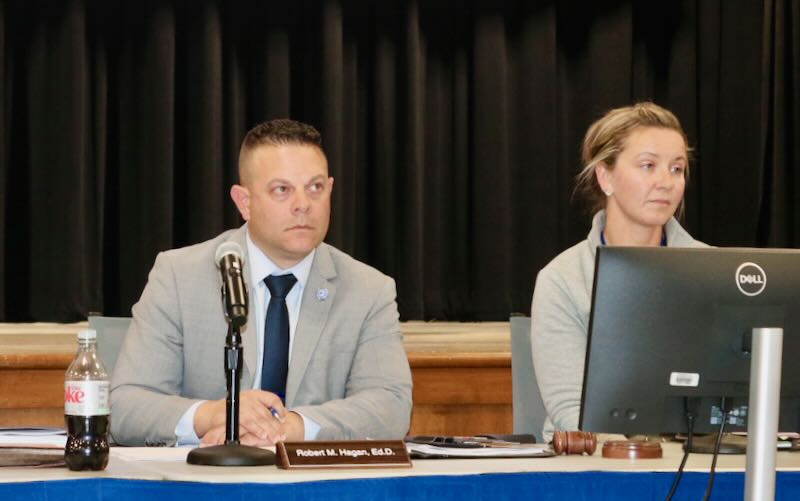
Yet the district was asked to hold the hearing without receiving the application itself. Superintendent Bob Hagan confirmed Wednesday night that the district never received it. The New York State Education Department did not respond to RiverheadLOCAL’s inquiry seeking a copy.
District Clerk Dawn Bozuhoski said 338 comments or letters had been received by the start of the hearing and would be submitted to the state with the transcript. Records subsequently obtained by RiverheadLOCAL included more than 300 online response entries and a separate compilation of 18 support letters, as well as written remarks and letters from elected officials
Ankrum opened the public comments during the hearing with a defense of the school’s academic performance and public status. He said RCS serves 1,054 students and reported that 75% of its students were proficient in math and 73% in reading on the previous year’s state exams.
“I’m not here to argue. I’m here to put a few facts on the record,” Ankrum said.
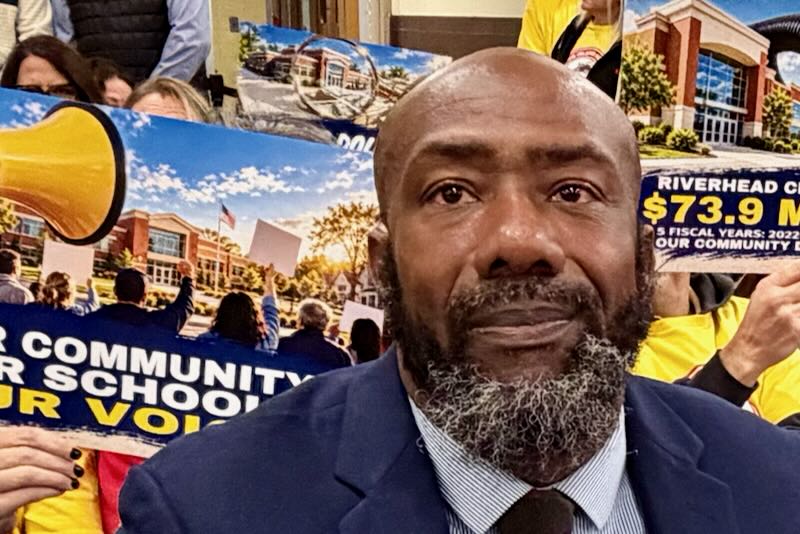
He described RCS as a nonprofit public school, with admissions decided by lottery when applications exceed available seats, and said its tuition rate is set by state law. He said nearly nine in 10 students are Hispanic or Black and about two-thirds qualify for free or reduced-price lunch.
The support packet contained five letters from families and 13 from faculty and staff, according to its submission log. Parents emphasized individual attention, a welcoming environment and the value of choosing a school suited to their children.
“For my family, Riverhead Charter School has been the right choice,” wrote Maria Braunskill, identified in the packet as the parent of two elementary students. She described daughters who enjoyed school, gained confidence and participated in music and theater.
Regina Lynch, who described herself as a parent and guardian of children with special needs, said the school’s smaller classes and accessible staff had made a meaningful difference for her family.
“For students with special needs, the right educational setting can mean the difference between falling behind and discovering their ability to thrive,” Lynch wrote.
Support also came from Denise Gross, a fourth-grade teacher and president of the Riverhead Charter School Employees Association, a NYSUT affiliate. She credited the school with helping students improve academically and creating a community across district boundaries.
“It’s the love, community, and safety that our school offers that has had the greatest impact on me,” Gross wrote.

Opponents questioned whether the school adequately serves students with disabilities and other intensive needs, and whether its academic results can be fairly compared with district schools. Their objections also reflected frustration with a system in which residents vote on district budgets and elect district trustees but do not vote on charter-school budgets or elect charter trustees.
Riverhead Central Faculty Association Vice President Jen Simoes called for independently verified information about special-education programming, student transfers and disciplinary practices before another five-year term is approved. A Wading River parent who identified himself as Gary Karlson also questioned services for students with disabilities and urged the state to reject renewal. The hearing’s opposition therefore included local parents as well as educators and union representatives from other districts.
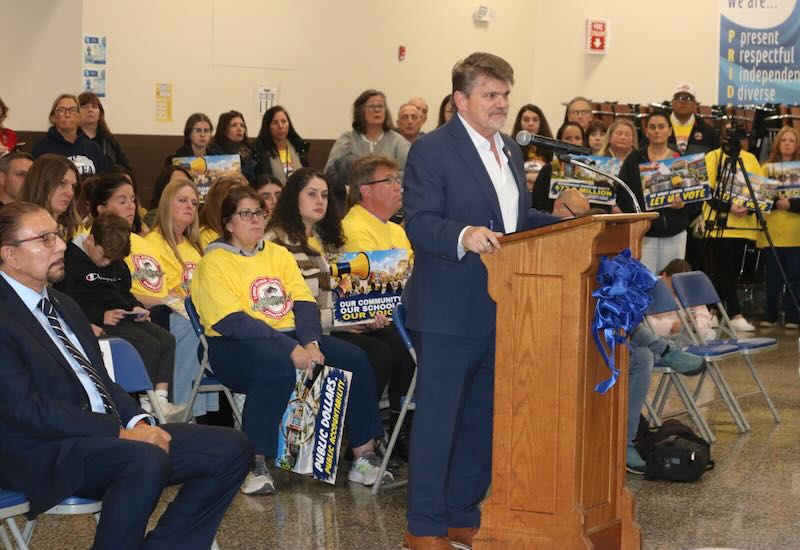
Assembly Member Tommy John Schiavoni, whose district includes the portion of the Riverhead school district in Southampton Town, opposed renewal, arguing that separate school systems duplicate expenses.
“We are not saving money. We are spending more money to educate children in the state of New York than we would without them,” Schiavoni said.
A letter from Assembly Members Jodi Giglio and Doug Smith, read at the hearing and included in the written record, urged a comprehensive assessment of the financial and educational consequences of the school’s K–12 expansion before another renewal. Giglio’s Second Assembly District includes all of Riverhead Town. The letter also supported local referendums, annual public budget hearings and a cumulative-impact analysis before approving new charter schools or locations.
Riverhead Town Supervisor Jerry Halpin also called for public participation in decisions involving taxpayer money.
“Taxation of anyone requires representation,” Halpin said, calling for public input at all levels of government, including Albany.
The online submissions echoed concerns about local control, district resources and financial oversight. They came from Riverhead-area communities and elsewhere on Long Island, and included some repeated language.
Shannon Stinson, who identified herself as an Aquebogue taxpayer and public-school parent, sought more public input into charter-school funding. Kevin Toolan, identifying himself as the Remsenburg-Speonk school board president, described the tuition and transportation costs his small district incurred when a charter-school student moved into it.
RCFA President Greg Wallace challenged the charter school’s spending, comparing a tuition payment of $18,340 per Riverhead student with this year what he said was RCS spending of $14,670 per student in an earlier fiscal year. He did not identify the year or explain the enrollment calculation behind his total.
“All told, it’s $1.27 million of taxpayer money that’s unaccounted for, and that’s just one year,” Wallace said.
In a detailed written response to questions Thursday afternoon, Ankrum identified the figures as 2017–18 data and disputed Wallace’s description of them. He said approximately $18,340 was the school’s total revenue per student — including grants and other income — rather than the Riverhead tuition rate. NYSED’s published basic tuition rate for Riverhead that year was $17,076.
The audit reports $8.92 million in total revenue and $7.75 million in expenses for 2017–18, producing a $1.18 million increase in net assets. Using the enrollment figure Ankrum supplied, total expenses were approximately $15,918 per student. His calculation excluding noncash depreciation and amortization produces operating expenses of approximately $14,730 per student, close to but not exactly Wallace’s $14,670.
“The surplus was spent on buildings,” Ankrum wrote. The audit’s cash-flow statement shows approximately $1.98 million generated by operations, $1.89 million in fixed-asset purchases and $285,000 in bond principal repayments that year. Cash decreased by approximately $202,000.
Ankrum said he could not match Wallace’s $1.27 million total, which implies approximately 346 students at the stated per-student difference, compared with total school enrollment of about 487. Wallace, however, referred to Riverhead taxpayers, while RCS enrolls students from multiple districts. The different enrollment bases do not, by themselves, resolve the calculation. Wallace did not identify the fiscal year or provide an enrollment calculation in his oral or submitted remarks.
Wallace did not respond to a written request for clarification Thursday, including questions about the figures underlying his calculation and whether he was alleging missing money or criticizing the school’s retention of a surplus.
More recent audits also account for substantial retained balances. The 2024–25 audit reports $21.81 million in revenue and support, $19.10 million in expenses and a $2.71 million increase in net assets. Accumulated net assets — assets remaining after liabilities — totaled $20.45 million at June 30, 2025. These schoolwide figures do not establish that $1.27 million in Riverhead tuition is missing.
Ankrum said reserves support capital debt, campus development, an operating cushion and longer-term educational and technology needs. He said a planned all-cash property purchase of about $4.36 million would use much of the cash held above a six-month operating reserve.
“The board has not yet adopted them as a formal written reserve policy,” he wrote of those priorities.
RCS posts annual audits and board minutes online. RiverheadLOCAL located budget summaries and approval motions in the minutes, but not the complete annual operating budgets. Ankrum said the adopted budgets were filed with NYSED and are available from the school under its FOIL policy. He also said the renewal application and attachments are available on request, with personal information redacted. His response did not include the complete budgets or application.
Charter schools are subject to New York’s Freedom of Information Law and Open Meetings Law. State law also requires online annual reports containing financial statements and the latest independent audit. Those existing requirements are separate from proposals for additional public budget votes, hearings and other oversight.
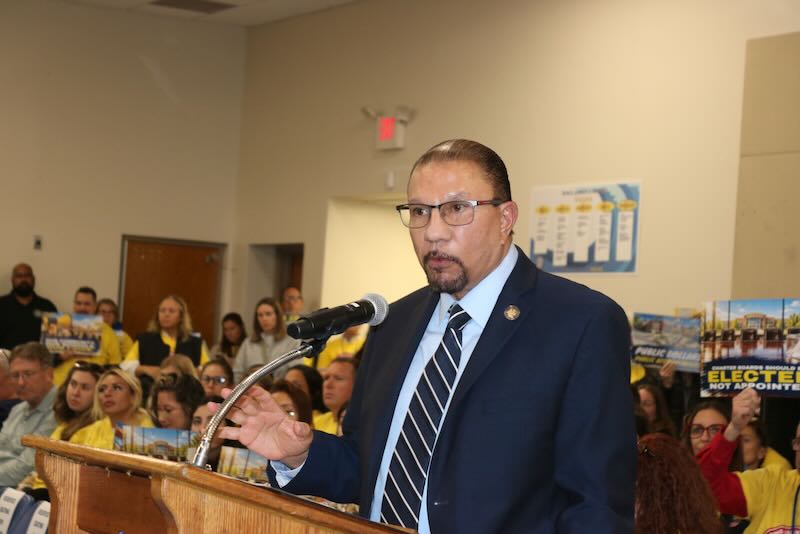
Assembly Deputy Speaker Phil Ramos, a Brentwood Democrat, criticized the financial burden on district schools and urged the Riverhead board to examine the academic results, financial consequences and community concerns surrounding the renewal. His appeal was directed to a board that can submit comments but cannot approve or reject the renewal.
Ramos holds a leadership position in the Legislature that can change charter-school law. Democrats control both legislative chambers and the governorship.
Questioned after his remarks about changing the funding system, Ramos initially pointed to his legislation requiring local approval of charter schools. His bill would require a public vote outside New York City before charter applications and renewals could proceed; it does not revise the tuition formula.
Asked about funding, he turned to his opposition to charter schools.
“I don’t believe they should exist,” Ramos said.
Asked again whether state law could be changed to address the financial burden on local districts, he said: “They should be funded by state money.” He did not identify a specific amendment to the tuition formula or explain a legislative plan to shift those costs from districts to the state.
Ramos also discussed SUNY’s charter-approval authority. But RCS is authorized by the Board of Regents, not SUNY, and has been Regents-authorized since its original charter was issued in January 2001. His description of charter schools as private schools conflicts with their designation as independent public schools under state law.
Wednesday’s hearing followed a separate effort by the Riverhead and Port Jefferson school boards to change state policy. At its Oct. 15 annual business meeting, the New York State School Boards Association adopted three positions advanced by Riverhead and Port Jefferson supporting legislation on charter-school residency requirements, funding and financial oversight.
The measures call for trustees and administrators to reside in New York and meet the same financial and ethical standards as public-school counterparts; exclude BOCES expenses from the tuition formula; and require equivalent auditing procedures and transparency. Their adoption establishes association advocacy positions, not changes to state law.
Riverhead school board President Erica Murphy, responding by email Oct. 22 on behalf of the board, said the proposals seek consistent standards and address the financial pressures on district schools.
“Taxpayers deserve confidence that public dollars are managed responsibly, and local communities deserve a meaningful voice in how those dollars are spent,” Murphy wrote.
The current renewal follows the Regents’ May 2022 approval of a five-year term that allowed RCS to add grades 11 and 12 and raise its enrollment ceiling from 850 to 1,244 over the term. That decision enabled students to complete their elementary and secondary education at the charter school.
At the October 2021 hearing preceding that decision, RiverheadLOCAL reported a large turnout of charter-school parents, many Spanish-speaking, alongside sharp opposition from district teachers. Supporters emphasized keeping children in one school through graduation. The Regents subsequently approved the renewal and expansion.
This time, supporters made their case chiefly through written accounts of students’ experiences, while the hearing’s oral testimony was dominated by opponents seeking changes in funding and governance. The local board closed the hearing without substantive comment from trustees or the district superintendent.
The survival of local journalism depends on your support.
We are a small family-owned operation. You rely on us to stay informed, and we depend on you to make our work possible. Just a few dollars can help us continue to bring this important service to our community.
Support RiverheadLOCAL today.
