
























Riverhead Neighborhood Preservation Coalition president Dominique Mendez is right.
 Riverhead Town, and Calverton in particular, does have a long and less-than-illustrious history of sand-mining, in spite of the town’s attempt to ban the practice.
The ban didn’t stop some companies from thumbing their noses at the town and digging mines anyway. Whether they pretended they were doing something else or just brazenly went ahead and dug their mines, these companies said, “go ahead-sue me.”
That’s because a sand mine = gold mine. Well, almost.
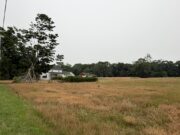
Steven Mezynieski, owner of Driftwood Farms in Orient, in 2012 bought 46 acres of industrially zoned land in Calverton — property farmed for many years by Elmer Zeh — for $1.785 million. He says he wants to board horses and grow hay there. And to do that profitably, he says he needs to level the site. To level the site, he says he needs to remove 415,000 cubic yards of sand from the site.
Fortunately for Mezynieski, he also owns an excavating business. He does excavating, land clearing, site development, drainage work, dune and beach restoration and road construction, according to his business website. So he’s got the equipment and know-how to get the job in Calverton done.
Even if Mezynieski didn’t own an excavating company, can digging 415,000 cubic yards of sand and hauling it off for sale be considered anything but a sand mine? It’s surely not a “minor modification” to the grade of the land — which would enjoy exempt status under state law. Heck, it’s more than twice the amount of soil dug up and relocated by the Heritage-Riverhead Retail Developers at the future Costco site.
According to his website, Mezynieski charges $20/yard for sand (delivered). According to his own price list, the retail value of what he wants to pull out of the Calverton site is $8.3 million. Yet at the town board meeting yesterday, Mezynieski referred to it as “$200,000 worth of sand.” Clearly he’s looking to minimize the scope of what he’s planning to do as well as the money he stands to make. I don’t know what it would cost him to excavate the sand, process it and haul it. We can assume the cost is significant, but we can also assume it’s significantly less than its multi-million dollar “street value.”
Nevertheless, Mezynieski seeks to invoke the protection of the state agriculture and markets law, arguing that since he plans to farm the 46 acres, his mining operation should be exempt from state and local permit requirements — saving town excavation fees of $830,000. The state agriculture and markets law trumps local codes where farmers are concerned, so that even activities regulated or banned by local codes are OK if they come under the “agriculture” umbrella.
Even sand mines.
But state law says the Department of Environmental Conservation, which has jurisdiction over mining, must decide if the mining is in furtherance of agriculture. If it’s not, it’s not exempt from permit requirements.
As the saying goes, if it waddles like a duck and quacks like a duck…
The DEC said Mezynieski’s proposal was indeed a duck.
The state agriculture and markets department’s “agriculture protection unit” (no mistake about their mission) told Mezynieski no-go: it’s a mine.
“The department does not find your proposed mining activity to be eligible for protection [under the Agriculture and Markets Law] as part of a farm operation,” the manager of the agriculture protection unit wrote on Aug. 19.
Having the unfavorable Aug. 19 response in hand, and knowing the town was set to deny his client’s application, Mezynieski’s lawyer, Peter Danowski wrote back to the agricultural protection unit manager asking very specific questions, seeking very specific answers. The ag and markets agricultural protection unit manager responded on Sept. 3:
Yes, the ag and markets department has protected the conversion of farm woodland to land suitable for agricultural production. Yes, the department has also protected the ability of a farmer to make minor modifications to the surface gradient to facilitate agricultural production activities.
And that was sufficient to muddy the waters enough yesterday that the town board tabled the resolution denying the exemption request, allowing time to seek advice from legal counsel.
This buys Mr. Danowksi more time to mine the town board for votes. He’s already got Councilman John Dunleavy’s support, so if he can just convince two more council members…
Time is on his side.
If a majority of the board goes along with it, fallow farm fields across Riverhead may begin to sprout a new cash crop: sand.

Denise Civiletti is the editor and copublisher of RiverheadLocal.com. An award-winning community journalist, she is an attorney and former Riverhead Town councilwoman (1988-1991); she lives in Riverhead with her husband and business partner, Peter Blasl and their two college-student daughters. The views expressed in her blog are hers alone.
The survival of local journalism depends on your support.
We are a small family-owned operation. You rely on us to stay informed, and we depend on you to make our work possible. Just a few dollars can help us continue to bring this important service to our community.
Support RiverheadLOCAL today.
