














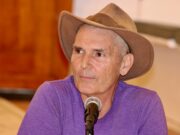


If every person has an animal totem, the cat, with its legendary nine lives, is definitely the one for Ted Squires of Flanders.
After many a close call during his dirt-bike-riding days as a youngster, Squires had a brush with death twice in late 1980s. Once, he was hit by a car in the New York City, sustaining critical injuries. The second time, he was shot by the sniper who killed one person and wounded four others in Riverhead during December 1988 and January 1989.
More recently, Squires, 64, cashed in another of his nine lives after a cut on the back of his right leg led to the development of a flesh-eating bacteria that almost took his life — and his leg — this past December.
“We will see a necrotizing fasciitis in half a dozen patients a year in various degrees,” Dr. Agostino Cervone, a surgeon at Peconic Bay Medical Center, said of the type of infection Squires contracted on the outer covering, or fascia, of his lower leg muscles. “Most of the time it happens in patients whose immune systems have been compromised.”
Internist Dr. John O’Connor initially saw Squires when he was first admitted at PBMC in December with a stomach virus days after receiving stitches for a cut on his leg sustained from falling off of a stool.
O’Connor said there was no initial redness or draining from the cut on the back of Squires’ leg at the time of admittance, though he and Squires’ son, Jason, noticed bruising on his foot early the next morning.
“We didn’t know if maybe he had bumped his foot in the night, but three or four hours later RN Luz Yanes called me because she noticed the leg had changed significantly and become very swollen, hot and red,” O’Conner recalled. “He also had a high fever and his blood pressure was dropping. I called [Dr. Cervone] right away at that point, but it was really the attentiveness of the nurse who deserves credit for noticing changes in his wound.”
A hallmark of the flesh-eating infection that nearly killed Squires is the speed at which the infection spreads throughout the body and because it occurs beneath the skin, can only be diagnosed through an incision into the skin, made so doctors can see what’s happening underneath, Cervone said.
When an incision was made, Cervone determined the infection spanned from Squires’ toes up to his knee.
“One of the things we do in surgery is something called the probe test, where you run your finger along the top of the muscle fascia and as long as your finger easily pushes forward, all of that is infection,” he said. “You have to debride, or remove, everything above that. With fasciitis you have to be aggressive, otherwise it will spread even further within hours. He was pretty sick at that point so it was, ‘Let’s aggressively debride him, see if we can save his leg and then see if he makes it through [the surgery] before anything else.”
Skin grafts were planned for Squires’ leg after it was determined he would live through the operation. Cervone said that determination took days.
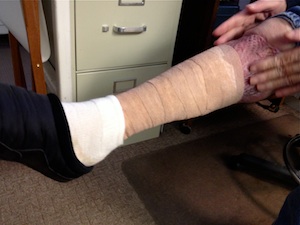 “Ultimately you say, ‘Okay, at the end, if he survives this, we’ll do skin grafts,'” he said. “It was pretty rough for the first three or four days … The whole area from his foot to his knee didn’t have skin on it so we used a negative-pressure apparatus called a ‘wound vac,’ applying sponges on his leg, wrapping it in plastic and putting it on suction to promote healing tissue. Once you have enough healing tissue underneath with new blood vessels, that’s when you do the skin graft.”
From Squires perspective, this experience was his closest to death.
“By the time I got to the hospital, I was feeling really sick and beyond that, I don’t really remember a lot until someone showed up to see me maybe four days later,” Squires said.
“My blood pressure dropped three times during my stay there and I was awake during the third one. I was thinking, ‘This could be it. This could be it right here.’ But then I said to myself, ‘Don’t even think that way, turn around and start fighting,” and I got through it. I think that’s important – your attitude towards life. Ya gotta go after it. You can’t let it take you over.”
Plastic surgeon Dr. Robert Jacobs took patches of skin from Squires’ thigh, poking holes into it in order to stretch the skin to fit over his shins.
“The people who took care of me were very good at their jobs,” Squires said of the recent experience, which saved his life, leg and resulted in the successful grafting of skin onto his right shin.
“I wasn’t awake for Christmas or New Year’s this year,” Squires said of the ordeal. “The first thing I remember is my friend Jim saying to me, ‘What have you done with yourself this time?”
Squires, who said he was once hit by a car in Queens, which led to an 18-month stint on crutches, was also shot in the back by 20-year-old Yusef Abdullah Rahman less than a year after being able to again walk without aid.
“The only reason he shot me was because of the location, ” Squires told RiverheadLOCAL.
“He was at the police station that night looking for a cop to shoot, but there was nobody going in and out of the police station because it was cold out. Since he couldn’t shoot a cop, he went looking for someone else to shoot and he found my house.”
Squires said he was watching TV in his Ostrander Avenue home on the night of Dec. 7, 1988 when he heard a knock on his kitchen door.
“I looked outside and noticed the outside light was off, which I knew I had left on,” he said. ” I said, ‘Something’s wrong here,’ turned off the light over the sink, turned around to go turn off the other kitchen light and he shoots me in the back with a sawed-off 12-gauge shotgun, through the window, which knocked me over where I laid paralyzed for about a half hour.”
Squires said the attack resulted in a one-week stay at the hospital, where medical staff removed some of the pellets lodged in his back, right shoulder and neck.
“They don’t take all the pellets out because that would do more damage, so I’ve still got a lot of shot in my back,” he said. “When I get X-rays, I have to remember to tell them because there’s been a couple times where people have come back and asked, ‘What happened to you? What are all these shots!”
Squires said the strangest part of the experience was a conversation with his son, a teenager at the time, expressing fear about the sniper.
“My son and I were riding through Polish Town and he said to me, ‘You know, Pop, if people are going to get shot in Riverhead, then I don’t want to live here,” and I said, ‘Nobody’s ever going to shoot us.’ That night I got shot.”
The high drama throughout Squires’ life has not gone unnoticed by family and friends.
“People joke around with me about having nine lives and I’ve wondered at times why these things happen, but they’re questions I really can’t answer,” said Squires, a longtime employee of Wedel Sign Co. in Riverhead.
“I have an appreciation for life, but it comes down to the fact that you gotta get up and go. You can’t lay there and feel sorry for yourself. You’ve got to persevere and get through things,” Squires said.
“The only way to go through life is to have fun, make everyone smile and remember that family is really important,” he said. “When you go through this kinda stuff, you need someone who is going to be there all the time and the only ones who are going to do that is your family.”
The survival of local journalism depends on your support.
We are a small family-owned operation. You rely on us to stay informed, and we depend on you to make our work possible. Just a few dollars can help us continue to bring this important service to our community.
Support RiverheadLOCAL today.
