




















Suffolk County supervisors are calling for changes in New York State’s property tax cap law, arguing that spikes in costs they can’t control are consuming much of the tax levy growth the law allows.
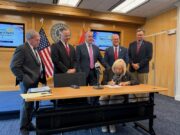
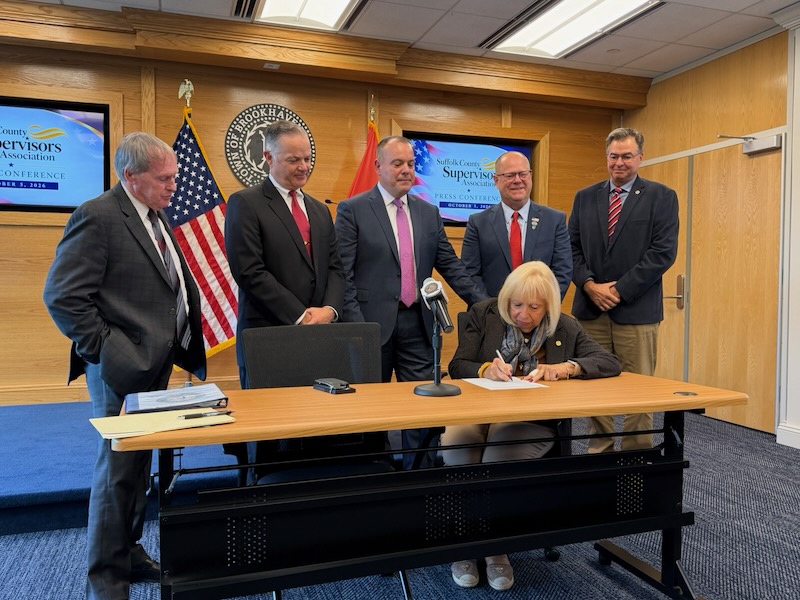
At a Suffolk County Supervisors Association press conference convened yesterday at Brookhaven Town Hall, the supervisors of six of the county’s 10 towns signed a letter to Gov. Kathy Hochul and state lawmakers, asking them to reconsider how the property tax cap treats expenses such as waste disposal, health insurance and pension costs, and to consider adjustments for inflation.
The supervisors also renewed local officials’ longstanding complaints about unfunded state mandates, calling on lawmakers to provide funding for new requirements imposed on municipalities by Albany.
The four supervisors who didn’t attend yesterday’s press conference agree with the association’s demands, Brookhaven Supervisor Dan Panico said. Absent yesterday were Kathee Burke-Gonzalez of East Hampton, Maria Moore of Southampton and Amber Brach-Williams of Shelter Island and Rich Schaffer of Babylon, Suffolk’s longest-serving supervisor. Schaffer also serves as chair of the association. He confirmed today that he supports the association’s position.
The bipartisan appeal comes as towns prepare their 2027 budgets.
State Comptroller Thomas DiNapoli calculated an inflation factor of 3.13% for calendar-year local governments, but the law limits their basic allowable levy growth factor to 2%.
A town’s actual limit can differ from 2% because the statutory calculation allows certain adjustments, such as for tax base growth, and limited exclusions from the cap, including qualifying pension increases.
Towns and other taxing jurisdictions can increase their tax levies above their calculated limits if 60% of the voting power of their governing boards approve an override.
“No municipality, no elected official ever wants to raise their taxes, and we certainly don’t want to pierce a tax cap,” Huntington Supervisor Edmund Smyth said. “However, it is impossible to maintain parks, beaches, roads, and garbage collection, along with other life-saving services, without exceeding the 2% tax cap this year,” he said.
“The costs are rising everywhere, and we hope the state will adjust the arbitrary 2% tax cap to establish a formula that recognizes economic reality,” Smyth said.
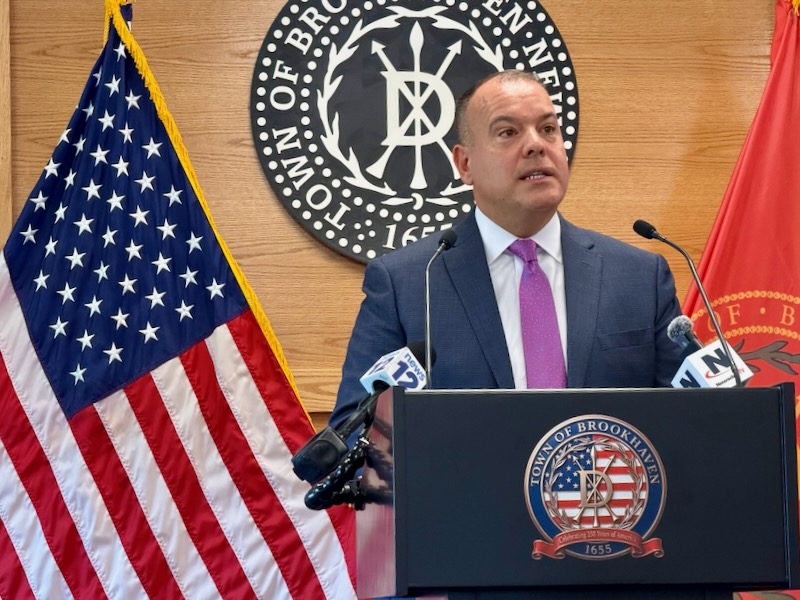
Panico devoted much of his remarks to the costs of solid waste management. The Brookhaven landfill, a facility Panico made a point of calling an ashfill, because ash from regional waste-to-energy incinerators is buried there, is expected to close in 2028. Panico warned that the region has no settled plan for handling the ash after the Brookhaven ashfill shuts down. He predicted disposal costs would climb sharply.
“The DEC has sat this out,” Panico said, referring to the State Department of Environmental Conservation, the agency responsible for developing and overseeing local implementation of municipal solid waste management plans.
“Waste management is going to be the single largest expense,” Panico said.
Islip Supervisor Angie Carpenter said a new garbage contract cost her town $6 million more than the previous one.
The supervisors also cited required pension contributions and employee health insurance premiums in a state-run program as pressures on their budgets.
Smithtown Supervisor Edward Wehrheim said the tax cap law allows his town to increase property taxes by $1.6 million in 2027, while projected increases in fixed costs beyond the town’s control already put the increase about $1.2 million over that limit.

Southold Supervisor Al Krupski called the bipartisan effort by town supervisors an impressive demonstration of what town government is all about.
“For towns, it’s nuts and bolts, right?” Towns must deliver essential services for their residents and supervisors must try to control costs everywhere yet still deliver. “So you think about those things on a day-to-day basis,” Krupski said.
“We need a good partner in the state government to say, you know, we all need to work together for the residents,” Krupski said, citing the cooperation that exists among the town supervisors. “It’s providing services and it’s controlling costs. It’s both parts of it, and I think you see that here today,” he said.
“If you want young families to live and to work here in Suffolk County, in all of our towns, you need to control the cost for the future. Whatever decisions we make today, are going to have huge impacts on the tax bills for our young residents in the future.”
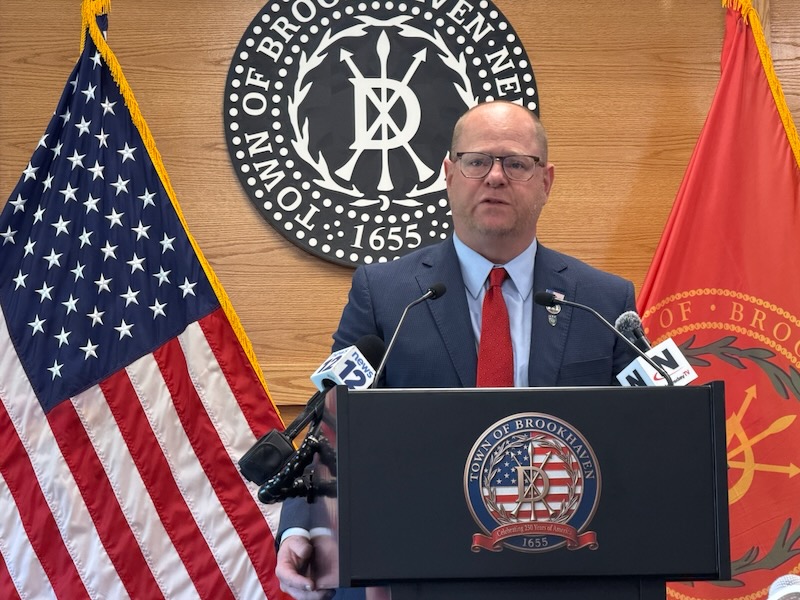
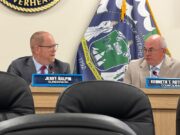
Riverhead Supervisor Jerry Halpin highlighted the contradiction between being asked to be a “pro-housing community” without being given the tools to deliver the services needed to sustain it.
“We’re just asking Albany to help us to continue that conversation, to sit down with us and figure this out,” he said.
Unfunded state mandates continue to cause local pain, the supervisors said. An example, Panico said, is the state cannabis law. Processing applications locally is a burden on town staff resources, he said.
“It’s a lot of personnel hours, a lot of expense, but we’re continually inundated,” Panico said. “We’ve asked the state to at least put some type of fee associated with filing these applications because real people have to do real work” to process the paperwork and respond to the state, with no fee charged to the applicant.
“And then you have the State of New York,” Panico continued. The state has issued licenses for adult-use cannabis dispensaries on property that is not zoned correctly for that use, he said. The town notifies the state, but the state goes ahead and issues the license anyway, he said.
“The issue is not about cannabis, it’s about breaking your promise to the towns and breaking the law,” Panico said.
He highlighted one case where the town is in litigation over that very issue. “Even though we showed they weren’t zoned correctly, the state went and [issued] a license. That one’s open. We’re in litigation at the behest of our residents, who understand what we adopted and where we were placing it. But the state just kind of does what the state wants to do, and they pass everything down to us, and we shoulder all of that burden,” Panico said.
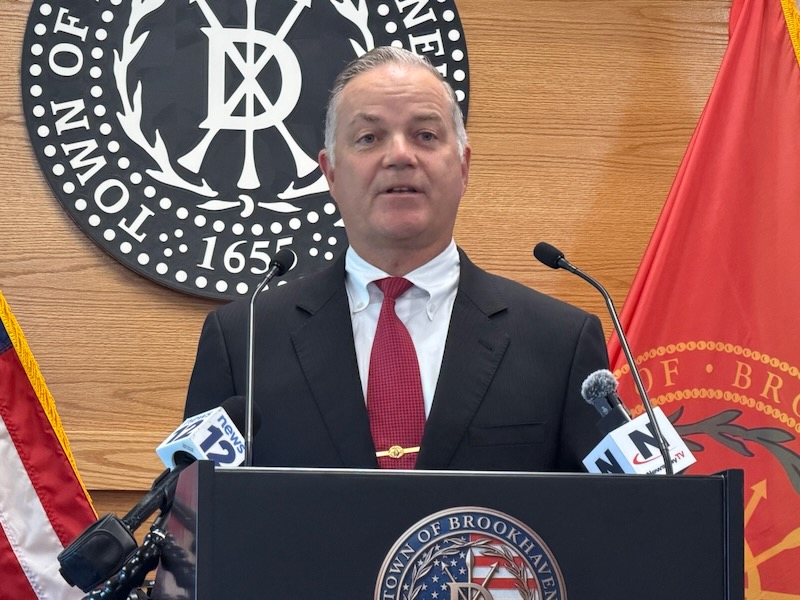
Panico expressed frustration that the property tax cap and the many unfunded mandates towns must bear are not even being discussed by the candidates for governor in this election year. The incumbent Hochul, a Democrat, faces a challenge from Nassau County Executive Bruce Blakeman, a Republican.
“It’s the state pressures that cause our costs to rise year over year over year,” Panico said. “We provide NYSHIP health insurance. But we don’t set the cost of that plan. You want to make everyone tier-four employees with regard to a pension, OK. If that’s what you want to do, you’re a higher level of government…pay for it,” Panico said.
“Everything that comes down” from Albany, the towns deal with, regardless of budgetary impacts, which are often onerous, Panico said, requiring towns to hire professionals to compile plans or applications.
“We do what’s right by the environment. We do what’s right by our employees. We maintain the roads, [collect] the garbage,” he said. “We try to deal with this individually as towns because the state has set this out. That’s the reality,” Panico said. Taxpayers must live with the result, he said.
Town budgets for the coming year are facing added pressure from the rising cost of gasoline, diesel fuel, electricity, heating and cooling costs. “The prices just continue to escalate,” Panico said.
What the tax ‘cap’ is — and isn’t
The property tax levy limit was enacted in 2011 under then-Gov. Andrew Cuomo and first applied to fiscal years beginning in 2012. Its purpose was to slow growth in New York’s property tax burden, including school district taxes. Cuomo’s administration said property taxes had risen at more than twice the rate of inflation from 2000 to 2010.
Despite its familiar name, the law does not cap an individual property owner’s bill or a government’s total spending increase at 2%. It generally limits growth in the total property tax levy to the lesser of 2% or inflation, subject to a formula with exceptions.
A town board can override its calculated limit with a 60% vote. School districts need approval from 60% of voters to override theirs. The law also permits certain costs, including qualifying pension increases, to be excluded from the calculation.
Under New York’s tax cap, a pension increase qualifies for an exclusion only when the statewide employer contribution rate for a retirement system rises by more than two percentage points from the prior year. Only the portion above two points can be excluded, applied to the relevant payroll—not the town’s entire pension bill. For 2027 town budgets, the state comptroller lists no exclusion for the Employees’ Retirement System. It lists a 0.8% payroll exclusion for Police and Fire Retirement System payments made in February, but none for those made in December.
The supervisors said the 2% tax cap and formulas for exclusions have not kept pace with the costs towns now face.
Carpenter pointed to exclusions available to school districts, including eligible capital expenses, and asked the state to consider comparable flexibility for towns. Under current law, school districts can exclude the property tax levy needed for eligible capital expenditures, including debt service on school capital projects. Towns have no comparable exclusion for capital projects or bond payments, even when voters approved the borrowing.
Bipartisan support for cap, opposition to change
The tax cap legislation was enacted in 2011 with strong bipartisan support. It was introduced at the request of Cuomo, a Democrat. Its prime sponsor in the State Senate, which was then controlled by Republicans, was Majority Leader Dean Skelos. Assembly Speaker Sheldon Silver was among its co-sponsors in the Assembly.
It is not clear there will be any appetite in Albany today for a change in direction.
“The property tax cap is a critical protection for homeowners, especially now when Washington’s tariffs and inflationary policies are driving up costs for families across New York,” Gordon Tepper, Long Island press secretary for the governor, said in an emailed statement. “Governor Hochul has provided more support to local governments than any other governor and brought middle-class taxes to their lowest levels in nearly 70 years. Elected officials across the state should be looking for ways to control costs, not asking homeowners to pay more.”
State Sen. Anthony Palumbo, a Republican who represents the First Senate District, also said he does not support any changes to the tax cap.
“Many municipalities and counties have been able to balance their budget and keep it within the 2% cap,” Palumbo said. “We can’t allow them to tax residents without some sort of controls in place, especially here on Long Island, where property taxes are placing tremendous strains on families and seniors,” he said. “If local governments need to pierce the cap, then they can put it to a vote and let the taxpayers decide.”
Second District Assembly Member Jodi Giglio (R-Baiting Hollow), whose district includes Riverhead Town and northeastern Brookhaven, said she is opposed to changing the law.
“If supervisors and mayors can show they are only increasing it to cover unfunded state mandates, then maybe something can be done.”
Giglio said state spending is “out of control.”. The 2% cap does not apply to spending and the state does not levy property taxes.
Giglio noted that Cuomo adhered to a self-imposted 2% spending limit for state government. But that’s no longer the policy, she said.
The state comptroller estimates the enacted 2026–27 state budget at $277 billion, up 7% from the prior year.
The survival of local journalism depends on your support.
We are a small family-owned operation. You rely on us to stay informed, and we depend on you to make our work possible. Just a few dollars can help us continue to bring this important service to our community.
Support RiverheadLOCAL today.
