


















Second in a three-part series. Riverhead was in a “state of seige” in December 1988, then-supervisor Joseph Janoski told Newsday after an elusive gunman claimed his fourth victim.
With four shootings in four consecutive nights, one fatal, Riverhead Police were on high alert and trying to devise a strategy to catch a shooter or shooters for whom they had no motive. Read part one: The Riverhead sniper: 25 years ago this month, fear swept through town for the holidays.
“We were getting a lot of leads as to who might be the suspect. We were chasing a lot of leads,” said Richie Von Voigt, a retired Riverhead police officer who was a member of the task force formed to catch the gunman. The East End Drug Task Force, Riverhead, Southampton Town, Suffolk County and State Police each had members on the task force.
“So now we’re out there really beating the bushes. It had us all on edge,” Von Voigt remembered. “This became a major problem for us because of the way he was picking victims.”
 Complicating the investigation was a phone call made to police after Bernard Timothy Heaney’s fatal shooting Dec. 5. The caller told police he had declared war on drug dealers and crooked cops.
It was Christmas shopping season, and the media was paying attention to the effect of the attacks on downtown business traffic. Janoski, who is deceased, told Newsday that based on conversations with police, “The operating theory has been a drug relationship,” while others in the Riverhead Police Department were telling the community that no connection to drugs had been made.
Police Chief Lawrence Grattan told reporters he believed the victims were targeted for some specific reason, and that there was no reason to believe a shooter was roaming the streets selecting victims at random.
There was also confusion as to whether the victims had any connection between them.
Police told reporters that two men, Ted Squires and Richard Jensen, weren’t cooperating with the investigation. Jensen, from his hospital bed, told reporters he was indeed cooperating. With the men being questioned about fictitious drug involvement and an assailant they knew nothing about, perhaps their innocence and lack of knowledge seemed like a lack of cooperation during questioning. In any case, drug involvement was eventually ruled out as a motive.
 Dozens of police officers patrolled town streets and the downtown area each night, and a police helicopter’s searchlight scanned the streets below for anything suspicious.
Maria Heaney, mother of Bernard “Timmy” Heaney, who was the first to be shot and was killed, visited her son’s Flanders Road auto shop several weeks after his shooting. She recalls standing outside and watching a man who seemed too tall for the bike he was riding pedal past. Later, she realized the man on the bike that day was the man charged with killing her son. Police officers had been at Timmy’s funeral for security – the second time she and her family buried a son. Who could have wanted to shoot her boy, she remembers wondering that day at his shop.
Four weeks after the initial spree, Southampton Town Police Officer Larry Doscinski’s cruiser stopped a bullet meant for him as he responded to a bogus car accident report shortly after midnight on Dec. 31. He and another officer searched the car’s body for a bullet hole immediately after the incident, but their flashlights missed the bullet’s ding, located just above the car’s searchlight on the metal pillar next to the windshield. By the time his relief spotted it as they swapped the car in the morning’s light, the shooter was long gone from the scene. His siege continued.
Then, a break.
On Jan. 22, an Old Quogue Road resident discovered a sawed-off shotgun and a cut-down .22-caliber rifle in the back seat of a car he had stored in his driveway. He gave them to police. Tests connected the weapons to the four victims. It’s unclear how police traced them to a suspect, but they identified 20-year-old Yusef Abdullah Rahman as a person of interest. The search was on.
 He was no longer staying at his uncle’s house on Fanning Street in Riverhead, where he’d lived while working at I.M. Young Potato Warehouse in Cutchogue. He had moved in with his grandfather on Old Quogue Road in Riverside. Police made a connection between Rahman and someone in Wyandanch and on Jan. 28 a county police officer patrolling a Wyandanch neighborhood recognized Rahman as he walked down the street, according to police accounts. Von Voigt said Rahman ran but gave no resistance once he was apprehended.
“When we picked him up he was quiet,” he said.
Reporters looked for anyone who knew the young man suspected of terrorizing an entire community. “Quiet,” “soft-spoken,” “nice” – friends, family and co-workers gave no indication of the violence and disregard for human life of which Rahman was accused. Helen Goff, a Flanders woman related to him by marriage, described a young man who enjoyed hanging out with her adolescent son, playing Nintendo and getting on the floor to play with the 10-year-old’s electric-car set, according to Newsday.
“Yusef never hung out with kids his own age,” she told the paper.
Doscinski remembers escorting a prisoner to the county jail in Riverhead sometime after Rahman’s capture. While there, an officer standing with an inmate called to Doscinski and said he had someone who wanted to speak to him. Rahman told Doscinski it was not him who had shot at him, Doscinski recalls.
“He looked like a young kid, seemed to be soft-spoken,” he said.
Attorney Eric Naiburg represented Rahman, who pleaded not guilty by reason of insanity. Naiburg believed his client suffered from a mental illness and didn’t truly understand his actions. Rahman told him he believed there were hostages being held, and that Heaney was a guard with a guard dog in the camp holding them.
“Every aspect of this case, when I presented it to him, he had a motivation that was commensurate with mental illness,” Naiburg said.
He asked his client, who claimed to have been participating in military operations, whether he had ever been wounded. Surely he must have been, Naiburg remembered saying. Rahman responded that he had been wounded in the lower torso. When Naiburg asked to see the scar, he said Rahman told him, “The wound doesn’t show, but it burns like hell.”
Rahman gave a “rambling account” when he took the stand, according to Newsday, “fingering a toy soldier while he talked.”
The defendant claimed he was a member of a unit that had eight other members: “Blaster,” “Skyman, who jumps out of planes,” “Shortwave,” “Booby, who sets the booby traps,” “Arrowman, who shoots a crossbow to knock out wires and lights,” “Frogman,” “Tunnelman,” and “Ortega.”
They had carried out 75 missions, he said, and saved thousands of people.
The written confession he gave police the day he was arrested didn’t make any mention of a mission, but gave a detailed account of his actions during the Heaney murder.
Rahman said that after he shot the dog, Heaney got out of the tool truck and he shot him twice. Heaney fell, calling to the other man in the truck for help. Rahman climbed into a tree and shot him again, climbed down and shot two more times.
“He was moving and making a groaning noise. That’s why I shot him two more times. I knew he was still alive and wanted to finish him off,” the confession states.
Rahman said in the statement he’d “been thinking about shooting someone for a long time before I did this.”
Naiburg knew his client faced an uphill battle using the insanity defense.
“Juries are generally very reluctant because they’re afraid the person will be released,” he said.
Rahman’s testimony and demeanor hurt his case, Naiburg said.
“He seemed in his testimony so aware of what was going on. He didn’t respond the way he did when I had talked to him. I think that’s what did him in,” his lawyer said.
 Rahman was convicted of murder in the second degree, attempted murder in the second degree, assault and reckless endangerment. He was sentenced to 42 years to life in prison. He was extradited to Missouri to face charges in several 1987 Kansas City murders, one of which he pleaded guilty to and received a life sentence to run concurrent with his sentence in New York.
He is currently incarcerated at the N.Y. state Green Haven correctional facility upstate.
Next: An interview with convicted killer Yusef Rahman.
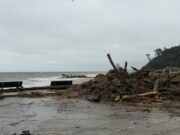
Photo captions, from top: 1. The building where Timothy Heaney had his auto-body shop, seen from the adjacent woods, where Yusef Rahman fired his shots Dec. 5, 1988. RiverheadLOCAL photo by Peter Blasl. 2. Former supervisor Joe Janoski. 3. Map showing locations where sniper shootings took place. 4. The home on Old Quogue Road in Riverside where Yusef Rahman lived with his grandfather in 1988. 5. Green Haven Correctional Facility.
The survival of local journalism depends on your support.
We are a small family-owned operation. You rely on us to stay informed, and we depend on you to make our work possible. Just a few dollars can help us continue to bring this important service to our community.
Support RiverheadLOCAL today.
