





















The two men driving the brush trucks that got stuck on dead trees in the Flanders brush fire Saturday are angry about the conditions on publicly-owned preserved lands in Flanders. But they’re even angrier about the statements made by government officials responsible for those conditions in the days following the small wildfire that burned 10 acres of woodlands.
 On Monday morning, County Executive Steve Bellone called a press conference in Hauppauge to announce the establishment of a permanent brush truck training course on 25 vacant acres of county land in Yaphank.
“We need to…make sure that our fire personnel, as they go in to do their work, have what they need and have the training that they need to combat those wildfires,” Bellone said.
“Training is not the issue,” an incredulous Flanders Fire Chief Joseph Petit said in an interview Monday evening. “The condition of the land is the issue.”
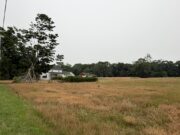
Fire lanes are so overgrown that they’re impassable (see video below) and thousands of dead oak trees — both standing and fallen — have created conditions in the forest so hazardous and so difficult to navigate that a disaster is inevitable unless immediate action is taken, Pettit said.
“It was horrendous, the worst I’ve ever driven in,” Riverhead Fire Department ex-chief Steve Beal, who was behind the wheel of the brush truck that got stuck on a dead tree stump as it drove into the woods to battle Saturday’s brush fire.

Beal, 52, has nearly 30 years experience driving Riverhead brush trucks — giant, all-wheel-drive vehicles known as “stump jumpers” designed to carry a crew of four and a 1,000-gallon tank of water deep into the burning woods. He’s driven stump jumpers into countless brush fires in Riverhead and throughout the region. Saturday was the first time he’s driven into woodlands where dead hardwood is such a problem, he said.
A combination of environmental factors caused a massive oak die-off across Suffolk about a decade ago. Thousands of dead oak trees were left standing, their concentrations documented by the state Department of Environmental Conservation in 2008. Flanders Fire District officials have for years expressed concerns about the vast number of dead oaks on preserved state and county lands in the district, home to about 11,000 acres of preserved pine barrens.
Normally, the stump jumpers can push trees down, if needed to access the fire.
“With this dead wood, you push these trees over and it pulls up the whole root and that’s where we had the problem,” Beal said yesterday. “We had a stump come out and it got jammed up under the truck.” The crew, armed with a chainsaw, got out and attempted to cut the truck free as fire burned the woods around them. It was useless, because the stump bent the truck’s tie rod; it had to be towed out of the woods by another brush truck.

Meanwhile the crew was stranded. If the fire had gotten up into the canopy of the forest — that’s when a brush fire really takes off — Beal said he and his crew might not be around to tell the story.
“Now you’re stuck in the woods and you gotta hope you have a full tank of water when that happens, so you can protect yourself,” Beal said. “You hope you can put the fire out enough to protect yourselves.”
Frank Belson, a 67-year-old ex-chief of the Flanders Fire Department who’s been driving its brush trucks for 25 years said he and his crew were going for the head of the fire when “we found there were tress cut in front of us.” Tree stumps and roots “acted like a wheel chock,” Belson said. They had to be cut away from the truck’s tires in a futile attempt to free it. “Westhampton’s brush truck yanked me out to get me going again,” Belson said.
“That’s how bad this area is with all those dead trees,” Belson said. “Usually when I go in I come out in one piece,” he said. “With all this dead stuff laying around, you wonder if you’re going to make it through.”
The overgrown fire lanes — paths cleared specifically to allow fire trucks deep access to the woods — can be cleared “easily, the way it was always done,” veteran firefighter and Riverhead Town Justice Allen Smith said yesterday.
“You go in there with a bulldozer and you clear them,” Smith said. “It’s not hard.”
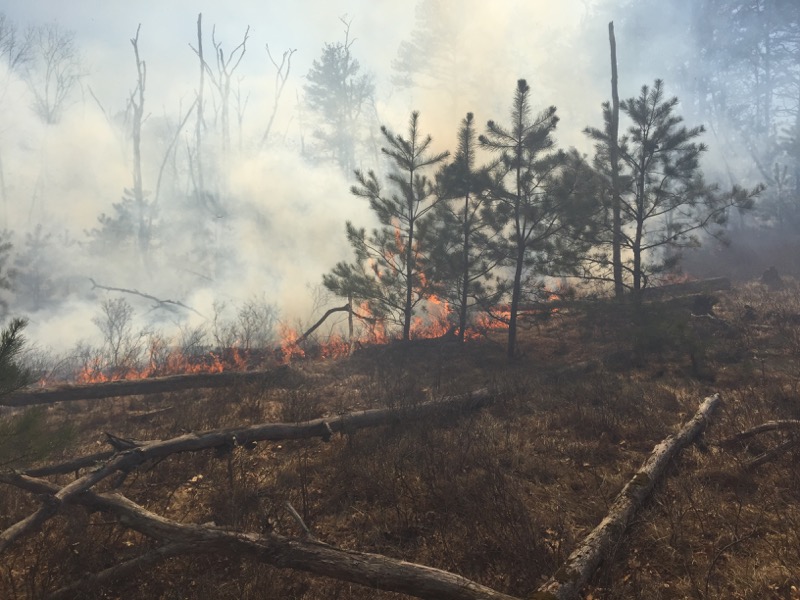
But that hasn’t been done and isn’t likely to be done any time soon because government officials are worried about environmental damage to the preserved pine barrens caused by ATVs and dirt bikes using the trails. The fire lanes have been allowed to grow in for that reason, and government workers have even purposely felled trees across fire lanes to prevent recreational vehicles from illegally using the trails, according to firefighters.
John Pavacic, executive director of the New York State Central Pine Barrens Joint Planning and Policy Commission, told RiverheadLOCAL a contractor hired by the commission in 2013 to conduct a survey and assessment of the 59,000 preserved acres in the pine barrens region, is mapping out existing fire lanes and will make recommendations to the commission on what lanes should be cleared and to what extent they should be cleared. Those recommendations will be taken to fire departments by the end of the year, he said.
The commission is “trying to balance” the need to prevent illegal activities, including dumping, with providing access for legitimate purposes for wildfire fighting, Pavacic said in an interview following Monday’s press conference.
“What we’re looking to do with these access roads, if they provide access in close enough proximity, then they can pull hose from their brush trucks to spray the fire, instead of having to penetrate the woodland area with the truck,” Pavacic said.

Local fire departments have retrofitted their brush trucks with cages to protect firefighters from falling dead oak trees, according to the chiefs. They call the dead trees “widow-makers.”
Get out of the truck and run a hose into the woods on foot?
“People making the decisions and the policies are people who have no clue,” Beal said. “If they had any experience they wouldn’t say half of what they say.”
Large-scale removal of dead oaks in the forest won’t be undertaken because it’s cost-prohibitive, Pavacic said, and also because the dead trees provide valuable natural habitat, Pavacic said.
“You also have to remember this is natural land set aside for ecological purposes,” Pavacic said Monday. “A number of these trees also provide habitats for different types of organisms — woodpeckers, flying squirrels, owls and so forth,” Pavacic said.
Firefighters say they find it hard to believe regulators equate protecting habitat for woodpeckers, flying squirrels and owls with protecting the hundreds of homes built in and around the woodlands and the lives of residents — and the firefighters who rush into the burning woods to protect lives and property.
“I don’t even know how to respond to that,” Chief Pettit said.
“With the fuel load in those woods, if it starts at the wrong spot and the wind is right, you’re going to lose a lot of houses and hopefully nobody dies,” Beal said.
Pavacic said ultimately the property owners — the state and county — are responsible for maintaining the land and the fire lanes.
The county, at least, has no immediate plans to clear the fire lanes in Flanders.
“We are aware of the complaints,” a spokesman for the Suffolk County executive said in an email yesterday.
“Under grant funding, the Central Pine Barrens Joint Planning and Policy Commission is currently conducting an assessment to see which fire lanes need clearing and is also performing the actual remediation.”
Riverhead Supervisor Sean Walter, who, along with Southampton Supervisor Anna Throne-Holst, Brookhaven Supervisor Ed Romaine and state DEC regional director Peter Scully, comprise the pine barrens commission, said yesterday he was unaware of the urgency of the problem.
“These fire roads must be cleared and I will make a push to do that,” Walter said last night. “A woodpecker is not going to care if he’s pecking wood over a fire lane or in the woods,” he said.
The pine barrens commission received “an additional $350,000” in state funding this year and Walter said he would push for allocating some of those additional funds to clearing fire lanes.
“It would be nice for the Flanders and Riverhead fire districts to formally write a letter to the pine barrens commission to ask them to allocate some of that money to open up the fire lanes,” Walter said.
The commission is discussing spending the extra cash on taking down pine trees to protect the forest from the spread of the devastating Southern Pine Beetle.
“Someone has to realize that a human life is worth more than a pine tree.”
The survival of local journalism depends on your support.
We are a small family-owned operation. You rely on us to stay informed, and we depend on you to make our work possible. Just a few dollars can help us continue to bring this important service to our community.
Support RiverheadLOCAL today.
