





















After Hurricane Sandy caught many Long Island residents off guard in 2012, a new emergency preparedness program has been training residents across the state on the steps they can take to be ready for the next natural disaster.
A crowd of local residents filled the Riverhead Free Library’s basement Saturday afternoon for a Citizen’s Preparedness Corps training session, where the National Guard explained how to prepare and respond to disasters.
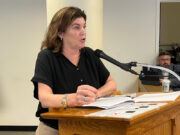
“New Yorkers weren’t exactly prepared for what was coming [with Sandy],” said Second Lieutenant Jennifer Alvarez. “We all got to the supermarket, we took everything that was there, but we did that just the day before. We want you to be more proactive.”

That means taking steps well in advance of a disaster to make sure your family has the tools and supplies it needs to ride out an emergency. She emphasized awareness, recommending that residents sign up for mobile alerts and buy a radio that can receive emergency broadcasts.
The event is just one of many being held across New York State in an initiative to better prepare communities when disaster strikes.
Governor Andrew Cuomo launched the Citizen’s Preparedness Corps in February 2014 to give New York citizens the knowledge and tools necessary to prepare, respond and recover from events like Hurricane Sandy, which devastated Long Island in 2012.
Here are four steps Alvarez said everyone should take to prepare themselves for an emergency:
- Develop an emergency plan: Sit down with your family and decide what you will do in case of an emergency. Decide how you will get in contact with each other and where you will go if a disaster strikes. Pick two places to meet with your family in case of an emergency, one outside the home and one outside of your neighborhood. FEMA has an online, prinatable form where you can write contact numbers, emergency meet-up locations and important personal information such as social security numbers and medical needs.
- Build a kit: In case of disaster, resources we frequently use might not be readily available to us. To account for this, the National Guard suggests stocking up on emergency supplies, both in the home and in a “go-bag” in case evacuation is necessary. This should include food and water for your family (including pets), health and hygiene supplies (medicine, toilet paper, hand sanitizer, etc.), personal supplies (clothes, glasses, sturdy shoes, etc.,) household equipment and tools (gasoline, flash lights, gloves, tape, etc.) and an emergency first aid kit. Include a copy of your emergency plan in your kit.
- Be aware: Have a radio where you can receive emergency broadcasts and sign up for alerts on NY-ALERT to get up-to-date information during an emergency.
- Get involved: It is best to affiliate with a recognized disaster volunteer organization such as the American Red Cross, New York Cares or The Salvation Army before a disaster happens. Getting involved with a disaster volunteer organization before an emergency will increase your ability to help when help is needed.

Attendees were also given survival go-bags, sturdy backpacks filled with necessities like purified water, food, a first aid kit, a flashlight, gloves, duct tape, a radio and more.
The library will have a portal where users can find information on emergencies and evacuations with links to resources on their redesigned website, which they plan to launch in the upcoming month.
“As a library, we’re here to serve and help the community,” Riverhead Free Library director Joy Rankin said. “I realized that by getting involved in this program, we could provide resources to everyone in their homes, not just for pleasure or entertainment. These things can be life changing.”
The event was sponsored by the Riverhead Free Library as well as local politicians Senator Ken LaValle, Assemblyman Anthony Plaumbo, County Executive Steve Bellone, Suffolk County Legislator Al Krupski and Riverhead Town Supervisor Sean Walter.
For future training information or to take the online course, visit http://prepare.ny.gov.

The survival of local journalism depends on your support.
We are a small family-owned operation. You rely on us to stay informed, and we depend on you to make our work possible. Just a few dollars can help us continue to bring this important service to our community.
Support RiverheadLOCAL today.
