

























America’s national bird seems to be here to stay on Long Island – and is being spotted with increasing frequency on the North Fork.
Local birder Sean Keenan has marked four sightings so far this year of both adult and juvenile bald eagles on the East End, including two in the past week in downtown Riverhead.
“We’ve been spotting them all year round on both forks, and there are nesting pairs that definitely stay around,” Keenan said yesterday. “When the leaves are on the trees, it gets harder and harder to spot them randomly, so this is a good time of year to see them.”
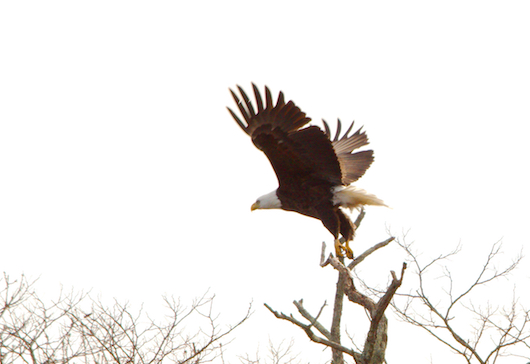
There are currently five known bald eagle nests on Long Island, including one in Mashomack Preserve on Shelter Island. One nest at William Floyd Estate in Mastic Beach has successfully produced a baby eagle, according to Keenan. “We watched them fledge an offspring all summer last year,” Keenan said. “He’s been hanging around with the two adults now.”
Though there are no known nests on the North Fork, Keenan, a local birder and wildlife photographer, says he has spotted bald eagles in the Flanders area carrying materials to build one.
“We’ve been seeing them flying around with nesting materials,” he said. “That’s not something they do unless they’re going to build a nest.”
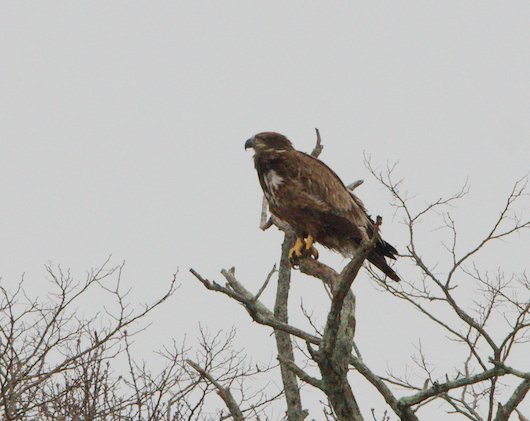
One of the largest birds of prey, the bald eagle stands about 30 inches high and has a wingspan of 72 to 84 inches. “The first time I saw one in 2013, it was a big deal,” Keenan said.
New York State’s bald eagle population once dwindled to just one nesting pair, but years of conservation efforts have led to a resurgence of the species across the state. Though sightings are still fairly rare on Long Island, the bird is now prosperous in upstate New York, where there are more than 170 nesting pairs.
“It’s something people have been waiting for as they repopulated from upstate New York, we’ve been wondering when they’re going to get to Long Island,” Keenan said. “When you point them out down on the river, people get really excited. Everyone is happy to see them around.”
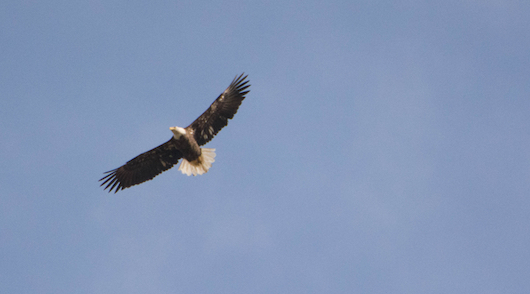
Bald eagles mate for life, settling down with mates in the same area they grew up, or “fledged,” in – give or take 250 miles. This area, called a “nesting territory,” is where the mated eagle pair will build a nest, reproduce and make a home for the rest of their lives.
Because the eagle has such a large nesting territory, it is possible that some of the nests found on Long Island likely belong to migratory bald eagles that are only passing through for the season. That’s why there are more sightings during migratory periods (fall and spring) than the rest of the year. But Keenan says he and his girlfriend, who is also a birder, had eagle sightings on Long Island all year round last year.
“Some of the ones we see may be migrating through,” he said. “Others may be residents.”
The bald eagle is currently listed as a “threatened” species on the New York State DEC website. Anyone who happens across a bald eagle should keep their distance and take care not to disturb it.
The survival of local journalism depends on your support.
We are a small family-owned operation. You rely on us to stay informed, and we depend on you to make our work possible. Just a few dollars can help us continue to bring this important service to our community.
Support RiverheadLOCAL today.
