

























While vast swaths of Long Island’s fire-prone pine barrens are west of the East End, communities throughout western Southampton Town learned quickly in March of 2025 that they could easily be right in the path of an out-of-control wildfire.
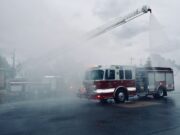
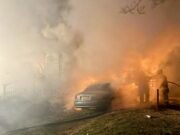
High winds and dry fuel conditions led to the rapid spread of a wildfire that reportedly started when a family in Manorville tried to make s’mores in their backyard on the morning of March 8, 2025, burning more than 600 acres before it was halted by a coordinated effort between 90 volunteer fire and ambulance companies and helicopter water drops by the U.S. Army and Air National Guard.
Since then, the Central Pine Barrens Commission has received a grant to prepare a Community Wildfire Protection Plan for a swath of the pine barrens from Eastport to Squiretown Road in Hampton Bays, as far north as Riverside and Flanders and bounded on the south by Montauk Highway, known as the “Southampton Pine Barrens Community Wildfire Protection Plan.”
The Southampton plan is being prepared by SWCA Environmental Consultants, which organized the first of three public informational meetings at the Flanders Community Center May 5.
Community Wildfire Protection Plans were first developed as part of the federal Healthy Forests Restoration Act of 2003 as a way for communities to identify how they are at risk for wildfires and prioritize areas where they can reduce fuel and the ignitability of buildings.
“Community Wildfire Protection Plans encourage agencies to work together, promote healthy ecosystems and forest restoration and make communities eligible for funding,” said SWCA Project Manager Arianna Porter at the forum.
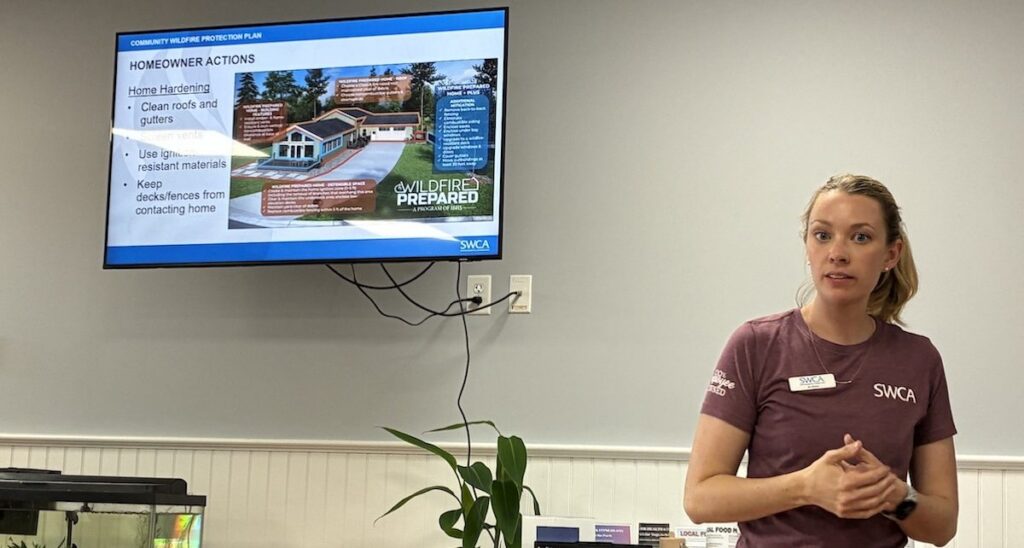
Porter gave an overview of how residents can keep their homes safe from fire and provided a timeline for the consultants’ work before attendees met to discuss their concerns in breakout sessions with local emergency response professionals and volunteer fire department personnel.
“There’s a lot here at risk,” she said, pointing out that the most damaging wildfires occur near areas where many people live, an area known in the wildland fire world as the wildland urban interface.
Porter said SWCA will develop its mitigation recommendations this summer and is expecting to have a draft of the plan available for public feedback in September 2027; it is expected to be finalized in October 2027.
Judy Jakobsen prepared the Central Pine Barrens Commission’s first Community Wildfire Protection Plan for the communities of Ridge, Manorville and Calverton after numerous wildfires in that area in 2012.
At the forum, Jakobsen said that plan enabled funding for numerous wildfire safety projects there, including fire wells along a road with inadequate water supply in Manorville, the creation of fire breaks — paths through the woods without fuel that can stop a fire, and community engagement.
“We’re hoping at some point most of the pine barrens will have some type of CWPP [Community Wildfire Protection Plan] in place,” she said.
How Can You Protect Your Home?
Porter said most wildfires spread to communities through embers that are carried on the wind from the main fire, not from actual flames. She urged people who live in the Southampton Community Wildfire Protection Plan area to remove anything combustible from five feet surrounding their homes.
A major point of entry into homes, she said, is through soffit vents in the eaves under roofs. Those vents can be fitted with fine screens to keep embers from entering.
Wooden fences leading to houses can also act as wicks, she said, bringing fire straight to a house. She said even a metal fence section closest to the house, connecting with a wooden fence further out, is a safer alternative. Keeping decks and gutters clear of leaves, and making sure there are no leaves under your deck will also help.
“You need to reduce the ignitability of your home, and the pathways to your home from the environment,” she said.
Southampton Town Fire Marshal Chris Hansen added that siding materials matter.
“Stay away from combustible materials,” he said. “Vinyl siding is just solidified gasoline. It runs right off the side of the house in a fire.”
Safer siding materials are adobe, stucco, metal, HardiPlank siding and even existing asbestos shingles, if they haven’t begun to degrade.
Burning the Fuels
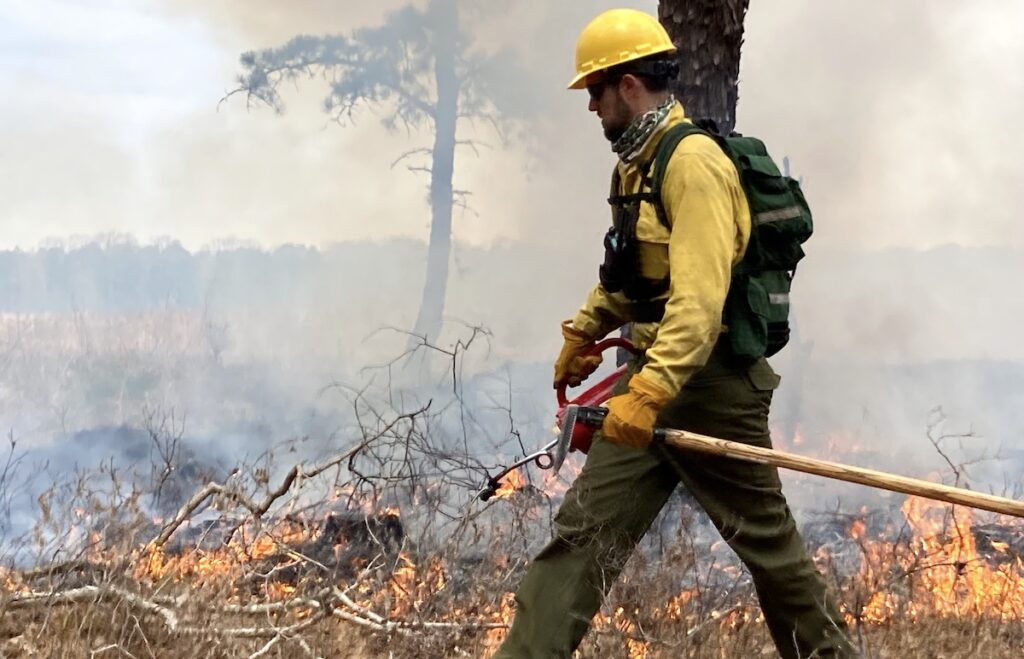
DEC Forest Ranger Bryan Gallagher has been working on the health of Long Island’s forests and grasslands for decades, and has been integral to the effort to bring ‘prescribed fire’ — the use of carefully controlled fires to reduce the fuels in the woods and prevent major wildfires — to Long Island.
Gallagher, a ‘burn boss,’ has been coordinating prescribed burns here primarily in areas where southern pine beetles have killed vast swaths of pitch pine woodlands — a project for which the state has grant funding.
His fire crews have been burning areas of the David A. Sarnoff Preserve in Riverside in recent years, little by little, in an attempt to protect the Riverwoods mobile home community on Route 104 not far from downtown Riverhead. He said they’re also working now on protecting a community near Toppings Path in Manorville, just west of Route 51.
He said homeowners can definitely help protect their property from fire.
“Don’t plant flammable plants next to your home. In the first five feet, you want nothing,” he said. “What’s the first thing people do when they build a new home? They put cedars and pines right next to the house, little bushes that ten years later are six feet wide and ten feet tall. That’s fuel.”
“If you have flammable trees and the crowns are touching, the fire’s just going to go from one crown to the next,” he added. “Try to get them at least 30 feet apart, so the crown fire can’t jump from one tree to the next.”
He said an upcoming priority is going to be a burn plan for the woods surrounding a subdivision called Oakville, just off of the Route 104 exit off of Sunrise Highway in East Quogue. That’s an area just east of where the Westhampton Pines Fire burned last year.
“It’s right next to the pine barrens fuels, and last spring, if those winds had been different, it could have gone there.”
Gallagher said a dangerous “crown fire” is more likely to occur in this area, the dwarf pine plains, because the trees are shorter and closer together.
“Everything’s touching each other, and it turns into a crown fire easily,” he said. “The fire department can’t put out 50-foot flame heights. It’s about waiting for the fire to reach areas where there’s less fuel.”
“They were really lucky,” he said of the circumstances at the Westhampton Pines Fire. The fire started running and got to Gabreski Airport, so it ran out of fuel. That weekend, the Army and Air Guard were already training, and they were able to drop a lot of water.”
Gallagher added that brush trucks used by local fire departments to get into the woods “are fast and effective — they can push trees over and get to the fire.”

Lessons From Westhampton Pines
Eastport Fire Chief Virginia Massey, who was at the forum, said the Westhampton Pines Fire gave departments a chance to “interact on a level they hadn’t before — it reaffirmed the capabilities of our communication and working together.”
She added that her department had recently received a grant for updated wildland firefighting gear, which is lighter and more maneuverable than the bunker gear used by structural firefighters.
“We’re always looking to update our equipment and do more training,” she said.
Suffolk County Fire, Rescue & Emergency Services Director of Emergency Preparedness Allison Petker said that, since the Westhampton Pines Fire, her office has been coordinating with Southampton Town to better notify people if they need to evacuate during an emergency.
She urged residents to text the word “suffolksmart” to 67283 to sign up for emergency alerts from the county. She said the county also has a tool, “Know Your Zone,” which tells people which storm surge zone their house is in.
“In an emergency we’ll tell residents of a zone if they need to evacuate to a safe point along the spine of Long Island,” she said. “Suffolk County Community College’s three campuses are our primary shelters, and they’re along the spine, which is helpful.”
She added that her office is also working to ensure individual fire departments are better able to communicate with one another during a multi-agency incident, using county emergency communication frequencies.
Southampton Town Supervisor Maria Moore, a member of the Pine Barrens Commission board, said the town has also recently updated its public notification messaging system as a result of lessons learned in the Westhampton Pines Fire.
“We were issuing statements, but it wasn’t necessarily getting out to the public in an orderly fashion,” she said. “Some people thought they were being evacuated and they weren’t.”
She added that the new alerts will be in the form of text messages, which people are more likely to read than other methods of communication, like social media, where misinformation can easily spread. To sign up for the alerts, text Southampton NY to 38276.
“That was definitely something that came out from the lessons learned from the March wildfires last year,” said Southampton Town Public Safety & Emergency Management Administrator Ryan Murphy of the need for a new public notification system.
He said the system will ultimately enable the town to access the federal Wireless Emergency Alert (WEA) system, which will allow it to send messages to anyone with a cell phone in a certain geographic area.
Murphy said the town’s alerts will work in coordination with the county alerts.
“If we used our system to put a message out, people would be getting the same messaging going out through the county,” he said. “We would work with the county on whatever we did. Evacuations should never be done in a silo. You can’t evacuate East Hampton and not tell Southampton, because you’re flowing people through an area. You also have to coordinate getting buses to people, trains, ferry schedules and Shelter Island. You have to time all of that stuff.”
The Future is Windy
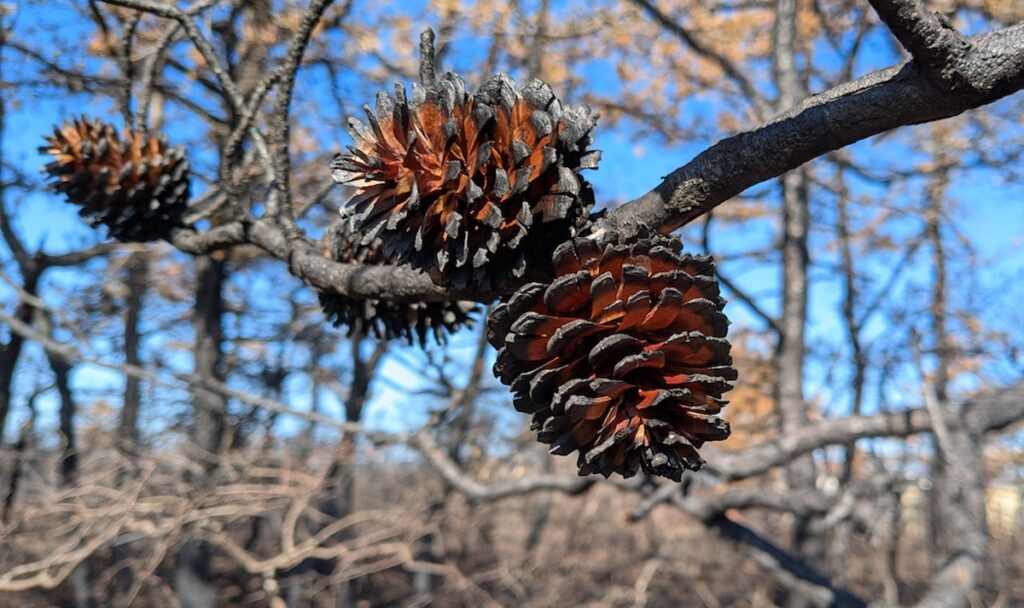
The New York Wildfire & Incident Management Academy is another tool to prevent wildfires that has been in our backyard for 27 years, since not long after the 1995 Sunrise Fires. The academy has been held annually every October at Brookhaven National Laboratory, providing national certifications for wildland firefighters and emergency response professionals.
This year, said academy founder Chuck Hamilton, the classes are being moved to December, because the fire season out west keeps getting longer and longer, and instructors and students are often still out fighting fires in October.
“We bring people from around the nation — local instructors familiar with the fuel types here, and guys from out west with the strategies and tactics they use out west,” he said, adding that local volunteer firefighters can benefit greatly from the training there.
“Wildland firefighting is all about knowledge and experience. The 1995 fires started it, but you don’t have to have a ’95 fire to do education,” he said. “It provides opportunities for our firefighters to become better firefighters.”
Hamilton said the conditions here are definitely changing. Most concerning, he says, are the dry winds that now blow for days in the spring, ripping the moisture out of the air at a time of year that was already fire season here — in the spring, when the sun is at its strongest. The East End was in such a wind pattern for much of last week, prompting fire weather alerts from the National Weather Service Sunday through Tuesday.
“We’ve had southwest winds two days in a row now at 30 miles per hour. The wind regimes are changing,” said Hamilton. “We’re having higher wind events and longer wind events. Northwest winds used to come through on one tide and not again. Now northwest winds are three to four days. These changes are here. They’re not going to go away.”
More information about the Southampton Central Pine Barrens Community Wildfire Protection Plan, including a community survey, is online here. Project Manager Arianna Porter can be reached at Arianna.Porter@swca.com.
The survival of local journalism depends on your support.
We are a small family-owned operation. You rely on us to stay informed, and we depend on you to make our work possible. Just a few dollars can help us continue to bring this important service to our community.
Support RiverheadLOCAL today.
