























This is the second in a series examining the history of the place known as EPCAL as the Town of Riverhead considers the sale of its remaining vacant land at the site where Grumman Aerospace built and tested military aircraft for the U.S. Navy from 1956 to 1996. See part one.
Four years passed before federal legislation authorizing the transfer of the Calverton Naval Weapons Industrial Reserve Plant to the Town of Riverhead in September 1994 and the actual conveyance of the site.
That took longer than anticipated and a lot of things happened in that time — some foreseen, some not.
As Northrop Grumman wound down its operations and packed up to leave in Calverton — scheduled to occur by the end of the of 1995, Riverhead Town set about to develop a reuse plan for the facility. The federal law required the town to establish a planning and redevelopment commission to oversee the creation of the reuse plan. After issuing a request for proposals and considering the responses, the town in July 1995 hired the NYC consulting firm of Hamilton, Rabinovitz & Alschuler to develop the plan.
Riverhead Town officials, meanwhile, had another plan weighing heavily on their minds: the Central Pine Barrens Comprehensive Land Use Plan.
The Pine Barrens Plan was required by the 1993 L.I. Pine Barrens Protection Act — a law passed by the State Legislature after four years of litigation between the L.I. Pine Barrens Society and the towns of Brookhaven, Riverhead and Southampton. The lawsuit, filed in 1989, was eventually dismissed by the state’s highest court, but the court, noting that the area of the L.I. Central Pine Barrens had been reduced by more than half and faced continued development pressure, said legislative action — and a comprehensive plan — was needed to address the preservation of the important natural resource.
The Pine Barrens Act designated the L.I. pine barrens and divided the region into two classifications: the “core preservation area” and the “compatible growth area.” The law also created the Central Pine Barrens Commission and gave it two years to produce a comprehensive land use plan. The plan had to be approved by all three towns (Brookhaven, Riverhead and Southampton) on or before March 15, 1995, a deadline later extended to June 30, 1995.
When the legislature established the boundaries of the pine barrens in 1993, the Calverton Naval Weapons Industrial Reserve Plant was still owned by the Navy and Northrop Grumman was still in operation. State law could not affect the use of federal lands. In 1994, all that changed when it became clear that the Town of Riverhead would own the land, since municipalities are subject to state regulation.

Riverhead officials did not want to cede control over the redevelopment of the Calverton plant to the Central Pine Barrens Commission. They tried and failed to get state legislators to amend the Pine Barrens Act to exempt the Calverton NWIRP. Town officials did negotiate the inclusion of a few significant items in the Pine Barrens Plan: all future economic development at the site was to be considered “non-development” for purposes of regulation by the Pine Barrens Commission; recognition that development would occur at the site; and individual development projects at the site would not be required to submit to formal review by and obtain approvals from the commission.
Make no mistake: a fierce battle was underway in the winter-spring of 1995. Not only was the town fighting to keep the Calverton property out of the regulatory jurisdiction of the new Pine Barrens Commission, it was attempting to leverage its bargaining position to move a boundary established by the state’s Wild, Scenic and Recreational Rivers Act more than a decade earlier, which would effectively sterilize a large portion of the site against development.
With the clock ticking towards the June 30 deadline — when the plan, if not approved by all three towns, would be void — town officials dug in their heels.
An 11th-hour compromise was struck. Its terms were memorialized in a June 21, 1995 letter from the Pine Barrens “consensus group” — which included the legislative sponsors of the Pine Barrens Act, State Sen. Ken LaValle and Assemblyman Thomas DiNapol, as well as environmental groups, developers and trade associations — to the Riverhead Town Board.
“The members of the Consensus Group, joined by [DEC regional director] Ray Cowen, unanimously agree with the Town that the area of Calverton that lies within ‘the fence’ and in the compatible growth area should be developed…” the letter read. One exception: about 410 acres that were designated pine barrens core area.
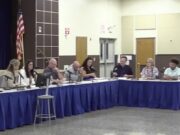
The Riverhead Town Board, sitting as the governing body of the Riverhead CDA, voted unanimously to approve the Pine Barrens Plan at a special meeting on June 28, 1995.
Might Six Flags call Calverton home?
Hamilton, Rabinovitz & Alschuler delivered its comprehensive master plan for the Calverton site less than a year later. Its vision was “a multi-use enterprise park that has at its core a major industrial complex. This reuse of existing facilities is augmented with a land allocation that builds upon the emerging leisure and tourism economy of the East End.”
The master plan included the following components: an industrial business park (365± acres); theme park (524± acres); sports park (911± acres); nature park (938± acres); and infrastructure (15± acres).
The business park would reuse the existing buildings for a variety of business uses.
The theme park district would be located in the northwestern portion of the property and would accomodate a “regional theme park,” including possibly a nationally affiliated theme park such as Six Flags. The 7,000-foot runway would be used for visitor parking.
On the eastern portion of the property, east of the 10,000-foot runway, would be the sports park district, where a 6,000-8,000-seat stadium would be the primary use, with the 10,000-foot runway used for parking.
The nature park area would encompass the pine barrens core area and McKay Lake and would include a community park and a public golf course.
The plan identified potential uses to include a business incubator, film and production studios and a raceway complex.
HR&A anticipated commercially zoned land would sell for $25,000 to $45,000 per acre.
On July 16, 1996, the Riverhead Town Board adopted the comprehensive master plan for the Calverton Naval Weapons Industrial Reserve Plant.
The next day, a Boeing 747 bound for Paris, France took off from JFK. About 12 minutes later, TWA Flight 800 exploded and crashed into the Atlantic Ocean off the coast East Moriches, killing all 230 people on board.
That unforeseen tragedy altered Riverhead’s plans for Calverton. The federal government took occupancy of the 325,000-square-foot Plant Six, where it brought debris from the crash for an investigation by the National Transportation Safety Board and the Federal Bureau of Investigation.
On the one hand, while the investigation there may have delayed the transfer to the town from the federal government, the investigation led to a post-transfer lease between the feds and the CDA that provided the town with a much-needed steady rental income that covered the town’s utility and maintenance costs as it examined proposals for the site.
And those proposals came rolling in — long before the town even owned the site.
Next: What those proposals were and how the town dealt with them- “EPCAL’s (would be) ‘greatest hits”
The survival of local journalism depends on your support.
We are a small family-owned operation. You rely on us to stay informed, and we depend on you to make our work possible. Just a few dollars can help us continue to bring this important service to our community.
Support RiverheadLOCAL today.
