






















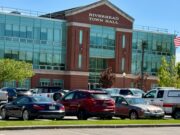

Five commercial properties on the south side of East Main Street should be placed on Suffolk County’s list of parcels for preservation with drinking water protection funds, according to a resolution unanimously adopted by the Riverhead Town Board yesterday.
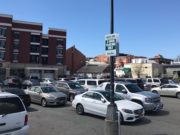
The town is asking the county to identify as priorities for acquisition the five properties at 103, 111, 117, 121 and 127 East Main Street. The five properties stretch from the parking lot entrance adjacent to Sunny’s Diner and Grill east to the building next to East End Arts gallery.
The board had not publicly discussed the measure prior to voting on yesterday.
The funding targeted for the acquisitions, should they come to fruition, would be the county’s “old” drinking water protection program, which was originally implemented 30 years ago. That program provided for revenue-sharing with municipalities of the quarter-percent sales tax collected by the county for acquisition of environmentally sensitive lands, as well as closing and capping landfills and remediating toxic and hazardous waste sites.
Each town submitted a list to the county of parcels targeted for acquisition with the town’s individual revenue-sharing allotment. The 10 towns of Suffolk had to agree to all towns’ lists and the lists were then approved by the county legislature.
The list has not been updated in 20 years, County Legislator Al Krupski said in a phone interview this morning.
Krupski said each of the towns has an unspent balance in the revenue-sharing allotments. Riverhead has $613,434 in its account.
A lot of the parcels on every town list are now “stale,” he said, either because they’ve already been acquired, are already developed or the owner rejected the idea of selling to the town and county.
Riverhead had 23 parcels on the list approved by the county legislature in 1998.
The resolution approved by the town board yesterday seeks to amend that list by adding the five East Main Street properties to it.
The measure was sought by the town’s open space committee, according to the resolution.
Councilman James Wooten, the town board’s liaison to the open space committee, advocates acquiring “a couple of those buildings to create green space on Main Street and open it up to the Peconic River.
“We’ve wanted to do that for 100 years,” Wooten said. He said he believes the green space — and dealing with vacant eyesores — would mean a lot for downtown revitalization .
The Main Street parcels’ proximity to the Peconic River is the main basis for the town’s proposal to designate them for possible acquisition, he said.
The program is voluntary, meaning that the property owner must be a willing seller, Krupski said. It’s not an eminent domain or condemnation process.
Riverhead grapples with blighted buildings downtown
Some of the properties being proposed for possible acquisition — long-vacant properties that have fallen into disrepair — have been the subject of scrutiny and recent enforcement action by town officials.
On March 26, Riverhead Supervisor Laura Jens-Smith called a press conference to announce that code enforcement officers and fire marshals had issed more than 100 violations to certain downtown property owners and, a week earlier, “orders to remedy” violations to owners who had not been cooperative with the town about correcting violations, she said.
Those orders gave the property owners 30 days to cure violations or face legal action.
In response to a Freedom of Information Law request, the town provided copies of the orders and the alleged violations at 117, 103 and 55 East Main Street. Those three properties had a total of 90 alleged violations, according to documents provided by the town in response to the FOIL request. The alleged violations were found during inspections made in November and December, according to the documents. The violations alleged included everything from failure to maintain premises in a clean condition, to peeling paint, leaking roofs, cracked foundations and walls or other components of a building that are not structurally sound.
Jens-Smith said last week the town had issued notices of violation to 10 different properties. A FOIL request filed by RiverheadLOCAL for the remainder of the violation notices has not yet been fulfilled by the town.
Riverhead has several long-vacant, large buildings on Main Street in the heart of its central business district. Officials and real estate brokers say they are functionally obsolete, in too great a state of disrepair, or both.
“Some of them are basically tear-downs at this point,” Wooten said today.
The owner of two of the large vacant buildings that were the subject of the orders to remedy said in a phone interview last week he’s working to comply with the town’s notices. But in the long term, said Shelly Gordon of Riverhead Enterprises, he’s not sure what to do about the buildings.
“I can’t invest a lot of money in them without a tenant and I may not be able to find a tenant without putting a lot of money into them,” Gordon said.
Riverhead Enterprises owns three of the buildings on the town’s proposed “priority acquisition” list adopted by the town board yesterday. Only one of them is vacant and the subject of an order to remedy — 117 East Main Street. The other two buildings owned by Riverhead Enterprises that made the proposed acquisition list — 121 and 127 East Main Street — are occupied by tenants.
Gordon could not be reached for comment today.
Another large vacant building that was hit with an order to remedy and is also on the acquisition list is the former West Marine building owned by North to South, the company that redeveloped the former Woolworth building with new shops and workforce apartments.
North to South principal Michael Butler said today he didn’t think it was fair for the town to treat him like a long-term landlord of vacant property since he’s only recently acquired the property
“We did a good job and worked hard on that Woolworth building,” Butler said. “We’ve only had this building 11 months. It takes time and planning to figure out what we’re doing there,” he said. Butler had propposed the idea of a ground-floor marketplace with apartments on upper floors.
“The business community’s gotta feel like they’re appreciated,” Butler said.
The town should “spend more time doing things the government controls, like improving the parking lot, installing better lighting, making people safe downtown by making it safe, clean, well-lit with plenty of parking,” Butler said.
Butler said he agreed that vacant buildings on Main Street should be cleaned up and made presentable on the exterior and any unsafe structures should be addressed. But going beyond that, especially for a new owner, is “a little like harassment,” he said. “I don’t want to be forced to spend $100,000 on a building I may well be tearing down.”
Riverhead adopted a code in 2017 that required the owners of vacant buildings to maintain them in such a way that they don’t appear vacant.
The town took Rimland’s to court for violating that code provision, but in a decision dated Dec. 28, Town Justice Allen Smith dismissed the case, ruling the code unconstitutional.
Town attorney Robert Kozakiewicz said last week he intends to revise the code to address the deficiencies the judge found. “It’s back to the drawing board,” he said.
The survival of local journalism depends on your support.
We are a small family-owned operation. You rely on us to stay informed, and we depend on you to make our work possible. Just a few dollars can help us continue to bring this important service to our community.
Support RiverheadLOCAL today.
