

























Business owners looking to site recreational marijuana shops in Riverhead Town may look to legally challenge the town’s zoning ordinance, after a Town Board majority refused their pleas to relax the law to meet state guidelines.
New regulations intended to allow more sites for recreational cannabis dispensaries in Riverhead don’t go far enough, the cannabis licensees told the Town Board during a public hearing Wednesday. Riverhead — one of only four towns on Long Island that did not opt out of allowing the recreational dispensaries — is seeking to relax the 2022 law that practically banned marijuana shops in the town.
Under the current zoning only four properties are eligible sites for cannabis businesses, according to town officials. The proposal being considered would open that up to 144 properties — 62 of which would be along Route 58, according to the town’s count.
Gahrey Ovalle, the president of the Long Island Cannabis Coalition, said in a letter to board members earlier this month that the new regulations “produced similar results that the last map/restrictions did with few location[s] available for cannabis retail to open.”
“Along with the 2,500 [foot] setback between dispensaries and lot line measurements, the final result will be unreasonable and impractical,” he wrote.
| MORE COVERAGE: Riverhead proposes relaxing zoning restrictions on marijuana businesses, but license holders say changes may not go far enough |
Two board members agreed with them. Supervisor Tim Hubbard and Council Member Bob Kern spent much of the hearing criticizing the proposal and arguing the town was missing out on its share of valuable tax dollars from marijuana sales.
However, the three other members of the five-person Town board, in public statements and interviews, indicated that they were against loosening the restrictions further than what is proposed.
The board majority’s decision to not pursue further changes to the zoning sets the stage for a precedent-setting challenge to Riverhead’s zoning laws. Under state law, local regulations for marijuana businesses cannot be “unreasonably impracticable,” as determined by the Cannabis Control Board, the governing body of the state Office of Cannabis Management. The Cannabis Control Board has yet to make any decisions regarding the “unreasonably impracticable” standard, which could be used in court to challenge the validity of zoning restrictions.
Licensees have said they want to work with municipalities to change zoning restrictions to be fair to new businesses. But business owners will sue if they have to, said Jeffrey Hoffman, a New York attorney who represents cannabis licensees.
“Nobody’s gonna win,” Hoffman said in an interview last week, before the public hearing. “If we have to get somewhere that we could have been in the next month or two here if it takes us 18 months and hundreds of thousands of dollars in litigation to get to that same place, nobody wins that.”
The town zoning laws for recreational cannabis businesses are not lawful, Hoffman said, because of regulations passed by Cannabis Control Board, specifically Part 119.2 of adult-use cannabis regulations, which sets the parameters of how municipalities can locally regulate retail cannabis businesses.
Town officials are looking to modify the existing restriction that marijuana shops cannot be 1,000 feet from any residential use, creating an exception to that prohibition for properties “with frontage along and located within five commercial corridors” as defined in the amended code. The commercial corridors are essentially the town’s business corridors, with the exception of downtown Riverhead, where marijuana shops and lounges are banned altogether. Each corridor could have one marijuana shop, with the exception of Route 58, on which marijuana shops must be at least 2,500 feet apart.
The regulations were written by Council Member Ken Rothwell — who voted to opt out of allowing recreational marijuana — and Deputy Town Attorney Annemarie Prudenti, who led several public meetings on the issue.
But even with the residential use distance restrictions eliminated, large distance requirements from other uses like schools are making it hard for stores to open in town, Long Island cannabis licensees said Wednesday during the public hearing.
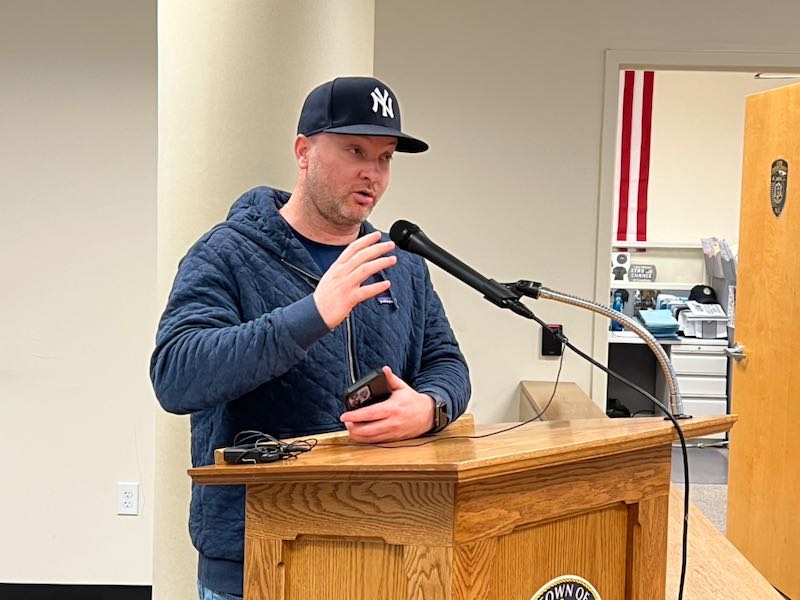
“Right now, you’re not gonna see anything happen with [Route] 58,” said licensee Brian Stark of Merrick, who added: “The small corridors have very limited availability.”
Stark said one of the biggest problems in the town’s zoning is that the distance restrictions are being measured from the lot lines of different parcels, instead of from building entrances. That, coupled with the fact that there are less than 10 spots on Route 58 for lease to the stores, makes it difficult to open.
Ralph Romano, a licensee, said he secured a site on Route 58, but that although the door to his space is more than 3,000 feet from the nearest entrance to a school, it would not be allowed under the zoning restrictions because it is measured using lot lines.
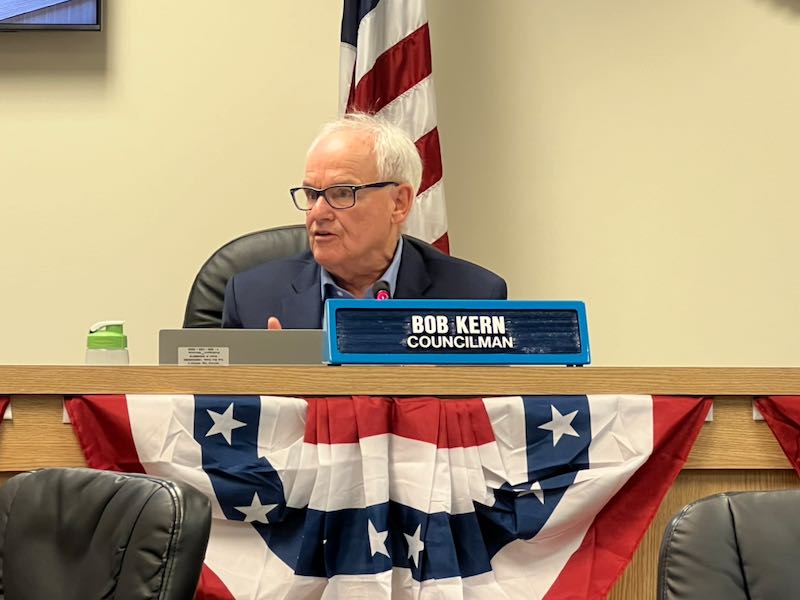
Kern said the distance limits between each dispensary “knocked out everything.” He said the town should have acted when cannabis licensees spoke out during the last forum held to discuss zoning code revisions.
“I don’t understand why we opt in to make it impossible to do it. You know, we keep doing these little steps, we’re trying this — let’s just do it,” Kern said.
Prudenti told Kern that a municipality has the power to make its own regulations. “So the criteria in here may not be how everybody wants it to read, but time, effort and public forums, and consideration and comments, were put in place because of those forums,” she said.
“The problem is, though — and I appreciate all the time that volunteers put into this — but when you put it to paper and you try to make it work, it doesn’t,” Hubbard said. “And it really limits — really severely limits — the spaces where they go. And that’s not really what we’re trying to do.”
“We voted to accept this, we got to try to make it work, and there’s a lot of good tax money out there that’s available to the town,” Hubbard said to applause.
“I’ve seen the numbers that are coming into some of the shops that are opening up west and in New York City, and it’s staggering the amount of money we are losing,” Hubbard said. “And we’re handcuffing ourselves as a board by really limiting down.”
Hubbard and Kern both said dispensaries sell safe products. If the town does not have dispensaries, it risks people buying drugs on the black market that contain life-threatening drugs like fentanyl.
Kern likened the restrictions to The Prohibition Era. “Whether we legalize it or not, it’s here. It’s legal. Stop pretending it’s not,” he said.
Hubbard and Kern both said that they would support going to the distance requirements mandated by the state. State regulations prohibit recreational marijuana dispensaries from being within 500 feet from a school, 500 feet from a public youth facility and 200 feet from a house of worship. Those are measured from the entrance of the building and only if they are located on the same road.
Ovalle, the Long Island Cannabis Coalition president, urged the board during the hearing to adopt new regulations closer to the state rules.
“By following the state regulations, the town will not be flooded with cannabis dispensaries, because there are rules that limit the amount that can exist,” Ovalle said. “Let the fundamental rules of emerging market determine the success or failure of any of these businesses on their own merit, and not due to the arbitrary discrimination set forth by the town or their committees.”
Merrifield said during the hearing that the town should not ease the location restrictions more than what is being proposed.
Unlike other board members, Council Member Joann Waski stayed silent during most of the hearing. In an interview on Friday, Waski said she would have voted to opt out of allowing cannabis sales. She said she supports the zoning being considered, but not loosening the restrictions further.
“We do not know what the negative impacts are going to be. We don’t know what kind of traffic situations will arise from this. We don’t know the impact to our police department,” Waski said. She said it is unknown how much the town would receive from the taxation on the products and that mitigating any negative impacts of marijuana would likely cost taxpayers more money.
“I don’t think that is something that we should just be opening the floodgates and letting anyone come in,” Waski said.
She opposes Kern’s argument that dispensaries would curb illegal drug use, stating that people with drug habits won’t go to dispensaries because it is too expensive.
Rothwell, who was absent from Wednesday’s meeting, stood by his legislation in an interview on Friday.
“This needs to take very small steps. I think the legislation that’s written right now that was presented at the public hearing is as far as you should be going at this moment,” Rothwell said, adding that the town could always open it up further.
Rothwell said the town needs a drug recognition expert, a police officer specialized in recognizing the impairment in drivers under the influence of drugs, before it loosens its restrictions further, he said.
“The people that are coming and speaking at our forum — we were very balanced,” Rothwell said. “But I’m not going to have people from Nassau and Queens come out to us and say hey, guess what Riverhead? I’m gonna open up my stores and all my shops out here and then make my money and then go back to Nassau and Queens where I don’t have it in my neighborhood or my location where my house is. We have to protect.”
Rothwell said he disagrees with the opinion that the town’s law is “unreasonably impracticable.”
“I feel obligated to protect my kids, the future kids, my future grandkids and the town itself,” Rothwell said. “Just like you monitor and for a long term, 25 or 30 years, you legislate for the future, not for the immediate present. We should not be thinking about a quick cash grab, that’s inappropriate.”
Local residents also brought concerns to the public hearing.
Garrett Moore of Riverhead, a high school teacher who regularly attended the forums held to draft the law, said he is against marijuana use and urged the board not to change the 1,000 foot distances for schools.
James Farley of South Jamesport said he is concerned about traffic generated by cannabis businesses. Recreational cannabis is not a typical retail establishment and has the potential to bring in more traffic to Jamesport from the east because Southold Town opted out of retail sales.
“In this particular situation, we have all of Southold starving for a joint, and they’re racing into Jamesport…,” Farley said. He urged the town to do a traffic study on the impact a business would have.
In a statement Friday, Hubbard said he thinks the board should vote on the “current amendments as presented at the public hearing.”
“We can always adjust things down the road if need be,” he said.
The record for Wednesday’s public hearing is open for written comment until the end of the business day March 1.
The survival of local journalism depends on your support.
We are a small family-owned operation. You rely on us to stay informed, and we depend on you to make our work possible. Just a few dollars can help us continue to bring this important service to our community.
Support RiverheadLOCAL today.
