

























Island Water Park Corp., the operator of Scott’s Pointe amusement park, was hit with a $45,000 penalty by the State DEC in 2020 for accepting about 6,000 cubic yards of solid waste at its Calverton site without a permit.
Under a February 2020 consent order signed by Island Water Park and the DEC, $25,000 of the penalty was suspended, conditioned on the company strictly following conditions of the consent order.
Island Water Park Corp. accepted the waste, consisting of a mixture of soil commingled with concrete, brick, asphalt, soil, rock, tile, glass, plastic, wire, textile and slag, without the required permit, in violation of state law, according to documents released by the State Department of Environmental Conservation in response to a Freedom of Information Law request.
The documents show that Island Water Park intended to use the material as fill for construction of its project, which at the time included two buildings and a 12.5-acre, groundwater-fed pond for water sports recreation.
Eric Scott, owner and president of Island Water Park Corp, did not return emails requesting comment for this article.
DEC police officers first got wind of dumping on the Scott’s Pointe site when it followed two trucks leaving a yard at “Durante” at 2:30 a.m., according to a DEC inspection report made on June 13, 2017. DEC police witnessed the dumping and observed two piles of debris that contained tile, textile, pulverized lumber, plastic, glass, foam, fragments of vinyl brush, electrical fixtures and scrap metal, as well as coal slag — a commonly used aggregate for fill which could contain harmful chemicals.
The DEC officials also observed that “several thousand yards of material are stockpiled on-site, with additional material used in a grade adjustment,” according to the June 13, 2017 report.”
A chemical analysis of waste samples from the piles dumped by Durante was done in August 2017 to classify the material for landfill disposal.
On Sept. 14, DEC staff witnessed the removal of two piles from the site, under the supervision of a Town of Riverhead monitor, Jeffrey Seeman. Roughly 55 tons of waste were hauled to the Brookhaven Town landfill, according to tipping receipts.
A few months later, on Dec. 13, 2017, DEC staff inspected the site again and observed that approximately 6,000 cubic yards of construction and demolition debris material were still stockpiled on site, according to a DEC report. Additional material had been used for grading the land and covered approximately 64,000 square feet of the site.
The DEC issued a notice of violation to Island Water Park Corp. owner Eric Scott and the company’s site manager DeLea Sod Farms Inc.on May 21, 2018. The DEC charged them of violating environmental regulations for unauthorized disposal of waste and the unauthorized operation of a solid waste management facility. Violations of the environmental law carry a civil penalty of up to $7,500 for each violation, as well as an additional penalty of up to $1,500 for each day the violation continues,the notice said.
It would be more than half a year later, on Feb. 6, 2019, before the DEC would visit the Island Water Park site again, according to the documents. The site had significantly changed, the inspection report said; the stockpiles of C&D materials, other than a small pile, had disappeared.
“Mr. Scott indicated that no materials had been hauled from the site and stockpiles would likely have been incorporated into grade adjustment/building foundation,” the report said. “The disappearance of the stockpiles, the scope of the project, and materials identified in grade adjustment corroborate that suggestion.”
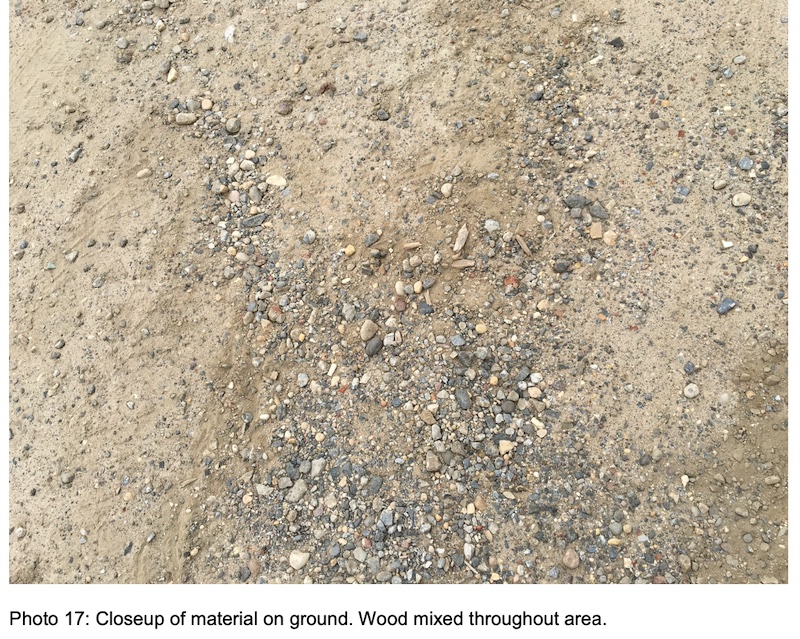
But the C&D could not be used as fill, the inspection report said, because it contained material like wood and plastic film. “This material qualifies as solid waste,” the report said.
Two days later, the DEC regional attorney spoke with Island Water Park Corp.’s attorney regarding activity at the site. In a letter summarizing the call, the DEC assistant regional attorney wrote that the violations issued to the company had not been resolved.
“This unauthorized management of solid waste not only constitutes an ongoing violation but is in contravention of Mr. Eric Scott’s previous assurances to staff that the unauthorized solid waste would be removed from the site,” the letter said.
“We expressed to you the Department’s concern that the solid waste would be encapsulated and covered by a concrete slab through the continued construction of the building,” the letter said. “Therefore, we further advised you that your client must cease and desist from any further management of the solid waste at the site and any construction activities in connection therewith until the unauthorized solid waste is removed from the site and the above violations are resolved.”
A month later, on March 15, 2019, an official complaint was filed by the DEC against Island Water Park. (DeLea Sod Farms, which was named in the notice of violation with Island Water Park Corp., was not named in the complaint.). The DEC requested an order from the commissioner enjoining further violations and sought a civil penalty of not less than $15,000.
Island Water Park began to prepare a cleanup plan for the site, the documents show. The DEC required that all unauthorized fill material be removed from areas outside of the partially constructed building, unless the fill would compromise the building’s structure. That fill would be capped by a liner.
“The depth to groundwater is greater than 20 feet, and although the underlying soils are sandy, little percolation of precipitation as recharge is expected within the building footprints,” a cleanup plan approved by the DEC said.
The cleanup of unauthorized waste began in late 2019, the documents show.
In February 2020, the DEC and Island Water Park Corp. entered into the consent order.
Island Water Park Corp. was also required to file covenants and restrictions on the property to ensure that the waste materials remained capped under the concrete floor and other impervious surfaces.
A Nov. 10, 2021 letter to the DEC from an engineer hired by Island Water Park indicates the work was done. The covenants and restrictions on the property were filed with the Suffolk County Clerk on June 7, 2022.
Dumping C&D waste on Long Island was made a felony in 2020, after a massive investigation by Suffolk County’s District Attorney into illegal dumping in the region. Contaminants on C&D material have the potential to leach on water falling through the ground to reach Long Island’s aquifer, polluting drinking water, according to a grand jury report commissioned by the DA and published in 2019.
The DEC took samples of the C&D waste from Island Water Park’s site to test for chemicals, the documents show. The DEC’s “analysis showed minimal chemical contamination” in the material, a DEC spokesperson told RiverheadLOCAL in a statement.
Island Water Park is within the Long Island Pine Barrens, an area critical to the purity of the region’s drinking water aquifer. The site is located within the “compatible growth area,” in which limited, environmentally compatible development is permitted.
It is also within the short-term capture zone of a public water well, according to Riverhead Water District Superintendent Frank Mancini. Mancini said he didn’t know about the DEC violation or the consent order at Island Water Park.
“Some textiles and carpet have tons of PFAS in them…textile could be an old shirt that has no PFAS in it,” Mancini said, referring to man-made chemicals that break down very slowly and have been linked to health problems, such as cancer. “I would just be speculating. But if the DEC sampled this stuff and then said that they were more or less weren’t that concerned about hazardous stuff — I mean, I have no other option other than to trust their analysis.”
Mancini said he’s thankful that the town required a groundwater monitoring well be installed on the Island Water Park site. If a well wasn’t already at the site, this incident would have been reason to install one, he said.
“We’re positioned as well as we could be to deal with this by coincidence, because I knew nothing about this when I requested the monitoring well,” Mancini said. “Because of [the site’s] proximity to the well field and the way the groundwater flow we think works, it seemed like a way to cover ourselves.”
Since the man-made 12.5-acre pond at the site is fed by groundwater, the monitoring well was made a condition of the project’s amended site plan approval, which was granted in February 2022, along with the requirement that use of the pond be “restricted to the proposed rope-tow cable system, and non-motorized water sport use, including but not limited [to] canoes, kayaks, rental sailboats, etc.”
The monitoring well agreement, which the site plan approval required to be in place for 20 years, would “provide for bi-annual groundwater monitoring and sampling.”
An undated copy of that agreement, obtained through a Freedom of Information Law request in July, was not signed by the town and had other errors. The agreement has since been redrafted, Mancini said.
The new agreement, which has not been authorized by the Town Board, was not immediately made available after RiverheadLOCAL filed a Freedom of Information Law request.
Water from the well has not yet been tested, said Mancini, who said he expects a “baseline” sample of the groundwater on the site “pretty soon.”
Dumping is also illegal under Riverhead Town law. Riverhead Town Attorney Erik Howard said in an email that the town’s planning, town attorney and code enforcement departments have no record of the citations issued by the DEC. He also said he had no recollection of the incident; Howard had been hired in June 2017, shortly before the first inspection by the DEC found the dumping had occurred, as a deputy town attorney focused on prosecuting town code violations in town justice court.
But at the time of the dumping incident the town had a monitor to ensure that excavated material going off of the Island Water Park site was properly recorded. Exportation of materials is subject to a fee payable to the town.
Seeman, the town’s monitor, said in an interview today that the town was “aware of the situation,” but that the DEC likely didn’t alert the town. Seeman said the town doesn’t have any record because “the DEC doesn’t involve local municipalities or their planning departments or anything else in any of these enforcement actions on the property owner,” he said. “It’s just between the DEC and the property owner.”
Seeman, who later supervised the cleanup of the site for Island Water Park, said he didn’t see anything that looked unusual in the piles of material being used for fill while he was the town’s monitor.
“Maybe the material came in and was used when I wasn’t there, or I didn’t recognize some of the things that the DEC saw and I had no reason to really suspect anything,” he said.
While the DEC technically classified the situation as dumping, “They weren’t dumping as if they were making it a dump site,” Seeman said. The DEC found certain material unacceptable under its regulations at the time, he said.
After the DEC consent order, Island Water Park Corp. began to change its project. It amended its site plan from a 49,200 square foot building approved primarily for warehousing, to a 30,000-square-foot building for entertainment uses. The company increased the size of its exterior balcony and patio.
The placement of an inflatable aquapark in the pond and the construction of a go-kart track and pickleball courts on the Island Water Park property without approvals earlier this year has Island Water Park again in trouble with the DEC, as well with the Town of Riverhead.
PRIOR COVERAGE: Legal woes mount for Scott’s Pointe as DEC issues tickets to operator for allegedly violating permit conditions
The DEC ordered Island Water Park Corp. in June to halt the use of public recreation on the pond, stating it was in violation of its mined land reclamation plan — and in July issued tickets for violating the stop-order. Social media posts by Scott’s Pointe show activity at the aquapark on the lake, which just recently closed for the season, continued despite the DEC’s notice.
There have been no new violations issued to Island Water Park Corp. since July, a DEC spokesperson said this week in response to a reporter’s questions. An inspection record kept by the DEC online shows that inspectors last visited the site on July 17 and observed multiple people on the aquapark. There is no indication in the report that tickets were issued to the company.
Riverhead Town sued Island Water Park Corp. in Suffolk County Supreme Court last month, asking the court to temporarily shut down Scott’s Pointe until the property gets in compliance with town law. That lawsuit was filed after town code enforcement officials issued tickets for town code violations in connection with the construction of the go-kart track and other infractions.
Island Water Park is asking the court to dismiss the town’s lawsuit. In an Aug. 16 court filing, the company admitted to building the go-kart track and pickleball courts without approvals, but says the town does not have any claim against the company. The lawsuit should also be dismissed under a legal doctrine known as laches, because the town unreasonably delayed asserting its claim, Island Water Park says.
The company also argues that the town is barred from suing because of the decision of a judge in a prior proceeding. Island Water Park pleaded guilty to town code violations and paid $5,700 in fines in Riverhead Justice Court last month for the appearance tickets issued to the company.
For more coverage of Scott’s Pointe, click here.
Denise Civiletti contributed reporting.
The survival of local journalism depends on your support.
We are a small family-owned operation. You rely on us to stay informed, and we depend on you to make our work possible. Just a few dollars can help us continue to bring this important service to our community.
Support RiverheadLOCAL today.
