

























Riverhead’s proposed plan to use real property transfer tax revenues for water mains to supply areas of town where drinking water quality is contaminated was criticized by the Long Island Farm Bureau and a member of the town’s Farmland Preservation Committee during a public hearing Tuesday at Town Hall.
Richard Wines of Jamesport, a longtime member of the Farmland Preservation Committee who also serves on a subcommittee focused on the transfer of development rights program, questioned the proposal due its potential impact on the town’s ability to use those tax revenues for the preservation of farmland.
Rob Carpenter, director of the Long Island Farm Bureau, expressed similar concerns and stressed that the town still has about 6,500 acres of farmland that remains unprotected from development.
Both men urged the board to reconsider the proposal to amend its current Community Preservation Fund Project Plan, adopted in 2021, to expand the types of water quality improvement projects eligible for the funding — which would allow funds to be spent on water main extension projects.
Town officials are currently seeking to use a portion of the transfer tax revenue to pay expenses associated with water main extensions that are not covered by state grant funding. Residents in two areas of Calverton have private drinking water wells that are contaminated with chemical pollutants. The town is already working on water main extensions to bring public water to them. A third area of Calverton, where residents also rely on private wells, also has similar contamination problems; the town is currently seeking grant funding to extend public water to homes in that area as well.
“We all support water quality preservation. We want to make sure these people who have contaminated wells get good water,” Wines told the board. “But this code is forever. It’s not just for this one project, or this one-time use,” he said.
The Community Preservation Fund was established in 1999 to allow the five East End towns to collect a 2% tax on real estate transfers. The tax was authorized with the aim of preserving farmland and open space. The transfer tax has generated $2.2 billion for the region since it was created in 1999 and has helped protect nearly 13,000 acres of land, according to Assembly Member Fred Thiele of Sag Harbor, principal author of the law.
Though Riverhead has had the most acres of agricultural land in the region in need of preservation, it has also historically had far less CPF income annually than the towns on the South Fork, because land values in Riverhead Town have been and remain far lower than land values in Southampton and East Hampton towns. For example, in the first half of this year, Riverhead had $4.63 million in CPF revenues; Southampton had $41.3 million and East Hampton had $25.2 million in CPF revenues during the same period.
The revenues raised by the transfer tax in each town must be spent in that town for the purposes provided by the state law.
At the height of the real estate boom in the early 2000s, as development pressures mounted, Riverhead officials decided to borrow against the town’s future CPF revenues, hoping to save farmland from development. The town issued $72 million in bonds to finance the purchase of development rights, planning to pay the debt off with future CPF revenues.
But when the real estate market crashed in the Great Recession of the late 2000s, the town’s real estate transfer tax revenues plummeted. Riverhead Town then had to rely on its CPF reserves to make up the difference between transfer tax revenues collected and debt payments due. Lacking enough current CPF revenues to cover the debt, Riverhead had to rely on CPF reserves to make the payments. It nearly depleted the reserves and, had that happened, the town would have had to make the payments out of the general fund, which would have had a big impact on local property tax bills.
The CPF debt burden was a major factor in the town’s credit rating being downgraded by Moody’s in 2015.
The local real estate market has since improved, especially since the pandemic, and CPF revenues have bounced back. But Riverhead still has more land to preserve than the money needed to preserve it. Other towns, Southampton and East Hampton in particular have the opposite problem: more CPF revenues and less land remaining to be preserved.
In response to that situation, Thiele in 2015 got the state law amended to authorizing CPF revenues to be used for water quality improvement projects. It was approved by voters in 2016. Riverhead Town, as required by the law, in 2021 adopted a plan water quality improvement project uses, but has never spent CPF revenue for anything other than land preservation.
“As you’re all aware, Riverhead does not exactly have a lot of CPF revenue,” Wines said. “For years, we were barely able to pay off the indebtedness of the bond,” Wines said. “This is beginning to change a little bit now, but still, the amount of revenue is very limited,” he said, and expressed concern tht the revised plan would allow the town to spend all of its CPF money on water quality projects, whereas currently the town can spend no more than 20% on such projects.
Deputy Town Attorney said the revised plan does not allow that. In fact, she said, the 20% limit is a requirement of the state law which the town has no power to change.

Riverhead Water District Superintendent Frank Mancini said the town is looking to use “a very small portion” of the CPF money “to pay for the upfront engineering costs that are non reimbursable” by state or federal grants.
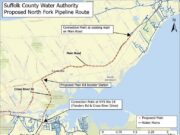
“The good news —Riverhead has fewer people on private wells than any other town in all of Suffolk County, but there are still areas where people have private wells,” Mancini said. The use of the CPF for water main extensions will be limited to three areas in Calverton, where groundwater is contaminated and there is no public water available.
“The first one we’re doing is Forge Road,” he said. There are hundreds of people living in the area with private wells and “very contaminated water,” he said.
The town expects its total non-reimbursable expenditure for the Forge Road extension to be about $193,000, which is what it would like to use the CPF revenue to pay, Mancini said.
“I want people to understand that we’re not looking to get millions of dollars from this fund. It’s really a source of money that we can use to get a much larger portion of grant funding to solve these problems and protect the public health of the residents of Riverhead,” Mancini said.
The town has been paying for the up-front engineering costs, for the preparation of a map and plan, out of the general fund, Mancini said. The map and plan is an “engineering study on the project that defines those costs and scope of the work, and that’s the tool that [the] community development [department] uses to apply for these grants,” Mancini said, noting the town has been “really successful in getting those grants.” It isn’t easy, he said. The state and federal governments “don’t just give you money for free and make it easy,” he said.
“And I just want to correct the record, because when we did the work session, we inadvertently communicated some information that was flipped,” Mancini said. “We’re not asking to get access to this money to do any wellhead treatment or any costs that would normally be covered by the ratepayers of the Riverhead Water District. We’re going to deal with those problems the way we always have,” he said. “What this is for is specific extensions that have been identified as people on private wells that are contaminated.”
Mancini said the town is seeking access to “a relatively small amount of money” from the CPF revenue for public health.
The Farm Bureau’s Rob Carpenter said “there’s no doubt that clean water is extremely important for those that are drinking it,” but “one of the things that we remain concerned about is the entirety of the Community Preservation Fund, not only in Riverhead, but in other towns, where, slowly, we’re seeing an eroding of the original intent, which was land preservation with a key focus on farmland preservation.”
Carpenter said his concern isn’t so much with the three or four projects currently being discussed. “I think there’s a lot more at stake than just these three or four different projects. With all due respect to the town staff, I think that my concern is not about these four projects, which are incredible and we support. It’s about what’s going to happen with the next Town Board and the next attorney, going forward … and how much more it could be utilized,” he said.
“We have more acreage in the crosshairs of development right now than any other town in the East End, yet we collect the least in CPF money,” Riverhead’s Director of Planning and Economic Development Dawn Thomas said. Riverhead’s share of the CPF has been under 4% of the total collected in the region.
The state law has been amended to allow uses other than land preservation, including affordable housing, because the South Fork towns have huge CPF collections and not much land to preserve, Thomas said.
“The CPF fund was a regional fund to protect the region. Riverhead has the most farmland in jeopardy” and the least amount of CPF revenues to protect it, she said. Everyone should focus on “getting some equity in that fund in terms of making it more regional.” Preservation of farmland and open space contributes to clean water for the region, not just for Riverhead, Thomas said. “And so there is a lack of equity there,” she said.
“And so we’re here fighting over the scraps today, unfortunately,” Thomas said. “I think that’s an important thing to remember, to focus on.”
The survival of local journalism depends on your support.
We are a small family-owned operation. You rely on us to stay informed, and we depend on you to make our work possible. Just a few dollars can help us continue to bring this important service to our community.
Support RiverheadLOCAL today.
