



















Riverhead Volunteer Ambulance Corps held a mass casualty drill Saturday in the area of the Long Island Railroad station in Riverhead.
“We learned a lot,” RVAC Chief Bill Wilkinson said in an interview Sunday.
“When we do stuff like this, we put the least experienced people in charge so they get experience in a controlled environment,” Wilkinson said.
The scenario for the drill was the explosion on a LIRR passenger train. Responders had to locate, triage, treat and transport injured passengers. RVAC utilized an out-of-service train owned by the Railroad Museum of Long Island. The train is one of several in the railroad museum’s collection, parked on an unused track north of the LIRR’s Railroad Avenue station house.
EMS crews from Southold Fire Department and Shelter Island participated in the drill, along with Riverhead Fire Department.
“When the ambulance crew got there, they were met by two patients outside of the train,” Wilkinson said. The two people “basically threw them off completely,” he said. “Normally, when you get to a scene like that, you pull up, you have some time to look and see what’s going on. But these patients bu- rushed them and dragged them into the train. They had no time to think or mentally prepare or anything,” the chief said.
“They went to work on triaging the patients, and I wasn’t nice about that,” Wilkenson said, referring to the scenario he devised for the drill. “I made some very complicated patients,” he said.
“So when we triage patients, we’re supposed to be basing it on pure facts, no emotions,” Wilkinson explained.
“There’s three things that we look for. First one is obviously respirations. And if your patient doesn’t have respirations, you just leave them, walk away,” he said.
“In one of the train cars we had a mother and their child. The child wasn’t breathing and the mother had an arterial bleed, which was serious. So according to triage protocols and standards, they’re supposed to ignore the fact that the kid’s not breathing there, just leave the kid and work on the mother,” Wilkinson said. But, he said, “the mother was a really good actress, and despite that she was bleeding to death, she was yelling at the triage people to take care of her kid, take care of her kid, and leave me — take care of the kid. So that’s what they did, and then she ended up bleeding to death.”
An important part of the training during a drill like the one held Saturday is “learning to leave our emotions out and do the best good for the most amount of people,” the chief said.
“The kid was gonna die no matter what. But when we have to take care of somebody who’s in that bad shape, it pulls resources from other patients that may have had a chance. Instead of having three different people triaging in different areas in the train, we had three people dedicated to one kid who was already gone,” he said. “If it was an adult, I’m sure they would have had no problems, and they would have skipped right over them. But because the fact that it was a kid and screaming mother — emotionally, it took a toll,” Wilkinson said.
Drill scenarios can feel very real as they unfold.
“All the patients had pretty realistic looking fake injuries,” he said. The people portraying the patients actually got there at 9 o’clock in the morning and started having their makeup and injuries applied. The crews didn’t get to the train until about 11:30 a.m.
“There was a lot that went into the preparation,” Wilkinson said. “Everybody was instructed to act like they were just in a train accident or screaming. They were yelling, they were crying. And all that stuff can overwhelm the initial responders,” he said.
“We can learn about this stuff in classrooms. You know, all day, every day, sit there and listen to lectures, but it’s completely different when you have a mother crying about her kid right in front of you,” he said.
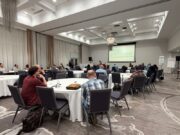
After the drill ended, everybody involved — including the people portraying patients — met in RVAC’s headquarters to review the event and the response to it, Wilkinson said.
A lot of preparation and coordination goes into staging a drill like that and it’s a very useful exercise, the chief said. He would conduct a drill like that twice a year if he had the resources, but he doesn’t. “I try to do at least one every two years,” he said.
“We can handle any patient in a one-on-one environment. But when your patients outnumber your crews, you know, 10 to one, it throws them off,” Wilkinson said. “So a drill like this is very, very useful.”
RiverheadLOCAL photos by Emil Breitenbach Jr.


The survival of local journalism depends on your support.
We are a small family-owned operation. You rely on us to stay informed, and we depend on you to make our work possible. Just a few dollars can help us continue to bring this important service to our community.
Support RiverheadLOCAL today.
