




















Riverhead’s townwide tax rate will increase 6.74% in 2026, about $4.50 per $1,000 of assessed property value, if the tentative budget presented today by Supervisor Tim Hubbard is adopted.
The supervisor’s budget calls for a 7.74% increase in the townwide tax levy, requiring the Town Board to again pierce the state-mandated property tax levy increase, which is set at 2% for 2026.
Spending in the three townwide funds — the general fund, the highway fund and the street-lighting fund — would be nearly $77.96 million next year, 6% more than this year. The portion of spending to be funded by property taxes in 2026 is nearly $61.2 million. The difference between the total tax levy and total spending is funded by non-tax revenues and fund balance (unspent funds from previous years.)
The total tentative town budget for 2026, which includes spending in special districts, tops $112 million next year. Special district operations are funded by taxes levied on properties within the boundaries of those districts, together with fees and revenues raised by district operations. Special districts in the Town of Riverhead include the sewer, water district, garbage, ambulance and parking districts. The special district tax levies are all under the 2% state limit the supervisor said today.
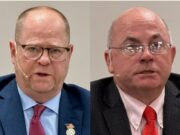
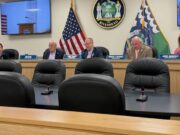
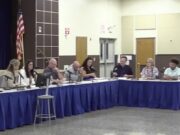
Hubbard presented his tentative budget at a special meeting of the Town Board this morning and discussed its details with Town Board members and Financial Administrator Jeanette DiPaola during a Town Board work session that followed the special meeting.
Hubbard read aloud the prepared budget message that accompanies the budget document. In it, he stressed that the budget was a collaborative effort with the members of the Town Board, the town government’s department heads, DiPaola and members of the supervisor’s senior staff.
The budget contains no merit raises for town staff and does not fund any new positions in town government.
The town must “absorb certain annual costs for things over which we have zero fiscal control. Those include contractual raises (Police Department and CSEA), health insurance premium increases for some 300+ employees and the ever-increasing New York State retirement rates,” Hubbard wrote. “Together, these three line items alone pierce the cap,” he said.
“The only increases included in this budget are those commensurate with Civil Service promotions and a 3.25% increase for elected officials (excluding the Town Board) which mirrors the contractual increase received by all CSEA employees in 2026,” Hubbard wrote in the budget message.
The bulk of the increase over 2025 spending levels are increased spending in police department salaries and retirement contributions, which taken together comprise roughly $2.9 million of the $4.3 million general fund spending increase, according to the supervisor’s budget presentation.
“Staffing at the Police Department remains at a historic high of 100 sworn officers. As stated last year, I will not cut back on Public Safety,” Hubbard wrote. “There is no ‘fat’ in this budget; in fact, it reflects a reduction of $319,009 in equipment and $216,000 in vehicle expenditures.”
Hubbard said nearly all municipalities in Suffolk County are going to pierce the 2% tax levy limit in 2026. He said the members of the Suffolk County Supervisors Association agree that “the tax cap is way out of whack.”
“It’s antiquated and needs to be updated. It needs to be revisited,” Hubbard said. “New York State doesn’t even adhere to it,” he said.
The law limiting property tax levy increases to 2% or the rate of inflation, whichever is lower, was passed by the New York State Legislature in 2011 and took effect Jan. 1, 2012. The tax cap does not apply to state budgets. It applies to local governments and school districts outside of New York City. New York City has its own set of tax limitations defined in the State Constitution. The 2% property tax cap law was advanced by then-Gov. Andrew Cuomo. It was overwhelmingly supported by the Republican-controlled State Senate, and largely opposed by the Democrat-majority State Assembly. Long Island Republican lawmakers, including Senate Majority Leader Dean Skelos and First District Senator Ken LaValle.
The Town Board can override the property tax cap by adopting a local law authorizing the override. The local law must pass by a 60% supermajority vote, which on a five-person board is three votes.
The Riverhead Town Board has pierced the tax cap with an override law in the past three fiscal years. It pierced the cap in 2018 through 2022 without the adoption of a local law authorizing it due to an error in calculating the tax cap for the 2018 fiscal year, according to the town’s independent auditor’s report for 2021.
MORE COVERAGE: Riverhead Town pierced 2% tax cap for 5 years without following proper procedure: audit report
The supervisor’s tentative budget, together with any amendments agreed to by the Town Board prior to the public hearing required by state law, becomes the preliminary budget. The Town Board must hold a public hearing on the preliminary budget on or before the Thursday immediately following the general election. Final revisions to the preliminary budget may be made after the public hearing but prior to adoption. The budget must be adopted by the Town Board no later than Nov. 20.
The survival of local journalism depends on your support.
We are a small family-owned operation. You rely on us to stay informed, and we depend on you to make our work possible. Just a few dollars can help us continue to bring this important service to our community.
Support RiverheadLOCAL today.
