















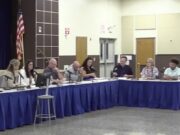








A proposal for a 33,700-square-foot cannabis greenhouse on Middle Road in Calverton got its first public airing before the Riverhead Planning Board Thursday night, drawing dozens of nearby residents concerned about the plan.
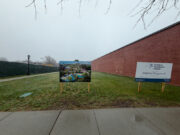
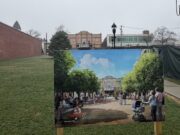
The applicant, Brother Bear Canna, is seeking site plan approval for the one-story structure at 1458 Middle Road. The facility would include grow rooms, fertigation and drying areas, packaging space, employee locker rooms and break areas, mechanical equipment, and an asphalt parking area.
The 5.3-acre property is located within the town’s Agricultural Protection Zone, where greenhouses are allowed on parcels of five acres or more. Under state law, cannabis is classified as an agricultural crop when cultivated under a license issued by the state Office of Cannabis Management.
“No further environmental review is required pursuant to SEQRA because it involves an agricultural use consistent with principles of farming,” Riverhead Senior Planner Greg Bergman told Planning Board members last week.
Bergman said the applicant submitted proof of active cultivation, processing, and distribution licenses from the state, but noted that the proposal requires two variances from the Zoning Board of Appeals: one for an eight-foot-high deer fence where six feet is allowed, and another for impervious surface coverage of 24%, which exceeds the 15% limit in the zone.
The Zoning Board of Appeals adjourned the case last month pending Planning Board comments before reconsidering the variance requests.
Odor, noise, and lighting controls
Bergman told the board that the greenhouse would be a fully enclosed, climate-controlled structure designed to prevent odors from escaping.
“The application proposes a sealed HVAC system with activated-carbon filtration,” he said. Bergman said he’d like to see specifications on the HVAC units that will be provided, including maintenance details and frequency of filter replacement.
He also raised concerns about noise from the exterior mechanical equipment and two backup generators proposed on site. The exterior equipment has the potential to generate some noise, Bergman said. “So I would like to see details on the anticipated noise levels from those structures,” he said. The plan currently proposes a five foot tall concrete masonry unit wall along the south side of the greenhouse for noise mitigation, but Bergman said he’d like to see details on the anticipated noise levels to see if the wall will be adequate.
The applicant’s engineer, Jerry D’Amaro of Manorville, said the wall will be replaced because he’s determined that it wouldn’t be an effective noise barrier. D’Amaro said the team is now studying alternatives such as 12-foot structural insulated panels capable of reducing noise by about 35 decibels.
Light containment and visibility
Planning Board Chairperson Ed Densieski asked about artificial lighting inside the greenhouse. Bergman explained that the applicant plans to use LED grow lights on a 12-hour cycle.
“There will be a retractable canopy system that closes during dark hours to contain light and prevent sky glow,” Bergman said.
The retractable canopies fully cover the lighting, so there won’t be any glow from the interior lighting at all, the applicant’s attorney, Larry Davis of Patchogue, said.
The plans call for extensive perimeter landscaping—more than 120 arborvitae and other evergreens—to screen the greenhouse from view along Middle Road. Bergman said he wants updated details on light fixtures, pole heights, and color temperature for the exterior lighting.
He also noted the existence of a freshwater wetland 225 feet to the northwest of the site. Absent disturbance of land within 150 feet of the wetland the greenhouse would not need a town wetlands permit. Bergman said he asked the applicant to request a nonjurisdiction letter from the State Department of Environmental Conservation.
Water supply, fire protection, and other details
The project includes two on-site irrigation wells for plant watering and tie-ins to the Riverhead Water District for domestic water and fire protection. D’Amaro said the building would be fully sprinklered and served by a new hydrant at the property’s corner. Wastewater would be treated through an innovative/alternative (IA) sanitary system subject to Suffolk County Department of Health review.
Bergman noted that the property abuts a 41-acre town-owned open-space parcel purchased with Community Preservation Fund money in 2008.
Board members focused on security, noise, and proximity to residences. Densieski asked how the site would be secured; D’Amaro replied that it would have “93 cameras and a central IT room recording all feeds,” but no overnight guard staff.
Member Ken Zilnicki questioned the need for an eight-foot fence if no outdoor cannabis cultivation is proposed. “Why would you need a deer fence if everything is indoors?” he asked. D’Amaro said the fence would help screen landscaping and secure the perimeter.
The existing single-family home on the property will remain a single-family home, D’Amaro said.
Bergman said staff would require documentation of both the odor-control and noise-mitigation systems before scheduling a public hearing.
Residents urge caution, ask for time to respond
During the open comments portion of the meeting, several residents and civic leaders urged the Planning Board to slow down the review process for the proposed greenhouse, citing the proximity of hundreds of homes and concerns about odor, noise, and property values.
Toqui Terchun, president of the Greater Calverton Civic Association, said the group has formed a committee of neighborhood representatives to track the application and communicate with the town. The civic group is “very concerned” about the proposal, Terchun said. “We recognize this is not the first cannabis project in Riverhead,” she said, “but this one is different because it’s at the epicenter of about 500 homes within a quarter-mile radius.”
Terchun asked the board to allow at least 90 days for community members to consult with independent experts. “We’re asking for time to attain a relationship with professionals who can advise us,” she said.
Diane Gaudiosi, a Windcrest East resident, read from a prepared statement on behalf of her 126-household community, which she said lies approximately 600 feet from the proposed project site.
“Most of our residents are in their 70s, 80s, and 90s,” she said. The applicant sent a team to meet with Windcrest East residents last week, she said. “The applicant’s presentation was highly technical and confusing. We need time to retain qualified attorneys and independent experts who can evaluate the applicant’s claims and present factual testimony to the board,” Gaudiosi said. “We’re simply asking for the same opportunity any community would need to properly respond to such a significant proposal,” she said.
Gaudiosi said there’s about 12 feet of trees between the residential community and the site. “During winter, when trees lose their leaves, residents will have an unobstructed view of a large, monstrous industrial factory building. And I’ve seen pictures of what they propose, and it’s really ugly,” she said.
Many residents in the senior community suffer from respiratory conditions such as emphysema, COPD and asthma, she said, and no health study has been done on the impact of cannabis odors on seniors with respiratory disease, she said. She also cited studies suggesting property values can decline near such facilities.
“We’re not professional advocates,” she said. “We’re just seniors trying to protect the homes we worked our entire lives to afford.”
Larry Levy, community manager at Foxwood Village, a 244-unit 55+ community just south of the site, said his residents share similar worries.
A constant hum day and night could be very disruptive for seniors, especially those who sleep with their windows open, Levy said. Levy also pointed to potential truck noise. “Hearing ‘beep, beep, beep’ at four o’clock in the morning with your windows wide open — that’s like an alarm clock going off.”
Levy, a real estate appraiser, said the project could also affect resale values. “If someone drives in and sees a tall industrial-looking greenhouse nearby, they may walk away from a full-price offer,” he said. “That’s how it gradually affects the market.” He said he supported the plan for an eight-foot fence but urged the developer to use mature evergreens at least eight feet tall to ensure adequate screening from Middle Road.
George Pammer, a Windcrest East resident, called the project “a wolf in sheep’s clothing.”
“What we’re being told is this is an agricultural use that is being done on agriculturally zoned land. But what we’re really getting is an industrial use that is not zoned industrial,” Pammer said. It will be in operation 365 days a year, 24 hours a day, he said and will increase large truck traffic on Middle Road.
Board: “Nothing will be rushed”
Chairman Ed Densieski assured residents that no decision would be made soon. “There’s going to be no action by this board until 2026,” he said. “Nothing is going to be rushed through.”
Bergman outlined the next steps: The applicant must first appear before the Zoning Board of Appeals, tentatively scheduled for Dec. 11, to resolve variance requests. After that, the application will return to the Planning Board for follow-up discussion, updated engineering details on odor and noise mitigation, and a determination on whether to schedule a formal public hearing.
“This is the first time the board has seen an application like this,” Bergman said. “We want to get all the details before taking any action.”
The survival of local journalism depends on your support.
We are a small family-owned operation. You rely on us to stay informed, and we depend on you to make our work possible. Just a few dollars can help us continue to bring this important service to our community.
Support RiverheadLOCAL today.
