

















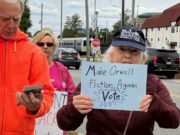











As 2025 drew to a close, families across the East End came together in rituals of goodwill and celebration, gathering around tables set with hope for the season ahead. Yet for many local families, this moment of togetherness arrived under a heavy shadow. The past year was defined not by holiday cheer but by uncertainty, fear and loss, tempered only by a growing resolve to stand together.
What these past 12 months have revealed for our Latino and immigrant neighbors is not a series of isolated hardships, but the steady force of federal and local policies that have repeatedly and profoundly reshaped daily life in our community. This reality is reflected in a recent study by the Pew Research Center.
The data confirms that the predominant sentiment among Latinos in the United States is one of increasing dissatisfaction and pessimism. More than 5,000 people surveyed by Pew expressed concern about the economy and immigration policy, as well as increasing fear of deportations, discrimination, and violence. Almost nine out of 10 said their daily lives have become more difficult, according to the study.
On the East End, this statistic translates into empty streets, paralyzed businesses, and families living in constant fear.
Throughout 2025, multiple federal operations and arrests were reported in Riverhead, Flanders, Hampton Bays, Westhampton, Greenport, East Hampton, and other Long Island towns. Reports of relatives suddenly disappearing and operations carried out in everyday spaces—bakeries, parking lots, delis, cars and bus stops—have sown panic among workers and families who, in most cases, are essential members of the community, contributing and raising their families in their towns for decades.
And over the past six months, the sense of concern has only worsened as enforcement tactics have become more visible and unpredictable. Masked federal agents in full tactical gear from ICE, ERO, and other agencies have been using public parking lots at local firehouses, Suffolk County Police precincts, Home Depots, a State Police barracks and other public and business locations as makeshift bases of operation, intensifying confusion and mistrust within the community.
Fire departments, local police departments, and state police spokespeople have repeatedly denied involvement in or assistance with any ICE operations, but advocates and members of the local community have raised questions about why and how their parking lots are being used, and what that message sends.
While President Trump claims he is deporting the “ worst of the worst,” the actual data indicates ICE is mostly detaining individuals without any criminal records – not even a pending charge, according to the Transactional Records Access Clearinghouse, or TRAC, a nonpartisan research center at Syracuse University that provides public access to detailed information on U.S. federal government enforcement, spending, and activities.
As of Sept. 26, about 71.5% of people held in ICE detention had no criminal convictions, according to TRAC.
This is because the vast majority of undocumented immigrants are law-abiding people. Like those who arrived on America’s shores in the 19th and early 20th centuries — at a time when “legal” immigration meant little more than a brief interview and health check at Ellis Island — they are fleeing poverty, famine, political repression and in some cases, violence or war. The common thread binding our immigrant ancestors to the new immigrants has been and remains seeking the chance to live a better life.
The stark difference is how very difficult or even nearly impossible it is to legally immigrate today from certain regions of the world. The U.S. immigration system has been broken for decades, with very few meaningful attempts to fix it since 1986. In all my reporting, not once have immigrants told me they chose to stay undocumented. There are simply very few paths to come or stay documented, even when they try to do so over and over again.
In the face of the constant threat under which immigrants live in the U.S. today — whether documented or not — a collective voice has also emerged in recent months. People have said, unmistakably, that enough is enough. Community protests, demonstrations, and events of all kinds have taken place throughout the region, signaling a turning point. And this dissatisfaction among the community has not been limited to the streets.
Local organizations, advocates, and community members of all races and backgrounds have launched rapid-response networks, established WhatsApp and Signal groups as preventive and alert measures, launched ICE trackers, held dozens of workshops to inform the community about their human and civil rights, documented federal enforcement activities, held impromptu and scheduled protests, and organized in response to enforcement actions they say lack transparency.
“No one should fear being taken from their home or neighborhood by armed individuals wearing masks who refuse to identify themselves, or be left uncertain about whether those detaining them are acting under lawful authority,” said Anita Boyer, an organizer of several protests across the East End, in a recent interview with Tu Prensa Local at a demonstration in Hampton Bays.
Neighbors, organizations, and community leaders have appealed directly to town boards, demanding explanations, transparency, and protection for immigrant neighbors.
East Hampton Town issued an official statement condemning the actions of masked federal agents, calling the arrests a source of “profound fear and uncertainty” and denouncing “inhuman” policies that undermine human dignity and due process.
The concern has also spread to schools, leading several districts to issue statements on the matter. The Riverhead Central School District was among the first on the East End to send a letter earlier this year reaffirming that schools must remain safe and trusted spaces for all students and that any immigration enforcement actions on school grounds can be carried out only with appropriate legal documentation, in accordance with New York State law.
This climate of persecution has profound and measurable consequences. Businesses have seen their sales drop by as much as 80%, according to local store owners. Professionals and community advocates report an increase in the number of parents requesting custody letters and powers of attorney out of fear of being detained. At the same time, food pantries and community centers are serving fewer immigrant families, not because the need has decreased, but because fear keeps them confined to their homes.
This fear is reinforced by cases like the one recently reported by Newsday, in which a federal judge condemned the treatment of a man detained by ICE in a holding cell in federal district court in Central Islip as “inhuman and unlawful.”
District Court Judge Gary Brown, a Trump appointee, described how the man, Erron Anthony Clarke, spent several days crammed with eight other men in a “putrid and cramped,” freezing-cold holding cell — a room designed to temporarily hold one person for a brief time — under bright lights 24 hours, forced to sleep on the floor around an open toilet in the middle of the cell. The man had entered the U.S. legally under a work visa. “He has no record of violence, drug use or criminal history,” the judge wrote. On Dec. 5, ICE agents arrested and detained him.
The behavior of federal officers during the court proceeding was almost as shocking as the condition of the man’s detention.
Judge Brown wrote that ICE removed Clarke from the Central Islip Courthouse and transported him to a private detention facility in Newark, New Jersey, hours before he was supposed to appear in court, despite an order to produce him for a hearing. He also criticized what he described as false statements and repeated failures to follow court directives.
Other tactics employed by the federal government are just as deceptive. I’ve learned from family members of several men who have been arrested and disappeared, after reporting to an immigration processing office in Hauppauge for a “check-in” or other mandatory appearance required for their pending applications for permanent residence. Upon leaving the office, they were followed, detained and arrested by masked federal agents, and quickly removed to out-of-state detention centers. Their only “crime”? Attempting to follow established procedures on the path to legal residency.
These events confirm that the fear is not exaggerated: it is a logical response to an increasingly visible reality.
The climate of anxiety and uncertainty extends far beyond individual households. The labor of the Latino community sustains agriculture, construction, restaurants, offices, health care, and more.
When an entire group is forced to live under constant threat, trust erodes, and everyone feels the consequences. Businesses struggle to find workers, communities grow more divided, U.S.-born children are left stranded or traumatized after immigration enforcement operations, and the entire local economy weakens.
Still, even among the fear and uncertainty that have defined this past year, something else has also taken hold on the East End.
It can be found in the watchful neighbor, the deli owner who keeps a sign of support on their door, the message sent late at night to warn others to be careful. These gestures do not erase the harm, nor do they pretend that the danger has passed, but they speak to a deeper truth. Communities endure not through force or fear, but through care.
As another year begins, the question that remains is not only how much our community has been affected so far, but, more importantly, what kind of place the East End chooses to be and who it chooses to protect. The decisions made by local leaders, law enforcement and residents will have lasting effects in the years to come.
Will we stand with our immigrant neighbors with compassion and humanity, or will we be indifferent, and in some cases even celebrate their suffering? The choice is in our hands.
The survival of local journalism depends on your support.
We are a small family-owned operation. You rely on us to stay informed, and we depend on you to make our work possible. Just a few dollars can help us continue to bring this important service to our community.
Support RiverheadLOCAL today.
