

















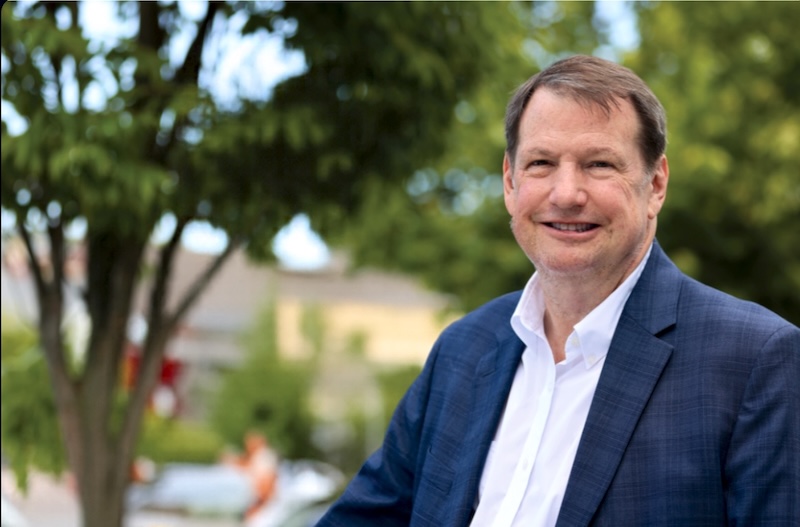
Chris Murray first ran for the State Senate in 2002. Then came the demands of work and family, and nearly a quarter-century passed before he tried again.
Now 64, the attorney and father of four is preparing to represent eastern Sufffolk County in Albany, with priorities drawn from the institutions he has served, the cases he has handled and the needs of his own family.
Murray, a Democrat from Strong’s Neck, defeated incumbent Republican State Sen. Anthony Palumbo of New Suffolk in the Nov. 3 election, flipping a seat Republicans had held since 1914.
In an interview Friday, Murray described a return to campaigning prompted partly by his alarm over the direction of the federal government — and partly by reaching a point in his life when he could take on the job.
“I wanted to do something,” he said.
With his children older and his life more settled, Murray said, the timing made sense. So did the political opportunity: He believed the district was winnable.
His first Senate campaign was in Nassau County’s 7th District, where he lived at the time, he said. This time, he won election to the 1st District, which includes Riverhead, Southold, Southampton, East Hampton and Shelter Island, along with northern Brookhaven Town.
Murray is a partner at the law firm Rivkin Radler in Uniondale. His practice has included commercial and environmental litigation, and he holds degrees from SUNY Albany and Georgetown University Law Center.
He also previously chaired the Suffolk County Community College board of trustees, a role that informs one of his goals for Albany: securing more support for community colleges. The college announced his election as board chair in June 2019.
Murray said he wants a seat on the Senate’s Higher Education Committee and believes community colleges deserve more funding.
“I think they’re great institutions, and they really give people a chance that otherwise might not have it,” he said.
His interest in services for people with disabilities is personal. Murray said his son is autistic, making pay for direct care workers an important issue for him.
All four of his children attended Long Island public schools, he said.
A different approach to taxes
Murray hopes to pursue his proposal for shifting some of the tax burden from consumers to higher-income earners.
“I think the tax code is really regressive, in how it treats middle class and poorer individuals, and I would like to shift the tax burden away from that,” Murray said, citing the sales tax in particular. It’s a flat tax that hits lower-income families harder, he said.
He has proposed reducing the state sales tax by 1% and replacing the lost revenue with an income tax increase on top earners.
Murray said his proposal could provide a tax break for people earning less than $600,000 a year.
His other ambitions include changes to a court system he encounters regularly as a litigator.
Murray said he wants to serve on the Senate Judiciary Committee. “I have a million ideas about how you can reform the New York State court system because currently the New York State court system is really not functioning very well,” Murray said.
He wants to pursue reforms to shorten delays in both civil and criminal cases. It can take three years to have a trial on a basic civil case, he said.
Fixing criminal court backlogs and relieving extremely overburdened public defenders means giving courts and public defenders the resources they need to move cases to trial promptly, he said.
“There’s got to be the resources put in, but also some accountability to the court system,” Murray said.
Murray’s position on bail — a hot-button topic for Republicans, including Palumbo — includes support for judicial discretion.
He points to the case of Kalief Browder as an example of the broken system that led to New York enacting criminal justice reform laws in 2019.
Browder was a 16-year-old from the Bronx, who spent three years in New York City’s Rikers Island jail without a trial on larceny and assault charges. He was accused of stealing a backpack. He maintained his innocence but sat in jail because his parents could not afford the $3,000 bail required to get him released pending trial. The charges were eventually dismissed and Browder, two years after his release, died by suicide.
“He was actually, I think, in the jail pending trial longer than he would be if he was convicted,” Murray said. “And and I think a lot of that problem has to do with the court systems being overburdened or not having enough resources to actually give people speedy trials,” he said, noting that the right to a speedy trail in a criminal case is guaranteed by the U.S. Constitution. When a public defender has a caseload of 150 cases, a speedy trial isn’t possible, Murray said.
Murray also supports creating a fifth appellate department to ease the workload of the Appellate Division’s Second Department, which includes Suffolk, Nassau, Queens, Kings and Richmond counties and five counties in the mid-Hudson region (Dutchess, Orange, Putnam, Rockland, and Westchester). In the Second Department, it takes about two and a half years for an appeal to be heard and then about another year for a decision, a timeline he calls “absurd.”
Environmental protection and the limits of growth
Murray sees the state government as a place to respond to federal policies he opposes, particularly on environmental protection.
He wants New York to work with other states on environmental initiatives and maintain strong protections against PFAS, the substances commonly called forever chemicals. Responsibility for paying to clean up contamination should fall more heavily on those who created and disposed of it, he said.
He has served as chairperson of the board of Citizens Campaign for the Environment, an environmental advocacy organization.
Closer to home, he opposes locating large data centers on Long Island, citing demands on water supplies, electricity and the power grid.
“Just makes no sense to have them on Long Island,” he said.
He is also skeptical of investing in new nuclear power plants, questioning their economics and the disposal of radioactive waste.
“I’m very hesitant. I wouldn’t say absolutely no, but I’m very cautious,” Murray said of nuclear power.
He said he would favor greater investment in wind and solar energy.
His agenda is broad, and Murray acknowledged that becoming effective in Albany will require narrowing his focus and developing expertise in particular areas. His committee assignments remain a question for the transition ahead.
He credited the national Democratic wave with contributing to his victory, while also pointing to his campaign’s efforts to reach voters and discuss substantive issues. He said he began to feel confident after the first day of early voting, when he saw a definite boost in voter turnout compared to past midterm election years.
Murray said Palumbo left him a voicemail conceding the race Wednesday and wishing him luck. Despite their political differences, he spoke warmly of his opponent.
“I had no problems with how the campaign was run,” he said.
For Murray, taking office will extend a record of civic involvement that has included environmental advocacy, civil liberties work and service to the community college.
He grew up upstate and moved to Long Island in the early 1990s, he said. Decades later, his family and public life are anchored here.
“This is where my roots are now,” he said.
The survival of local journalism depends on your support.
We are a small family-owned operation. You rely on us to stay informed, and we depend on you to make our work possible. Just a few dollars can help us continue to bring this important service to our community.
Support RiverheadLOCAL today.
