


























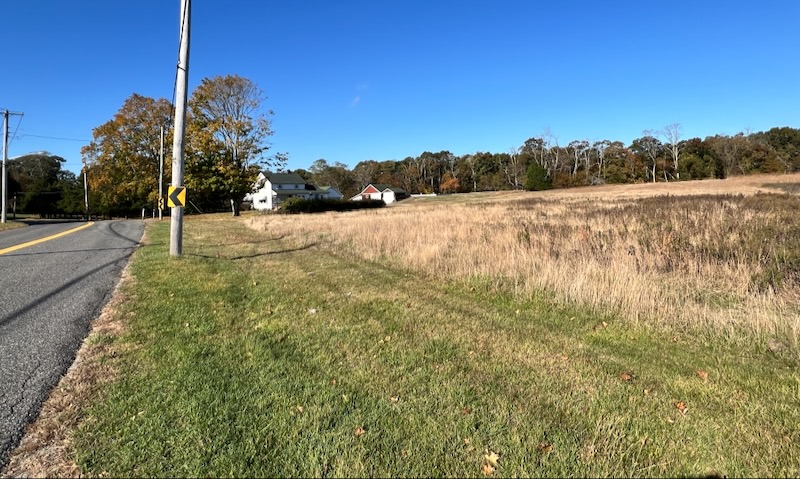
A proposed cannabis cultivation facility at 1458 Middle Road in Calverton will have to undergo an acoustic modeling study after Riverhead Planning Board members questioned the applicant’s noise submissions and residents packed Town Hall Thursday to oppose the project.
The application by Brother Bear Canna was on the board’s June 18 agenda for discussion only, not for a public hearing. But the proposal drew a large crowd of residents from nearby neighborhoods, including Windcrest East, a 55-and-over gated community immediately east of the site, who spoke during the public comment portion of the meeting.
Residents have raised concerns about noise, odor, traffic, water use, security, waste disposal and the effect of the proposed facility on property values. They also continued to dispute the premise that the operation should be treated as agriculture.
“This is not farming,” said George Pammer, who lives on Green Ash Street, adjacent to the proposed site. “This is a 31,000-square-foot facility that we’re putting a translucent top on, so we can call it a farm. That’s not what this is. This is not a farm. This is an absolute industrial activity that will have trucks coming and going, it will have loading bays. It’s got to have a vault built inside. It’s going to have 26 HVAC units. I don’t know a single farm where they grow corn that … has to be put in a vault.”
The Planning Board did not take action on the application Thursday. But after a lengthy discussion of the applicant’s noise information, board Chairman Ed Densieski asked town senior planner Greg Bergman to notify the applicant in writing that the board wants an acoustic study.
ScienceDirect defines acoustic modeling as the simulation of sound propagation within a specific environment, using methods to analyze acoustic characteristics and effects, including reflection, absorption and transmission. In a land-use review context, an acoustic modeling study can be used to evaluate how sound from proposed equipment or operations may travel across a site and to nearby properties, taking into account factors such as distance, buildings, barriers, terrain and existing ambient sound. Acoustic consultants also use modeling and measurement data to identify potential noise problems and recommend mitigation.
Noise study questioned
Bergman said the applicant had submitted a “neighborhood sound study” by AGS and a memo from E Noise Control. The sound study looked at a facility in Maryland that the applicant said was comparable to the proposed Calverton greenhouse.
According to Bergman, sound samples at the Maryland facility were taken at 10 feet, 100 feet, 300 feet and 600 feet. The study found 66.3 decibels at 10 feet, 59 decibels at 100 feet, 52 decibels at 300 feet and 53.7 decibels at 600 feet, Bergman said.
“It is noted that is slightly odd to see an increase as the study location is further away from the source,” Bergman said, adding that the increase may have been caused by noise from an adjacent highway.
Bergman said the study may have some value, but it does not give the board the kind of site-specific information it needs.
“I don’t think it gives the board any sort of empirical data to see what the existing ambient noise levels at this site are, what the potential impacts from this building, the orientation of the building are,” Bergman said.
Bergman also noted that an earlier version of the plans showed five-foot concrete masonry walls on the north and south sides of the building, which he recalled were proposed as noise mitigation. Those walls no longer appear on the plan, he said.
“I’m just not sure why they were initially proposed or why they were then removed,” Bergman said.
Attorney John Anzalone of Harris Beach Murtha, representing the applicant, said the walls were removed after the Zoning Board of Appeals denied a variance related to maximum impervious coverage. The applicant would be willing to put them back if the Planning Board requires them, he said.
“The reason those walls were put in there was for mitigation,” Anzalone said. “That was part of conversations with planning before I was brought onto the project.”
He said the facility complies with standards applicable to agricultural uses, which he said are excluded from the town’s ordinary noise ordinance.
“These were done as a proffer, as a mitigation to the neighbors,” Anzalone said. “That’s why the original sound wall was proposed, and they are willing to put it back in if this board still requires.”
Agriculture or industry?
Bergman pushed back on the suggestion that the agricultural classification removes noise from the Planning Board’s review.
He said he had discussed the issue with the New York State Department of Agriculture and Markets, and that protected farm practices in the town code are intended to protect existing farm practices. The Middle Road site, he said, is not currently an active farm.
“The Department of Ag and Markets was very clear,” Bergman said. “When I raised some of these concerns, they were very clear that the agricultural-in-nature opinion was not sort of like a get-out-of-jail-free card or a carte blanche.”
“What’s before the board right now is a site plan application, and the board has a responsibility to look at site plan issues, one of them being noise,” Bergman said.
Densieski said he believes the proposed facility is industrial.
“I understand what you’re saying, and I support Ag and Markets, a vital tool for out here,” Densieski said. “But I disagree with an industrialization of farming, and I don’t care if it’s cannabis or carrots. In my opinion, Ag and Markets got it wrong. I think this is an industrial use.”
The statement drew applause from the audience.
Bergman said the board has been given a written zoning determination that the proposed use is agricultural, and he did not know how to reconcile that determination with the board chairman’s view.
“Farming is an industrial use,” Bergman said. “Farming is not just a farmer sitting on a porch looking at a field. Farming requires heavy machinery. You go past farms, there’s diesel generators that are powering irrigation pumps, there’s noise, there’s heavy equipment, there’s machinery. Agricultural production is an industrial use. Yes, it’s not a factory, it’s not a steel foundry, but agricultural production is an industrial use. It’s not a quiet, clean use.”
Board member George Nunnaro said the board should at least require an acoustic modeling study.
“I think it’s a good idea,” Densieski said.
“I think we owe it to our constituents to at least do that,” Nunnaro said.
Anzalone told the board the town’s noise ordinance expressly excludes agricultural operations and said the site plan section of the town code does not use the words “noise” or “sound.”
Bergman responded by citing the town’s site plan review provisions, including language addressing physical compatibility, protection of residential areas, neighborhood tranquility, community character and property values.
“When we talk about community character and property values, I would argue that the operation of a site is absolutely within the purview of the Planning Board for a site plan review, and that does include potential impacts again from noise, odor, light,” Bergman said.
Equipment, waste and extraction questions
Board members also questioned the applicant’s description of the equipment.
Board member Ken Zilnicki asked whether the sound from the Maryland facility, which he said had 14 units, would be multiplied at the Middle Road site if there are 26 units.
Anzalone said there are two primary condenser units that cause the most sound, and that those condenser units were the main noise sources measured at the Maryland facility.
“The facility that we have has two primary units that cause the most sound, which are the condenser units,” Anzalone said.
Zilnicki questioned the size of the equipment, noting that the applicant’s engineer referred to units ranging from 14 to 30 tons.
“I have a five-ton unit at my house outside,” Zilnicki said. “When it starts up, it’s a bit noisy.”
“Oh, there’s no question that they are noisy,” Anzalone said. “Any condenser unit is noisy, any HVAC unit … creates noise.”
Bergman said the site plan needs to be clearer about what equipment is proposed on the concrete pads shown on the plan.
“The site plan itself is maybe not really doing anybody a service,” Bergman said. “Right now, we just see a number of concrete pads. The site plan doesn’t specifically identify it as a condenser unit or a fan, it just shows concrete pads for equipment.”
“What might help the board to understand the site plan a little better is to identify what equipment is going to be on those pads, as opposed to just a pad,” Bergman said.
Bergman said he would inform the applicant that the board wants an acoustic modeling study, notes on the plans identifying the equipment on the pads, verification of equipment numbers and details about licensing.
The board also raised questions about the proposed operation itself.
Board member Joe Baier asked what happens to the cannabis plants after harvest and whether the operation is hydroponic.
Anzalone said the plants would be grown in pots, in a soil mixture that is “90% soil” and rich with peat. Water would be dropped on top of the plants, and the facility would use “split light,” meaning both natural and artificial light, he said.
When plants are harvested, Anzalone said, the soil would be reused if possible. Otherwise, it would be replaced with new bagged soil.
Baier asked what happens to the roots and other parts of the plant that are not used.
“Similar concept that you would have in any farm when you have corn stalks,” Anzalone said. “The corn stalk is not useful… they destroy the stalk. Same thing here.”
“So they discard it somehow,” Baier said.
“Yes,” Anzalone said.
“So it’s a solid waste,” Baier said.
“Yes,” Anzalone said. “As what happens with virtually all farming.”
Bergman said drying, curing, packaging and trimming are included in the state’s definition of cannabis cultivation. He said his zoning determination letter had addressed New York State law defining cultivation as agricultural production practices including soil preparation, planting, growing, harvesting, drying, curing, grading and trimming cannabis plants for sale to other categories of licensees.
Anzalone said the applicant’s license does not permit extraction of oils or similar cannabis products.
That prompted Bergman to question why the floor plan shows almost 1,000 square feet for extraction.
“They’re not permitted for extraction. I don’t know why you’d have almost 1,000 square feet shown for extraction,” Bergman said. “Let’s put a pin in that and come back to that when they’ve got their design team back.”
Residents press objections
Public speakers urged the board to scrutinize the application closely.
Pammer, the Green Ash Street resident, said the facility would be subject to extensive state cannabis security requirements, including secure storage, video surveillance, visitor logs and fencing.
“This is not a farm,” Pammer said. “This is an absolute industrial facility that is trying to put itself into a painting where it’s a farm and it is not. Don’t buy this painting.”
Steve Haber, who lives on North Woods Road in Calverton, said sound already carries through the area from the Long Island Expressway, Manor Road, Middle Road, Route 58 and Sound Avenue.
“I work with sound, I can get filters, and I can give you statistics,” Haber said. “I can save this board a lot of time and money. Anytime that you want, you can come over to my house. We can either sit in the front of my house or we can sit on the porch in the back, and you will be able to hear the LIE, Manor Road, Middle Road, 58, Sound Avenue. That is how sound travels.”
Haber questioned whether the sound measurements relied upon by the applicant were taken in winter or summer, when foliage could affect sound conditions.
“I don’t know a farm that operates 24 hours a day, seven days a week with turbines and plants,” Haber said.
Linda Nemeth of Windcrest East raised concerns about water quality and water use. She said Windcrest had been refused an irrigation well because of concerns about groundwater quality, while the proposed facility would use water to grow cannabis.
“They are getting a well and they’re going to disperse it onto something that people will ingest or smoke, whatever, and there’s no problem,” Nemeth said.
She also questioned whether a backup generator would create additional noise.
“What happens when all the power goes out and this huge generator, the pad that they have for a — I’m assuming, a diesel, maybe I’m wrong — generator to power up because they can’t stop working?” Nemeth said. “What’s that noise? We haven’t heard that yet.”
Kerry McKillop, who lives on North Woods Road, read from the town code section describing the intent of the Agricultural Protection Zoning Use District, saying the district is intended to facilitate agricultural land uses, preserve prime agricultural soils, maintain an agricultural vista, promote agritourism and preserve the rural character of Riverhead.
“There will be no agritourism. The vista will be horrible. They’re not using the soil. They’re more than likely going to pollute the soil,” McKillop said.
She said residents had looked for evidence that the site had ever been farmed and found none.
“The family that lives next door said in the current owner’s ownership time, it was never farmed. Her parents owned it previous to her, it was never farmed,” McKillop said. “I went on to the county GIS, I could find no evidence of it ever being farmed.”
Kevin Donaghue of Golden Spruce Drive in Windcrest East said residents of both Windcrest East and Foxwood Village would be affected by the proposal.
“Between the two of us, two communities, we have hundreds of people who are going to be affected by this,” Donaghue said. “Their property values will definitely decrease, and I think we’re going to have noise pollution, light pollution, to say the least, and odor pollution.”
Toqui Terchun, president of the Greater Calverton Civic Association, said opposition to the project is growing.
“The number of people who are opposed to this project, for not only site plan reasons, is large, and it is growing weekly,” Terchun said.
She said the applicant should consider another site.
“If you’re surrounded by 500 to 600 people who don’t want you around, why do you want to be there so badly?” Terchun said. “Perhaps you might want to look at another option, another piece of land that might fit your project better.”
Nemeth also raised the tax issue, saying she understood the applicant had sought agricultural tax treatment.
“The town keeps saying that they wish to build the tax base for the town, that’s why they’re allowing all of this,” Nemeth said. “In that tax base, with everybody in that building, it will probably pay less tax than any one of our homes will pay, so what’s the tax base? The detriment to the town compared to the tax they will get is certainly not worthwhile.”
The site owner has applied to the Suffolk County Agricultural and Farmland Protection Board for agricultural assessment on the parcel. The application appeared on the county board’s April 2026 meeting agenda, but no determination was available on the county website as of Friday.
Al Braunreuther of North Woods Road said he has lived near the site for 23 years.
“This is not what I signed up for,” Braunreuther said. “This is going to be in my backyard, not his.”
Ralph Cohan of Golden Spruce Street asked the board to consider where the project’s equipment comes from.
“If all this equipment is industrial equipment, and 80% of that is going to be industrial equipment, how do we call it a farm?” Cohan said. “When a farmer goes and buys a tractor, he goes to an ag supplier. When he goes and buys seed, he goes to an ag supplier. When these people go and buy HVAC systems, they go to an industrial facility.”
George Alfano of Windcrest said he was concerned about truck noise, including backup alarms.
“We have sanitation trucks come in, and when they back up, you could hear them a quarter mile away,” Alfano said. “Now we’re going to have trucks backing in and out of there with the emergency alarm, a safety device that’s on all the trucks. It’s a state law. How is that going to work out?”
Helen Reynolds of Windcrest East said odor had not been adequately addressed.
“The word smell or odor was mentioned once by the lawyer or whoever he represents,” Reynolds said. “Nobody addressed that. Tell me about the possibility of the smell.”
Next steps
The next steps for the application will include submission of the acoustic modeling study, revised or clarified plans identifying the proposed equipment on the concrete pads, verification of equipment numbers and sizes, clarification of the extraction area shown on the floor plan, and further review of noise mitigation measures, including whether sound walls should be restored to the plan.
The Planning Board’s next meeting is scheduled for July 2 at 6 p.m.
The survival of local journalism depends on your support.
We are a small family-owned operation. You rely on us to stay informed, and we depend on you to make our work possible. Just a few dollars can help us continue to bring this important service to our community.
Support RiverheadLOCAL today.
